Commentary - (2025) Volume 11, Issue 5
Received: 01-Oct-2025, Manuscript No. jssc-26-188309;
Editor assigned: 03-Oct-2025, Pre QC No. P-188309;
Reviewed: 17-Oct-2025, QC No. Q-188309;
Revised: 22-Oct-2025, Manuscript No. R-188309;
Published:
29-Oct-2025
, DOI: 10.37421/2472-0437.2025.11.320
Citation: Rezaei, Ali. ”Steel Industrial Warehouse Design: Safety,
Stability, Sustainability.” J Steel Struct Constr 11 (2025):320.
Copyright: © 2025 Rezaei A. This is an open-access article distributed under the terms of the Creative Commons Attribution License, which permits unrestricted use,
distribution and reproduction in any medium, provided the original author and source are credited.
The design of robust steel industrial warehouses necessitates a comprehensive understanding of various structural considerations to ensure safety, stability, and longevity. A significant aspect of this design process involves addressing the impact of seismic loading and wind forces, which are critical environmental factors that can significantly influence structural integrity. Research has emphasized the importance of selecting appropriate structural systems, such as portal frames and braced structures, and detailing the design methodologies for beams, columns, and roof structures to withstand these dynamic loads. Material selection and connection details are also paramount for optimizing performance and constructability, contributing to the overall resilience of these large-span buildings [1].
In parallel, the exploration of advanced connection typologies for steel warehouse structures is crucial for optimizing seismic resilience. This includes investigating the behavior of various bolted and welded connections within moment-resisting frames and braced systems under cyclic loading. Understanding the ductility, strength, and energy dissipation capabilities of these connections provides vital insights for designers aiming to enhance the overall performance of industrial buildings when subjected to extreme seismic events [2].
Furthermore, the optimization of structural layouts for large-span steel industrial warehouses is a key area of focus, particularly concerning efficient material usage and maintaining adequate load-bearing capacity. Computational methods are employed to analyze different framing systems, such as trussed roofs and single-layer grids, and to evaluate their performance against gravity and wind loads. This research offers practical guidance for minimizing structural weight while ensuring necessary safety margins are met [3].
The critical issue of fire resistance in steel industrial warehouses also demands attention. Studies evaluate the behavior of structural steel members under elevated temperatures, presenting thermal analysis and structural response simulations. These assessments are vital for understanding the impact of fire on load-carrying capacity and deformation, providing valuable data for designing effective fire protection systems and ensuring occupant safety [4].
The application of cold-formed steel members in industrial warehouse construction, particularly for secondary framing and cladding, is another area of significant interest. Research examines the structural behavior, buckling characteristics, and connection efficiency of these lightweight members under various loading scenarios. This work contributes to understanding the suitability of cold-formed steel for cost-effective and sustainable warehouse designs [5].
The dynamic response of steel industrial warehouses subjected to wind-induced vibrations is also a crucial design consideration. Advanced techniques, such as computational fluid dynamics (CFD) and finite element analysis (FEA), are used to model wind loads and structural behavior, investigating phenomena like vortex shedding and flutter. These findings are essential for designing structures that can effectively withstand dynamic wind effects and ensure occupant comfort and safety [6].
A comparative study of different structural systems for industrial warehouses, including portal frames, multi-bay frames, and space frames, evaluates their performance in terms of cost, constructability, and structural efficiency. This analysis incorporates considerations for seismic and wind loads, as well as functional requirements for large storage spaces, assisting engineers in selecting the most appropriate system for specific project needs [7].
The investigation into the influence of advanced composite materials in secondary structural elements for steel industrial warehouses, such as purlins and girts, offers potential benefits. This includes examining the advantages of weight reduction, enhanced durability, and improved corrosion resistance compared to traditional steel components, highlighting the growing role of composites in modern industrial construction [8].
Moreover, the structural integrity of industrial warehouse roofs under snow and ice loading conditions is addressed through analytical and numerical methods. These approaches calculate snow drift accumulation and its impact on roof structures, considering varying roof shapes and exposure conditions, which is vital for ensuring the long-term safety and serviceability of warehouses in regions prone to significant snowfall [9].
Finally, the influence of different foundation types on the seismic performance of steel industrial warehouses is explored through analyses of soil-structure interaction. Evaluating the effectiveness of various foundation systems in mitigating seismic-induced settlements and rotations provides crucial insights for selecting appropriate foundations for stable warehouse construction [10].
The foundational aspects of designing resilient steel industrial warehouses are deeply rooted in understanding and mitigating the effects of significant environmental forces, notably seismic loading and wind. Research highlights the necessity of selecting robust structural systems, such as portal frames and braced configurations, and meticulously detailing the design of primary components like beams, columns, and roof structures to ensure unwavering stability and safety under a spectrum of environmental conditions. The judicious selection of materials and the precision of connection details are consistently underscored as critical factors for optimizing both structural performance and constructability, thereby enhancing the overall durability of these industrial facilities [1].
Advancements in the field are continuously pushing the boundaries of connection typologies for steel warehouse structures, with a strong emphasis on bolstering seismic resilience within moment-resisting frames and braced systems. This ongoing research scrutinizes the behavior of a variety of bolted and welded connections when subjected to cyclic loading, offering profound insights into their ductility, inherent strength, and capacity for energy dissipation. The findings derived from these investigations are indispensable for engineers tasked with elevating the seismic performance of industrial buildings against extreme events [2].
Simultaneously, the optimization of structural layouts for expansive steel industrial warehouses is a subject of intensive study, focusing on maximizing material efficiency and ensuring adequate load-bearing capabilities. The utilization of advanced computational methods facilitates the analysis of diverse framing systems, including elaborate trussed roofs and sophisticated single-layer grids, alongside a thorough evaluation of their performance under gravitational and wind forces. This body of work provides actionable recommendations for minimizing structural weight while strictly adhering to essential safety margins [3].
A critical concern in the structural design of industrial warehouses is their resistance to fire. Studies in this domain meticulously assess the thermal and structural responses of steel members when exposed to elevated temperatures. Through detailed thermal analysis and sophisticated structural response simulations, the impact of fire on load-carrying capacity and deformation is thoroughly examined. This research is instrumental in generating the data necessary for designing effective fire protection systems and ultimately safeguarding occupants within these facilities [4].
The integration and performance of cold-formed steel members within the construction of industrial warehouses, particularly for secondary framing and cladding applications, represent a significant area of development. Investigations delve into the structural behavior, intricate buckling characteristics, and connection efficacy of these lightweight members when subjected to a range of loading scenarios. This research contributes valuable understanding regarding the suitability of cold-formed steel for creating warehouse designs that are both economically viable and environmentally sustainable [5].
The dynamic behavior of steel industrial warehouses under the influence of wind-induced vibrations is meticulously studied using advanced analytical tools. Techniques such as computational fluid dynamics (CFD) and finite element analysis (FEA) are employed to accurately model wind loads and predict structural responses, specifically addressing phenomena like vortex shedding and flutter. The insights gained are fundamental for designing structures capable of withstanding dynamic wind forces, thereby ensuring occupant comfort and safety [6].
A comparative analysis of various structural systems employed in industrial warehouses, encompassing portal frames, multi-bay frames, and space frames, provides a comprehensive evaluation based on cost-effectiveness, ease of construction, and structural efficiency. This assessment integrates crucial considerations for seismic and wind loads, alongside functional requirements pertinent to large storage capacities, aiming to guide engineers in selecting the optimal system for diverse project specifications [7].
The exploration into the utility of advanced composite materials for secondary structural components in steel industrial warehouses, such as purlins and girts, reveals significant potential. This research examines the advantages of employing composites, including substantial weight reduction, enhanced durability, and superior corrosion resistance when contrasted with conventional steel elements, thereby underscoring the emerging and pivotal role of composites in contemporary industrial construction practices [8].
Furthermore, the structural integrity of industrial warehouse roofs is rigorously assessed concerning snow and ice loading conditions. Employing a combination of analytical and numerical methodologies, this research quantifies snow drift accumulation and evaluates its consequential impact on roof structures, taking into account variations in roof geometry and environmental exposure. This work is indispensable for guaranteeing the long-term safety and functional serviceability of warehouses situated in regions experiencing substantial snowfall [9].
Finally, the critical interplay between foundation types and the seismic performance of steel industrial warehouses is investigated through detailed soil-structure interaction analyses. The study evaluates the efficacy of diverse foundation systems, ranging from isolated footings to combined and mat foundations, in effectively mitigating seismic-induced settlements and rotations, offering essential guidance for the selection of suitable foundations conducive to stable warehouse construction [10].
This collection of research addresses key aspects of designing and constructing steel industrial warehouses. It covers seismic and wind load considerations, the importance of structural systems like portal frames and braced structures, and the design of beams, columns, and roof structures. The studies also delve into advanced connection typologies to enhance seismic resilience, optimization of structural layouts for material efficiency, and fire resistance of steel members. Furthermore, the research explores the use of cold-formed steel members, the dynamic response to wind-induced vibrations, comparative analysis of different framing systems, the potential of composite materials, roof integrity under snow loads, and the influence of foundation types on seismic performance. Overall, the findings aim to improve the safety, stability, cost-effectiveness, and sustainability of industrial warehouse designs.
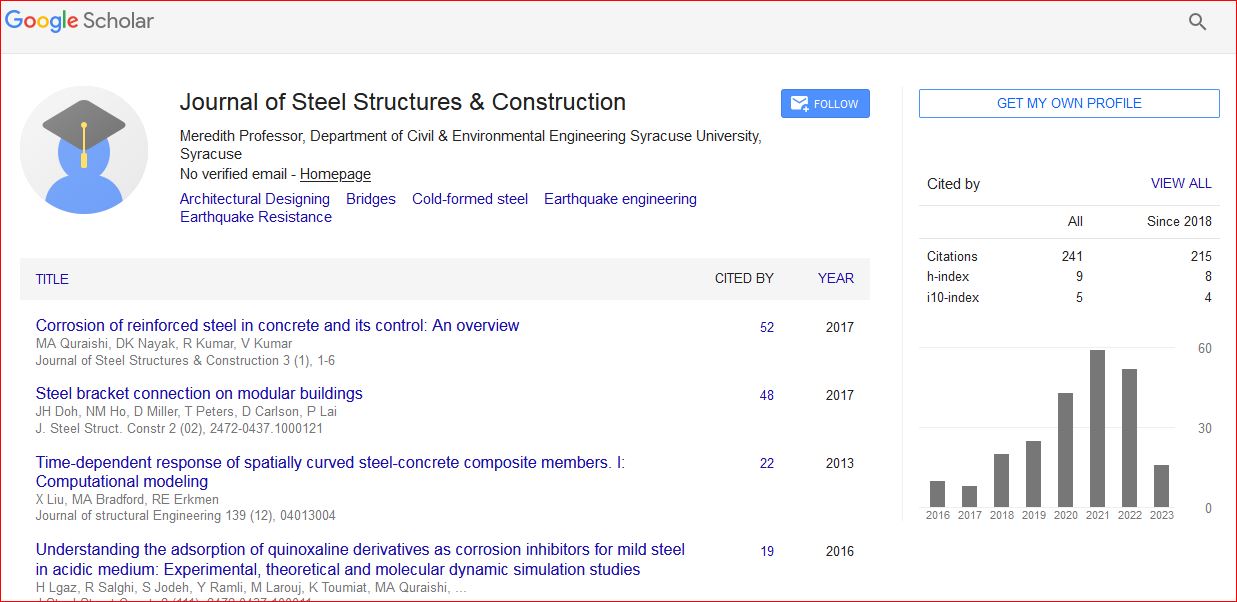
Journal of Steel Structures & Construction received 583 citations as per Google Scholar report