Perspective - (2025) Volume 11, Issue 2
Received: 01-Apr-2025, Manuscript No. jssc-26-188261;
Editor assigned: 03-Apr-2025, Pre QC No. P-188261;
Reviewed: 17-Apr-2025, QC No. Q-188261;
Revised: 22-Apr-2025, Manuscript No. R-188261;
Published:
29-Apr-2025
, DOI: 10.37421/2472-0437.2025.11.292
Citation: Tanaka, Hiroshi. ”Steel Column Stability: Tall Buildings’
Safety and Resilience.” J Steel Struct Constr 11 (2025):292.
Copyright: © 2025 Tanaka H. This is an open-access article distributed under the terms of the Creative Commons Attribution License, which permits unrestricted use,
distribution and reproduction in any medium, provided the original author and source are credited.
The structural integrity of high-rise buildings is profoundly dependent on the performance of their constituent elements, with steel columns playing a pivotal role in load-bearing and overall stability. Understanding and mitigating the various failure mechanisms these columns can experience is paramount for ensuring safety and longevity. Buckling, a phenomenon where a structural element under compression loses its stability and undergoes sudden lateral deflection, is a primary concern for steel columns, especially in tall structures subjected to significant axial loads and lateral forces such as wind and seismic activity. This section will explore the multifaceted aspects of steel column stability in high-rise construction, drawing upon recent research to provide a comprehensive overview of the challenges and solutions [1].
The inherent behavior of steel columns under dynamic loading, particularly seismic events, necessitates a thorough investigation into their performance and ductility. Tall buildings are particularly vulnerable to earthquakes, and the ability of steel columns to absorb and dissipate seismic energy without catastrophic failure is a critical design consideration. Research in this area focuses on developing refined models that account for material nonlinearity and geometric effects under such dynamic conditions, aiming to enhance the resilience of high-rise structures [2].
Slender steel columns, common in many high-rise designs, are susceptible to lateral-torsional buckling, a failure mode triggered by eccentric loads that cause a combined twisting and bending motion. Addressing this specific type of buckling requires a deep understanding of its influencing parameters, such as bracing conditions and the geometric properties of the column's cross-section. The development of novel analytical solutions and numerical simulations is crucial for designing effective bracing strategies and optimizing section shapes to prevent premature failure in these critical structural members [3].
The presence of geometric imperfections, such as initial out-of-straightness and residual stresses, can significantly compromise the buckling strength of steel columns. These imperfections, often unavoidable in the manufacturing and erection processes, can reduce the load-carrying capacity of columns. Advanced computational methods are employed to quantify the impact of these imperfections, leading to recommendations for realistic imperfection tolerances in design codes to ensure adequate safety margins in practice [4].
Beyond static and seismic loading, the stability of steel columns must also be considered under extreme environmental conditions, such as fire. Elevated temperatures can severely degrade the material properties of steel, leading to a reduction in stiffness and strength, and potentially initiating buckling. Research into the fire resistance of steel columns focuses on analyzing material property degradation and the onset of buckling under combined thermal and mechanical loads, evaluating various fire protection strategies to maintain structural integrity during a fire event [5].
Composite steel columns, which integrate steel with concrete, offer a promising approach to enhancing stability and load-carrying capacity in tall buildings. These composite sections leverage the synergistic effects of steel and concrete to resist axial loads and bending moments more effectively than pure steel columns. Investigating various composite designs and their buckling behavior under different loading conditions, often validated against experimental data, demonstrates their superior performance and potential for more efficient high-rise construction [6].
In thin-walled steel columns, a complex interaction can occur between global buckling (overall instability of the column) and local buckling (instability of individual plate elements within the column's cross-section). This coupled phenomenon is a significant challenge in the design of tall structures. Advanced finite element techniques are employed to simulate these combined buckling modes, emphasizing the importance of considering both local and global stability simultaneously to accurately predict the ultimate load capacity and mitigate risks [7].
Innovation in steel column design is continuously driving advancements in the stability of very tall buildings. This includes exploring the use of high-strength steels, optimizing cross-sectional shapes for improved stiffness and strength, and employing advanced connection detailing. Sophisticated numerical simulations are used to assess the performance of these novel designs under various loading scenarios, paving the way for more efficient and stable steel columns for next-generation high-rise structures [8].
Steel columns in tall buildings frequently experience combined axial and bending loads, particularly in the lower stories and core elements. Understanding the stability limits under such combined loading conditions is critical. Detailed analytical solutions and validated finite element models are used to predict buckling behavior, with a focus on identifying critical interaction curves that define stability limits, leading to the design of robust and stable columns [9].
Finally, the long-term stability and serviceability of steel columns in tall structures require consideration of creep and other time-dependent effects. Sustained loads and environmental factors can influence structural behavior over the building's lifespan. Advanced material models and simulation techniques are utilized to predict cumulative deformation and potential stability issues, ensuring that steel columns maintain their integrity and performance over extended periods, which is crucial for the durability of tall buildings [10].
The critical aspects of steel column stability in high-rise buildings are extensively examined, with a particular focus on buckling phenomena under axial loads and lateral forces. The research highlights how material properties, geometric imperfections, and connection details collectively influence the load-carrying capacity and overall performance of these essential structural elements. Advanced analysis techniques, such as finite element modeling, are underscored as necessary for accurately predicting buckling behavior and ensuring the safety and serviceability of tall steel structures. Key findings suggest that composite design and optimized cross-section selection are effective in enhancing column stability [1].
Investigations into the seismic performance of steel columns in tall buildings reveal the combined effects of axial load and transverse seismic excitation. Crucial mechanisms for withstanding earthquake forces, such as ductility and energy dissipation, are explored. The study presents refined models incorporating material nonlinearity and geometric effects under dynamic loading, offering practical recommendations for designing ductile steel columns capable of enduring significant seismic events and contributing to resilient high-rise construction [2].
Lateral-torsional buckling of slender steel columns, a critical failure mode in tall structures subjected to eccentric loads, is addressed through novel analytical solutions and numerical simulations. The research assesses the influence of parameters like bracing conditions and section properties, providing insights into effective bracing strategies and optimized section shapes to prevent premature buckling and maintain structural integrity. These findings are particularly relevant for the design of long-span steel structures [3].
The impact of geometric imperfections on the buckling strength of steel columns in tall buildings is investigated using advanced computational methods. The study quantifies how initial out-of-straightness and residual stresses affect the critical buckling load, emphasizing that even minor imperfections can significantly reduce a column's load-carrying capacity. Recommendations are provided for establishing realistic imperfection tolerances in design codes to ensure adequate safety margins for practical applications [4].
Fire resistance and the stability of steel columns under elevated temperatures in tall structures are analyzed. The research examines the degradation of material properties and the onset of buckling under combined thermal and mechanical loads. Various fire protection strategies are evaluated for their effectiveness in maintaining structural integrity during fire events, offering valuable insights for the fire safety design of high-rise steel buildings [5].
A comprehensive stability analysis of composite steel columns in tall buildings is presented, focusing on the synergistic effects of steel and concrete. The study explores various composite section designs and their buckling behavior under different loading conditions. Advanced numerical models are validated against experimental data, demonstrating the enhanced stability and load-carrying capacity of composite columns compared to traditional pure steel columns [6].
The complex interaction between global and local buckling in thin-walled steel columns, a common concern in tall structure design, is examined using advanced finite element techniques. The research simulates coupled buckling modes and highlights the importance of simultaneously considering both local and global stability for accurate prediction of ultimate load capacity. Design recommendations are offered to mitigate the risks associated with combined buckling phenomena in steel columns [7].
Innovative steel column designs aimed at enhancing stability in very tall buildings are explored, including the use of high-strength steel, optimized cross-sectional shapes, and advanced connection detailing. Sophisticated numerical simulations are employed to assess the performance of these new designs under various loading scenarios, including wind and seismic forces. The findings suggest that these novel approaches can lead to more efficient and stable steel columns for next-generation high-rise structures [8].
Stability of steel columns subjected to combined axial and bending loads, a prevalent scenario in the lower stories of tall buildings, is investigated through detailed analytical solutions and validated finite element models. The research emphasizes critical interaction curves that define stability limits for such loading conditions, discussing practical implications for the design of robust and stable steel columns in both core and perimeter areas of high-rise structures [9].
Long-term stability and serviceability of steel columns in tall structures are examined, considering creep and time-dependent effects. The study analyzes how sustained loads and environmental factors influence structural behavior over a building's lifespan, employing advanced material models and simulation techniques to predict cumulative deformation and potential stability issues. The research offers insights into designing steel columns that maintain integrity and performance over extended periods, crucial for the durability of tall buildings [10].
This collection of research addresses the critical stability of steel columns in tall buildings. It covers various failure modes including buckling under axial and lateral loads, seismic performance, lateral-torsional buckling, and the impact of geometric imperfections. The studies also explore fire resistance, the benefits of composite steel columns, and the interaction of global and local buckling. Furthermore, innovative designs and long-term serviceability considerations such as creep effects are investigated. Advanced analytical and numerical techniques are frequently employed to predict behavior and inform design strategies for ensuring the safety and resilience of high-rise structures.
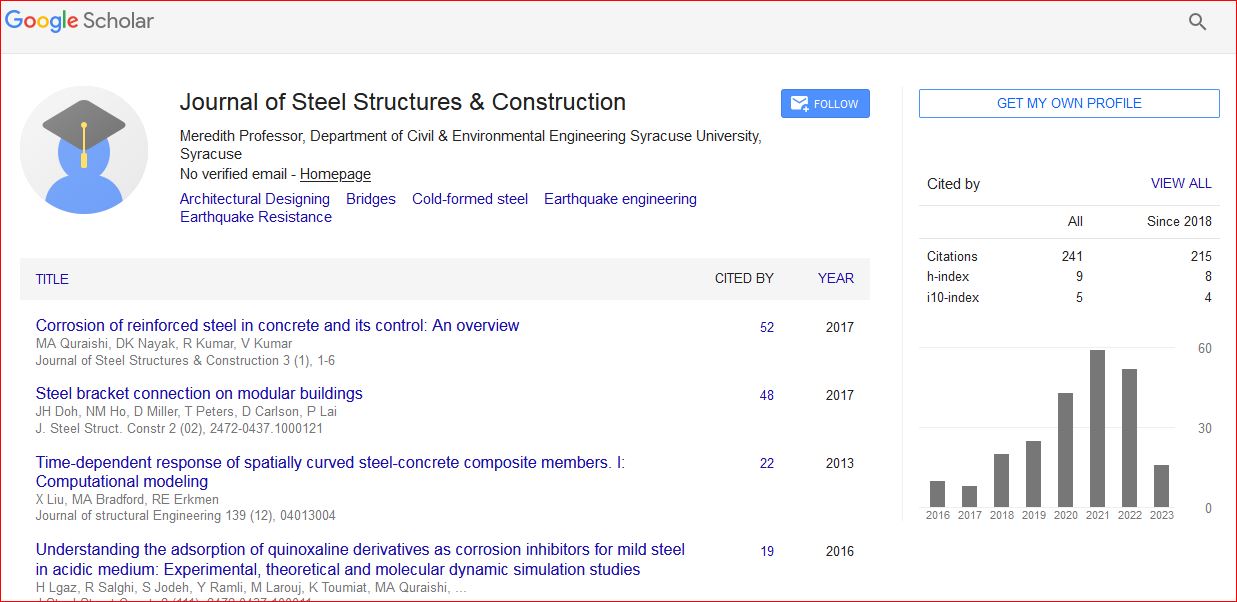
Journal of Steel Structures & Construction received 583 citations as per Google Scholar report