Perspective - (2025) Volume 13, Issue 4
Received: 04-Aug-2025, Manuscript No. jcdd-25-176820;
Editor assigned: 06-Aug-2025, Pre QC No. P-176820;
Reviewed: 20-Aug-2025, QC No. Q-176820;
Revised: 25-Aug-2025, Manuscript No. R-176820;
Published:
01-Sep-2025
, DOI: 10.37421/2329-9517.2025.13.686
Citation: Schneider, Nora. ”Statins: Crucial Benefits, Risks,
Individualized Approach.” J Cardiovasc Dis Diagn 13 (2025):686.
Copyright: © 2025 Schneider N. This is an open-access article distributed under the terms of the Creative Commons Attribution License, which permits unrestricted use,
distribution and reproduction in any medium, provided the original author and source are credited.
This comprehensive meta-analysis unequivocally confirms that statins significantly reduce major cardiovascular events, including myocardial infarction and stroke, along with all-cause mortality and specific cardiovascular outcomes across a diverse range of patient populations. This evidence profoundly underscores their broad efficacy and fundamental importance in contemporary clinical practice, establishing them as a cornerstone of cardiovascular disease management[1].
Furthermore, an in-depth review critically examines the current evidence and established guideline recommendations concerning statin utilization for primary prevention. This analysis highlights the crucial need for individualized risk assessment and a shared decision-making process between clinicians and patients to optimize outcomes while simultaneously minimizing potentially unnecessary medical interventions[2].
A focused article provides a thorough overview of statin-associated muscle symptoms (SAMS), delving into their complex underlying mechanisms. It outlines various diagnostic approaches and discusses diverse management strategies designed to enhance patient adherence to therapy and improve overall long-term outcomes, which is undeniably crucial for the sustained success of chronic statin treatment[3].
Moving to potential adverse effects, a rigorous meta-analysis precisely quantifies the increased risk of new-onset diabetes mellitus (NODM) linked to statin therapy. This finding strongly emphasizes the necessity for meticulous patient selection and vigilant monitoring, particularly in individuals already identified as having a high risk for developing diabetes, ensuring a careful balance between therapeutic benefits and potential side effects[4].
Beyond their primary lipid-lowering capabilities, an insightful review explores the multifaceted pleiotropic effects of statins. It specifically focuses on their distinct anti-inflammatory, anti-thrombotic, and endothelial protective properties. These diverse actions are increasingly recognized as significantly contributing to the overall broad spectrum of cardiovascular benefits observed with statin use, extending their impact beyond mere cholesterol reduction[5].
A systematic review and meta-analysis compellingly demonstrate a robust association between consistent statin adherence and significantly improved cardiovascular outcomes. These include substantial reductions in mortality rates and major adverse cardiovascular events, thereby emphasizing the absolutely critical role of consistent medication use as a cornerstone for achieving long-term therapeutic success and patient well-being[6].
In the realm of personalized medicine, a comprehensive review investigates the pharmacogenomic aspects of statin therapy. It discusses how inherent genetic variations among individuals can profoundly influence both the efficacy and the likelihood of adverse effects of statins, thereby paving the way for more personalized treatment approaches and significantly enhancing patient safety profiles[7].
Addressing a specific patient demographic, this article carefully reviews the existing evidence supporting statin use in elderly patients. It meticulously balances the well-documented cardiovascular benefits against potential risks, such as adverse events and drug interactions. This underscores the imperative for careful consideration and highly individualized treatment strategies tailored for this often vulnerable patient population[8].
Providing a targeted update, this article reinforces the efficacy and safety of high-intensity statin therapy, particularly in individuals diagnosed with advanced atherosclerosis. It highlights the critical role of such aggressive lipid reduction regimens in substantially improving clinical outcomes and slowing disease progression in this high-risk group[9].
Finally, a forward-looking review explores the emerging evidence concerning the non-cardiovascular benefits of statins. This includes their potential therapeutic roles in fields such as oncology, neurodegenerative diseases, and other chronic inflammatory conditions, suggesting a considerably broader therapeutic scope that extends well beyond their established lipid management functions[10].
Statins are widely recognized for their profound impact on cardiovascular health, primarily through their lipid-lowering capabilities. A meta-analysis robustly confirms that statins significantly reduce major cardiovascular events, all-cause mortality, and specific cardiovascular outcomes across various patient populations, underscoring their broad efficacy and importance in clinical practice [C001]. This efficacy is crucial in both secondary prevention and increasingly in primary prevention, where careful risk-benefit assessment is paramount. A comprehensive review examines the current evidence and guideline recommendations for statin use in primary prevention, highlighting the importance of individualized risk assessment and shared decision-making to optimize patient outcomes and minimize unnecessary interventions [C002]. Consistent medication use is vital, with a systematic review and meta-analysis demonstrating a strong association between statin adherence and improved cardiovascular outcomes, including reduced mortality and major adverse cardiovascular events [C006].
Beyond their direct impact on lipid levels, statins exert several pleiotropic effects that contribute to their overall cardiovascular benefits. A review explores these effects, focusing on their anti-inflammatory, anti-thrombotic, and endothelial protective properties [C005]. These additional mechanisms contribute significantly to the comprehensive cardiovascular protection statins offer, making them more than just cholesterol-lowering agents. For patients with advanced disease, high-intensity statin therapy plays a critical role. An article provides an update on the efficacy and safety of high-intensity statin therapy in individuals with advanced atherosclerosis, reinforcing its crucial role in achieving aggressive lipid reduction and significantly improving clinical outcomes [C009]. This aggressive approach is often necessary to combat the progression of severe arterial disease.
However, statin therapy is not without potential challenges and side effects. Statin-associated muscle symptoms (SAMS) are a common concern, impacting patient adherence and quality of life. An article offers a comprehensive overview of SAMS, discussing their underlying mechanisms, diagnostic approaches, and various management strategies to improve patient adherence and outcomes, which is crucial for long-term therapy [C003]. Another important consideration is the risk of new-onset diabetes mellitus (NODM). A meta-analysis quantifies this increased risk associated with statin therapy, highlighting the need for careful patient selection and monitoring, especially in those at high risk for diabetes, to balance benefits against potential side effects [C004]. These considerations necessitate a personalized approach to treatment.
Individualized treatment is further supported by pharmacogenomics. A review explores the pharmacogenomic aspects of statin therapy, discussing how genetic variations can influence statin efficacy and adverse effects, paving the way for more personalized treatment approaches and improved patient safety [C007]. Special populations also require tailored considerations. For elderly patients, balancing benefits and risks is particularly important. An article reviews the evidence for statin use in elderly patients, carefully balancing the cardiovascular benefits against potential risks and drug interactions, emphasizing the need for careful consideration and individualized treatment in this vulnerable population [C008]. Finally, emerging research suggests statins may have benefits extending beyond cardiovascular health. A review explores emerging evidence regarding the non-cardiovascular benefits of statins, including their potential roles in oncology, neurodegenerative diseases, and other inflammatory conditions, suggesting a broader therapeutic scope beyond lipid management [C010].
Statins are crucial for managing cardiovascular disease, as evidence consistently confirms their efficacy in significantly reducing major cardiovascular events and all-cause mortality across diverse patient populations. Their benefits extend beyond lipid lowering, encompassing anti-inflammatory, anti-thrombotic, and endothelial protective actions. These pleiotropic effects contribute substantially to overall cardiovascular health. However, their use requires careful consideration of potential side effects, such as statin-associated muscle symptoms and an increased risk of new-onset diabetes mellitus, necessitating individualized risk assessment and vigilant monitoring. Patient adherence is paramount for therapeutic success, with strong associations demonstrated between consistent use and improved outcomes. Pharmacogenomic insights are paving the way for personalized treatment, optimizing efficacy and safety. Specific populations, such as the elderly and those requiring high-intensity therapy for advanced atherosclerosis, demand tailored approaches to balance benefits against risks. Additionally, research is exploring the broader non-cardiovascular benefits of statins, suggesting potential roles in oncology, neurodegenerative diseases, and inflammatory conditions, broadening their therapeutic scope beyond traditional lipid management.
Indexed at, Google Scholar, Crossref
Indexed at, Google Scholar, Crossref
Indexed at, Google Scholar, Crossref
Indexed at, Google Scholar, Crossref
Indexed at, Google Scholar, Crossref
Indexed at, Google Scholar, Crossref
Indexed at, Google Scholar, Crossref
Indexed at, Google Scholar, Crossref
Indexed at, Google Scholar, Crossref
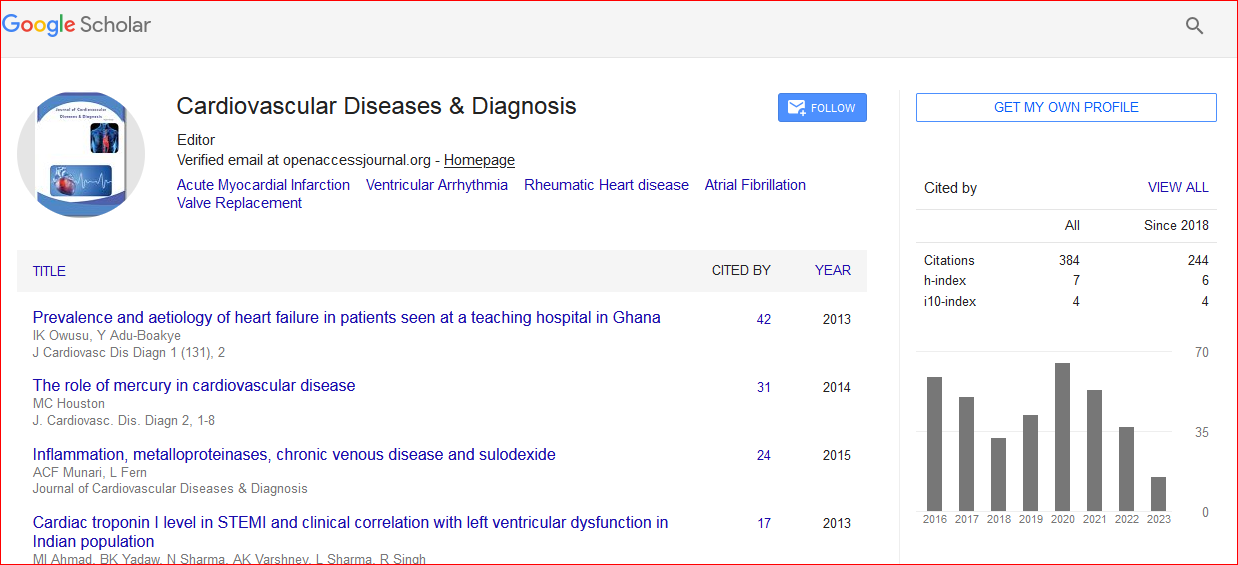
Cardiovascular Diseases & Diagnosis received 427 citations as per Google Scholar report