Perspective - (2025) Volume 15, Issue 4
Received: 03-Aug-2025, Manuscript No. jprm-25-174460;
Editor assigned: 06-Aug-2025, Pre QC No. P-174460;
Reviewed: 19-Aug-2025, QC No. Q-174460;
Revised: 25-Aug-2025, Manuscript No. R-174460;
Published:
30-Aug-2025
, DOI: 10.37421/2161-105X.2025.15.753
Citation: Bianchi, Matteo. ”Spirometry: Updates, Challenges and Evolving Applications.” J Pulm Respir Med 15 (2025):753.
Copyright: © 2025 Bianchi M. This is an open-access article distributed under the terms of the Creative Commons Attribution License, which permits unrestricted use, distribution and reproduction in any medium, provided the original author and source are credited.
Spirometry is a foundational tool in respiratory medicine, continually evolving to improve diagnostic precision and patient management. A significant advancement includes the Global Lung Function Initiative (GLI) 2022 reference equations, which offer updated standards for interpreting lung function tests. These equations are vital for accurate diagnoses across diverse populations, refining the GLI-2012 equations to reduce misclassification in clinical practice by incorporating more current and globally representative data[1].
The global healthcare landscape recently faced unprecedented challenges, notably during the COVID-19 pandemic. This period saw a significant impact on spirometry services worldwide, as highlighted by an international survey. The survey revealed widespread adjustments in testing protocols, infection control measures, and overall service availability, reflecting the immense pressure on pulmonary function laboratories and respiratory societies to sustain essential diagnostic services amidst a global health crisis[2].
Beyond conventional spirometry, other diagnostic modalities complement its utility in assessing respiratory health. One such method involves fractional exhaled nitric oxide (FeNO), for which practical recommendations exist for both adult and pediatric use. This guideline clarifies FeNOâ??s role as an important adjunct to spirometry, particularly in diagnosing and managing inflammatory airway diseases like asthma, emphasizing its value in assessing airway inflammation and informing treatment strategies[3].
At its core, understanding spirometry requires appreciating its fundamental physiological principles. It explains how these measurements directly reflect lung mechanics and gas exchange. By bridging theoretical knowledge with practical application, it illuminates the clinical utility of spirometry in diagnosing and monitoring various respiratory conditions, providing clinicians with a clearer grasp of its underlying science[4].
The dynamic nature of lung health necessitates approaches that track changes over time. This involves recent advancements in understanding lung function trajectories, which focus on monitoring shifts in lung capacity across an individual's lifespan. The exploration of innovative measurement techniques and methodological approaches underscores the clinical importance of these trajectories in identifying individuals prone to accelerated lung decline, thereby enabling earlier interventions[5].
Interpreting lung function tests is not without its complexities, especially when dealing with older adults. This demographic presents unique challenges due to inherent age-related physiological changes and the prevalence of comorbidities. Addressing these complexities requires emphasizing the critical need for age-appropriate reference values and meticulous clinical correlation to prevent misdiagnosis and ensure optimal management of respiratory health in the elderly population[6].
Spirometry continues to hold a pivotal and reinforcing role in the comprehensive diagnosis and management of diverse respiratory diseases, encompassing both obstructive and restrictive lung conditions. An updated review consolidates current best practices, illustrating how precise spirometric measurements directly inform therapeutic strategies and help assess disease progression, ultimately contributing to improved patient outcomes[7].
Innovation in healthcare delivery is expanding the reach of diagnostic tools. Tele-spirometry is emerging as a significant development in managing respiratory diseases, particularly in the context of remote healthcare. A systematic review evaluates the practicality, accuracy, and patient adherence to home-based spirometry, suggesting its substantial potential to enhance accessibility to lung function monitoring and foster more patient-centered care models[8].
Environmental factors exert a profound influence on respiratory well-being. Air pollution, for example, has well-documented detrimental effects on human lung function and contributes significantly to various respiratory diseases. A critical review synthesizes evidence, demonstrating how exposure to pollutants can impair spirometric parameters and exacerbate conditions like asthma and Chronic Obstructive Pulmonary Disease (COPD), highlighting the urgent public health imperative for cleaner air initiatives[9].
The paradigm of respiratory disease management is shifting towards more personalized approaches, especially for conditions like Chronic Obstructive Pulmonary Disease (COPD). A narrative review explores how spirometry is instrumental in guiding tailored treatment plans. This involves stratifying patients based on their specific spirometric findings to optimize pharmacotherapy and achieve better disease control, moving away from a generalized, one-size-fits-all methodology[10].
Spirometry remains a fundamental and indispensable diagnostic tool in respiratory medicine, crucial for assessing lung function and diagnosing a wide array of respiratory diseases. Its importance is continually reinforced by updates that enhance accuracy and applicability. For instance, the Global Lung Function Initiative (GLI) 2022 reference equations have significantly improved the interpretation of lung function tests across diverse populations. These updated equations build upon the GLI-2012 standards, offering more current and globally representative data to refine diagnostic precision and minimize misclassification in clinical practice [1]. A deep understanding of the physiological principles underpinning spirometry is equally vital. These principles explain how spirometric measurements directly reflect lung mechanics and gas exchange, providing clinicians with a robust framework for diagnosing and monitoring various respiratory conditions [4]. The accurate application of these tests, therefore, relies heavily on both updated reference standards and a solid grasp of the underlying bodily functions they measure.
The versatility of spirometry extends significantly into the diagnosis and ongoing management of a broad spectrum of respiratory conditions. It plays a pivotal role, particularly in identifying obstructive and restrictive lung diseases, with current best practices underscoring how precise spirometric measurements are essential for guiding therapeutic strategies and assessing disease progression, ultimately contributing to improved patient outcomes [7]. Beyond static measurements, the field is advancing with a focus on lung function trajectories. This innovative approach involves tracking changes in lung capacity over extended periods, exploring new measurement techniques and methodologies. The clinical significance of these trajectories lies in their ability to identify individuals at higher risk for accelerated lung decline, thereby enabling earlier, more targeted interventions [5]. This emphasizes a proactive and dynamic approach to respiratory health management.
The application of lung function assessment also encompasses specialized tools and addresses specific population challenges. Fractional exhaled nitric oxide (FeNO), for example, serves as a valuable adjunct to spirometry, particularly in diagnosing and managing inflammatory airway diseases like asthma in both adults and children. Guidelines clarify FeNO's utility in assessing airway inflammation and guiding treatment decisions, providing a more nuanced understanding of a patient's condition [3]. However, interpreting lung function tests is not uniformly straightforward across all demographics. Older adults present unique challenges due to age-related physiological changes and common comorbidities. This necessitates the use of age-appropriate reference values and careful clinical correlation to avoid misdiagnosis and ensure optimal respiratory health management in the elderly population [6]. Additionally, for conditions like Chronic Obstructive Pulmonary Disease (COPD), spirometry is crucial for personalized management, allowing for patient stratification based on findings to optimize pharmacotherapy and enhance disease control, moving away from a one-size-fits-all treatment paradigm [10].
External environmental factors and technological innovations are continuously shaping the landscape of spirometry and respiratory care. The COVID-19 pandemic severely impacted spirometry services worldwide, leading to significant alterations in testing protocols, infection control measures, and service availability. An international survey highlighted the substantial challenges faced by pulmonary function laboratories and respiratory societies in maintaining these essential diagnostic services during a global health crisis [2]. Concurrently, the detrimental effects of air pollution on human lung function and its contribution to various respiratory diseases remain a critical public health issue. Evidence demonstrates how exposure to pollutants can impair spirometric parameters and exacerbate conditions such as asthma and COPD, underscoring the urgent need for cleaner air initiatives [9]. In response to evolving healthcare needs, particularly the demand for remote care, tele-spirometry is emerging as a promising solution. This systematic review explores the feasibility, accuracy, and patient adherence to home-based spirometry, indicating its potential to improve accessibility to lung function monitoring and facilitate patient-centered care in a broader context [8].
Spirometry stands as a cornerstone in diagnosing and managing a broad spectrum of respiratory conditions. The Global Lung Function Initiative (GLI) 2022 equations represent a significant update, enhancing diagnostic accuracy by providing more current and globally representative reference data for lung function tests, which is crucial for minimizing misclassification in clinical settings. Understanding the physiological basis of spirometry further solidifies its clinical application in monitoring various respiratory conditions. The COVID-19 pandemic profoundly impacted spirometry services, necessitating widespread changes in testing protocols and infection control measures globally, challenging pulmonary function laboratories to maintain essential diagnostic capabilities. Looking beyond standard measurements, research into lung function trajectories offers innovative ways to track changes in lung capacity over time, aiding in identifying individuals at risk for accelerated decline and guiding early interventions. Specific applications and considerations include the use of fractional exhaled nitric oxide (FeNO) as an adjunct to spirometry for managing inflammatory airway diseases, and the unique challenges in interpreting lung function tests in older adults due to age-related physiological changes. Furthermore, spirometry plays a vital role in the personalized management of Chronic Obstructive Pulmonary Disease (COPD), allowing for tailored treatment plans based on individual patient findings. Technological advancements are evident in the emergence of tele-spirometry, which shows promise in expanding access to lung function monitoring, particularly in remote healthcare settings. Finally, the impact of external factors like air pollution on lung function cannot be overstated, as exposure to pollutants demonstrably impairs spirometric parameters and exacerbates conditions such as asthma and COPD, underscoring a critical public health concern.
None
None
1. Sanja S, David AK, Mark RM. "Global Lung Function Initiative (GLI) 2022 reference equations for spirometry: an update to the GLI-2012 equations.".Eur Respir J 60 (2022):2102345.
Indexed at, Google Scholar, Crossref
2. Mark RM, Gerard LR, Snehal AB. "Spirometry testing during the COVID-19 pandemic: An international survey of respiratory societies and pulmonary function laboratories".Respirology 26 (2021):217-224.
Indexed at, Google Scholar, Crossref
3. David JMS, Andrew DM, Ian DP. "Recommendations for the use of FeNO in adults and children: a British Thoracic Society guideline".Thorax 77 (2022):961-981.
Indexed at, Google Scholar, Crossref
4. Mark RM, Gerard LR, Janet S. "The physiological basis of spirometry and its clinical application".Breathe (Sheff) 19 (2023):230069.
Indexed at, Google Scholar, Crossref
5. Mélanie F, Sammy L, Sharon D. "Lung function trajectories: latest advances in measurement, methodology and clinical application.".ERJ Open Res 7 (2021):00412-2020.
Indexed at, Google Scholar, Crossref
6. Riccardo P, Vio B, Sanja S. "Challenges in Interpreting Lung Function in Older Adults.".Front Physiol 11 (2020):938.
Indexed at, Google Scholar, Crossref
7. Bartolome RC, Mark LB, Gary TF. "Spirometry for Diagnosis and Management of Respiratory Diseases: An Update".Clin Chest Med 41 (2020):393-404.
Indexed at, Google Scholar, Crossref
8. Hussain A, Ali AA, Hiba TA. "Tele-spirometry in respiratory disease: A systematic review.".Respir Med 183 (2021):106497.
Indexed at, Google Scholar, Crossref
9. Vaibhav S, Ritu S, Anuj S. "Impact of Air Pollution on Lung Function and Respiratory Diseases: A Review".J Clin Med 11 (2022):2874.
Indexed at, Google Scholar, Crossref
10. Marc M, G ML, J PFMdB. "Spirometry-Based Personalized Management of COPD: A Narrative Review.".COPD 17 (2020):1-13.
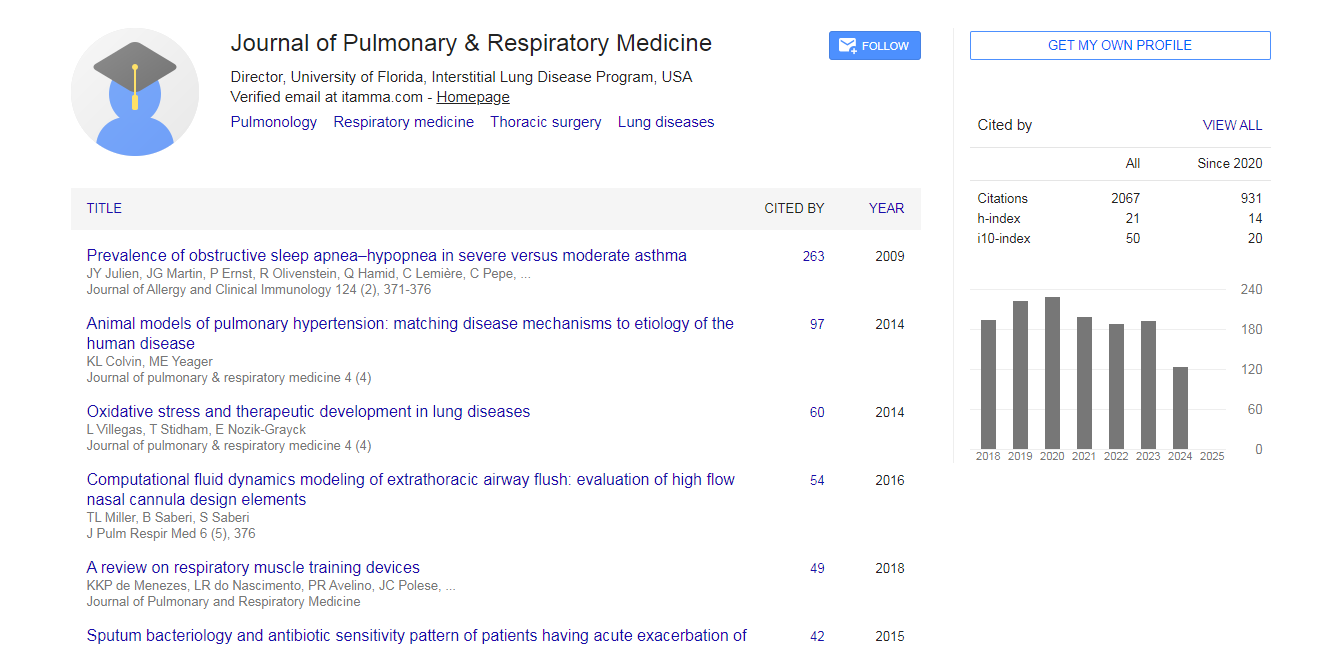
Pulmonary & Respiratory Medicine received 1690 citations as per Google Scholar report