Short Communication - (2025) Volume 14, Issue 2
Received: 01-Apr-2025, Manuscript No. jsp-26-182242;
Editor assigned: 03-Apr-2025, Pre QC No. P-182242;
Reviewed: 17-Apr-2025, QC No. Q-182242;
Revised: 22-Apr-2025, Manuscript No. R-182242;
Published:
29-Apr-2025
, DOI: 10.37421/2165-7939.2025.14.718
Citation: Malhotra, Rajiv K.. ”Spine Trauma: Comprehensive Management for Optimal Recovery.” J Spine 14 (2025):718.
Copyright: © 2025 Malhotra K. Rajiv This is an open-access article distributed under the terms of the Creative Commons Attribution License, which permits unrestricted use, distribution and reproduction in any medium, provided the original author and source are credited.
Spine trauma represents a critical area of medical concern, demanding comprehensive understanding and effective management strategies to mitigate severe consequences for patients. The immediate evaluation and subsequent long-term care are paramount in addressing the multifaceted nature of these injuries, aiming to prevent secondary damage and optimize functional recovery [1].
Advancements in surgical techniques have significantly improved the treatment of traumatic spinal fractures, particularly those affecting the thoracolumbar region. Innovations in spinal stabilization and decompression, including minimally invasive procedures and novel instrumentation, are continuously being developed to enhance patient outcomes [2].
Following traumatic spinal cord injury, the journey towards recovery is often lengthy and complex, necessitating dedicated long-term rehabilitation programs. These programs are designed to address physical, occupational, and psychological needs, with the ultimate goal of maximizing independence and improving the overall quality of life [3].
The accurate and timely diagnosis of spine trauma relies heavily on sophisticated imaging modalities. Computed tomography (CT) and magnetic resonance imaging (MRI) play indispensable roles in identifying injuries, assessing stability, and guiding therapeutic decisions, with emerging techniques offering further diagnostic potential [4].
Injuries to the cervical spine in trauma patients pose unique challenges due to the critical proximity of the spinal cord. A thorough diagnostic workup and prompt implementation of treatment strategies, including early immobilization and surgical stabilization, are crucial to prevent neurological deterioration [5].
During surgical interventions for spine trauma, protecting the spinal cord is of utmost importance. Neuroprotective strategies, ranging from pharmacological agents to hypothermia and spinal cord monitoring, are employed to minimize secondary injury and enhance neurological recovery [6].
The management of polytrauma patients who have sustained associated spinal injuries requires a highly coordinated and rapid response. Initial assessment and resuscitation are vital for these complex cases, emphasizing the early identification and management of life-threatening conditions within the trauma team framework [7].
Survivors of spine trauma often face significant long-term complications, such as chronic pain, spasticity, and psychological distress. Effective management of these sequelae is essential for improving their quality of life, requiring ongoing multidisciplinary care and patient education [8].
The economic impact of spine trauma is substantial, encompassing acute care, rehabilitation, and long-term support costs. Understanding these financial implications and developing cost-effective management strategies are crucial for optimizing resource allocation and reducing healthcare expenditures [9].
Patient-reported outcome measures (PROMs) have emerged as vital tools for evaluating the effectiveness of spine trauma management. Their routine use in assessing pain, function, and quality of life provides valuable insights for tracking progress and informing treatment decisions in spinal cord injury rehabilitation [10].
Spine trauma management encompasses a broad spectrum of clinical considerations, beginning with the comprehensive evaluation of the injury. This initial phase is critical for identifying the extent of damage and determining the most appropriate course of action, whether surgical or non-surgical. The overarching aim is to prevent further injury and facilitate the best possible functional recovery. A multidisciplinary team, including specialists from emergency medicine, neurosurgery, orthopaedic surgery, and rehabilitation, is essential for addressing the complex needs of these patients [1].
In the realm of surgical interventions, advancements in treating traumatic spinal fractures, particularly those of the thoracolumbar spine, are noteworthy. Current techniques focus on effective spinal stabilization and decompression, with a growing emphasis on minimally invasive approaches and the utilization of sophisticated instrumentation. Considerations regarding surgical indications, perioperative care, and the timing of interventions are paramount for optimizing neurological outcomes and patient recovery [2].
Following the acute phase of traumatic spinal cord injury, long-term rehabilitation plays a pivotal role in restoring function and improving quality of life. Rehabilitation programs are meticulously designed, integrating physical therapy, occupational therapy, and psychological support. Factors influencing recovery, such as injury severity, patient motivation, and access to specialized care, are carefully considered to maximize independence [3].
The diagnostic pathway for spine trauma is significantly enhanced by advanced imaging techniques. The utility of CT and MRI is well-established for detecting bony and soft tissue injuries, assessing spinal stability, and informing treatment strategies. Ongoing research into novel imaging modalities promises to further refine the acute assessment of spine trauma [4].
Cervical spine injuries in trauma settings require specialized attention due to the delicate structures involved. A systematic diagnostic approach, combining clinical assessment with appropriate imaging protocols, is fundamental. Treatment strategies are tailored to the specific fracture or dislocation, with a strong emphasis on early immobilization and precise surgical stabilization to avert neurological decline [5].
During operative management of spine trauma, spinal cord protection strategies are of paramount importance. Various neuroprotective measures, including pharmacological interventions, hypothermia, and intraoperative spinal cord monitoring, are employed to mitigate secondary injury and enhance the chances of neurological recovery. Evidence-based application of these strategies is key [6].
For patients experiencing polytrauma with accompanying spinal injuries, prompt and coordinated management is imperative. The initial assessment and resuscitation efforts must prioritize the identification and stabilization of life-threatening injuries. The established protocols for managing spinal trauma in a multi-injured patient are crucial for efficient care delivery by the trauma team [7].
The long-term consequences of spine trauma can be profound, manifesting as chronic pain, spasticity, autonomic dysreflexia, and psychological challenges. Comprehensive management plans are developed to address these sequelae, aiming to improve the overall well-being of spine trauma survivors. Continuous multidisciplinary care and robust patient education are cornerstones of this approach [8].
Quantifying the economic implications of spine trauma is essential for effective healthcare planning. The costs associated with acute treatment, rehabilitation, and ongoing support represent a significant burden. Strategies focusing on cost-effective management and efficient resource allocation, driven by early and comprehensive care, can mitigate long-term financial impacts [9].
Evaluating the success of spine trauma management increasingly relies on patient-reported outcome measures (PROMs). These tools capture patient perspectives on pain, function, and quality of life, providing objective data to track progress and guide treatment adjustments in spinal cord injury rehabilitation [10].
Spine trauma necessitates a comprehensive approach encompassing evaluation, immediate management, and long-term outcomes. Timely diagnosis and appropriate interventions, including surgical and non-surgical methods, are crucial for preventing secondary injury and optimizing functional recovery. A multidisciplinary team is vital for addressing complex needs. Advancements in surgical techniques, particularly for thoracolumbar fractures, focus on stabilization and decompression using minimally invasive methods and novel instrumentation. Long-term rehabilitation programs are essential for spinal cord injury recovery, addressing physical, occupational, and psychological aspects to maximize independence and quality of life. Advanced imaging, such as CT and MRI, plays a critical role in diagnosis and treatment planning. Management of cervical spine injuries requires prompt intervention to prevent neurological deterioration. Neuroprotective strategies are employed during surgery to minimize secondary injury. Polytrauma patients with spinal injuries require rapid, coordinated care, prioritizing life-threatening conditions. Survivors often face long-term complications like chronic pain and spasticity, necessitating ongoing multidisciplinary management. The economic burden of spine trauma requires cost-effective strategies and resource allocation. Patient-reported outcome measures are increasingly used to assess treatment effectiveness and guide care.
None
None
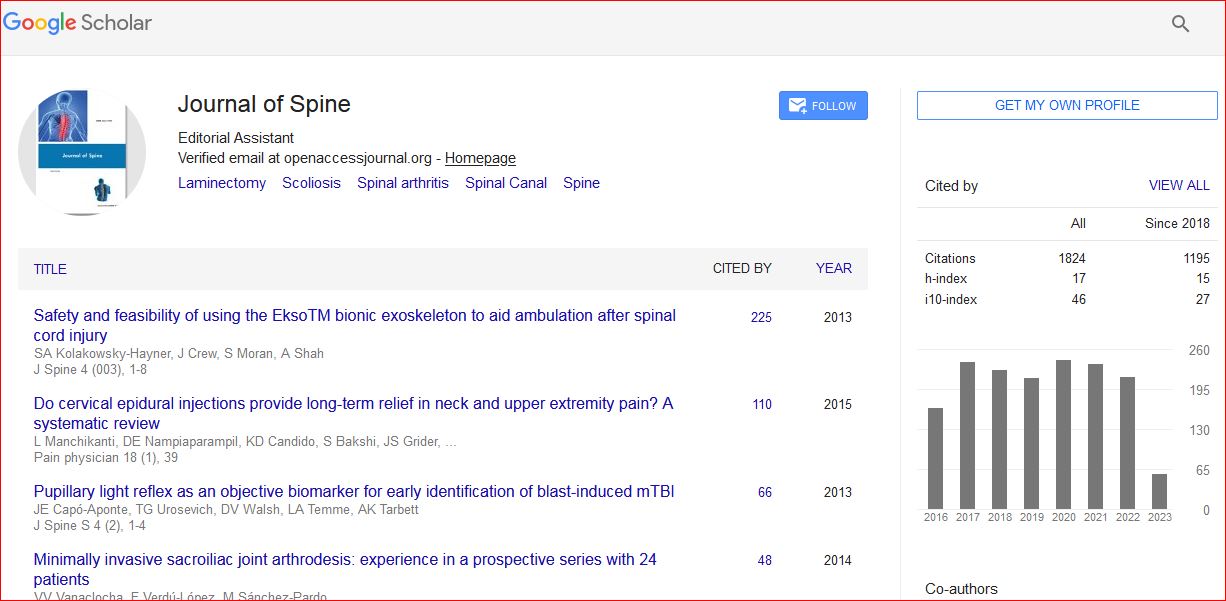
Journal of Spine received 2022 citations as per Google Scholar report