Perspective - (2025) Volume 14, Issue 3
Received: 02-Jun-2025, Manuscript No. jsp-26-182255;
Editor assigned: 04-Jun-2025, Pre QC No. P-182255;
Reviewed: 18-Jun-2025, QC No. Q-182255;
Revised: 23-Jun-2025, Manuscript No. R-182255;
Published:
30-Jun-2025
, DOI: 10.37421/2165-7939.2025.14.725
Citation: Ivanova, Natalia V.. ”Spinal Neuropathic Pain: Mechanisms, Challenges, and Future Therapies.” J Spine 14 (2025):725.
Copyright: © 2025 Ivanova V. Natalia This is an open-access article distributed under the terms of the Creative Commons Attribution License, which permits unrestricted use, distribution and reproduction in any medium, provided the original author and source are credited.
Neuropathic pain arising from spinal pathologies is a complex and debilitating condition that significantly impacts patient quality of life. This review aims to provide a comprehensive overview of the multifaceted nature of this pain, exploring its underlying mechanisms, diagnostic challenges, and therapeutic strategies. The initial exploration delves into the intricate mechanisms of neuropathic pain associated with lumbar spinal stenosis, detailing nerve root compression, inflammation, and central sensitization that contribute to persistent pain, and emphasizing the importance of accurate assessment for differentiation from other pain types, with a review of pharmacological, interventional, and rehabilitative approaches highlighting a multimodal and individualized treatment plan. [1] Further research focuses on the neurobiological underpinnings of neuropathic pain triggered by degenerative disc disease and vertebral fractures within the spine. This investigation discusses the roles of specific ion channels, growth factors, and glial cells in pain transmission and modulation, underscoring limitations of current treatments and pointing towards future research directions such as gene therapy and novel neuromodulatory techniques for managing this complex pain condition. [2] A consolidated understanding of neuropathic pain associated with intervertebral disc degeneration is presented, elaborating on mechanisms involving inflammatory mediators and neuropeptides released from degenerated discs that sensitize nerve endings and dorsal root ganglia. The paper also discusses clinical manifestations and management strategies, emphasizing the integration of pharmacological agents and minimally invasive procedures. [3] The diagnostic approach to neuropathic pain in patients with spinal cord injury is outlined, covering prevalence, characteristic symptoms, and contributing factors. A comprehensive overview of diagnostic tools, including neurological examination and patient-reported outcomes, is provided, alongside a discussion of the current treatment landscape encompassing pharmacotherapy, neuromodulation techniques, and psychological support. [4] Facet joint arthropathy is examined as a distinct source of neuropathic pain in the lumbar spine. The review explores the inflammatory cascade originating from degenerated facet joints and its impact on surrounding neural structures, discussing conservative and interventional treatment options such as intra-articular injections and radiofrequency ablation to target pain originating from these joints. [5] A comprehensive review addresses neuropathic pain linked to spinal tumors, including primary bone tumors and metastatic lesions. It details pain generation mechanisms like direct nerve compression, infiltration, and paraneoplastic syndromes, and discusses diagnostic and management challenges, stressing the need for a multidisciplinary approach involving oncologists, pain specialists, and surgeons for optimal outcomes. [6] Central sensitization in post-surgical neuropathic pain is investigated, explaining how inflammatory mediators and altered neuronal excitability in the central nervous system contribute to hyperalgesia and allodynia. Strategies to mitigate central sensitization, including optimizing perioperative pain management and utilizing specific pharmacological agents, are discussed. [7] Neuroinflammatory processes involved in neuropathic pain caused by spondylolisthesis are examined, focusing on the release of pro-inflammatory cytokines and chemokines from injured and degenerated spinal structures that contribute to nerve root irritation and sensitization. Emerging therapeutic targets that modulate neuroinflammation to alleviate pain in this patient population are also discussed. [8] Genetic and epigenetic factors that may predispose individuals to developing neuropathic pain associated with spinal disc herniation are explored. The study examines how variations in genes involved in pain signaling pathways and inflammatory responses can influence pain perception and chronicity, suggesting that understanding these factors could lead to personalized treatment approaches. [9] Finally, the efficacy of various neuromodulation techniques, including spinal cord stimulation and peripheral nerve stimulation, for treating refractory neuropathic pain secondary to spinal pathologies is reviewed. Patient selection criteria, optimal stimulation parameters, and potential complications are discussed, concluding that neuromodulation offers a valuable option for patients inadequately responding to conventional treatments. [10]
The multifaceted nature of neuropathic pain arising from spinal pathologies is thoroughly explored, beginning with an examination of lumbar spinal stenosis. This condition involves nerve root compression, inflammation, and central sensitization, which collectively lead to persistent pain. Differentiating this specific type of pain from others is crucial, and a multimodal, individualized treatment approach encompassing pharmacological, interventional, and rehabilitative strategies is highlighted. [1] Delving deeper into spinal neuropathic pain, research investigates the neurobiological basis of pain triggered by degenerative disc disease and vertebral fractures. The study emphasizes the roles of specific ion channels, growth factors, and glial cells in pain transmission and modulation, while also acknowledging the limitations of current treatments and proposing future research avenues, including gene therapy and novel neuromodulatory techniques. [2] A review consolidates the current understanding of neuropathic pain linked to intervertebral disc degeneration. It elaborates on the mechanisms by which inflammatory mediators and neuropeptides released from degenerated discs sensitize nerve endings and dorsal root ganglia, alongside a discussion of clinical presentations and management, advocating for an integrated approach using pharmacological agents and minimally invasive procedures. [3] In the context of spinal cord injury, the diagnostic approach to neuropathic pain is detailed. This includes an assessment of prevalence, characteristic symptoms, and contributing factors, supported by a comprehensive overview of diagnostic tools such as neurological examination and patient-reported outcomes. The current treatment landscape, encompassing pharmacotherapy, neuromodulation, and psychological support, is also discussed. [4] Facet joint arthropathy is identified as a specific source of neuropathic pain within the lumbar spine. The article scrutinizes the inflammatory cascade originating from degenerated facet joints and its detrimental effects on adjacent neural structures, reviewing both conservative and interventional treatment modalities, including intra-articular injections and radiofrequency ablation. [5] A broad review addresses neuropathic pain associated with spinal tumors, encompassing primary bone tumors and metastatic lesions. It elaborates on the mechanisms of pain generation, such as direct nerve compression, infiltration, and paraneoplastic syndromes, and highlights the diagnostic and management complexities, underscoring the importance of a multidisciplinary approach for optimal patient care. [6] Central sensitization as a contributor to post-surgical neuropathic pain is investigated. The review explains how inflammatory mediators and heightened neuronal excitability within the central nervous system lead to hyperalgesia and allodynia, discussing strategies aimed at mitigating central sensitization through optimized perioperative pain management and targeted pharmacological interventions. [7] Neuroinflammation's role in neuropathic pain stemming from spondylolisthesis is examined. The discussion centers on the release of pro-inflammatory cytokines and chemokines from compromised spinal structures, which provoke nerve root irritation and sensitization, and explores novel therapeutic targets designed to modulate neuroinflammation for pain relief. [8] Genetic and epigenetic factors potentially predisposing individuals to neuropathic pain associated with spinal disc herniation are explored. The research investigates how genetic variations within pain signaling pathways and inflammatory responses influence pain perception and its chronicity, suggesting that a deeper understanding of these factors could pave the way for personalized treatment strategies. [9] Lastly, the efficacy of various neuromodulation techniques, such as spinal cord stimulation and peripheral nerve stimulation, for managing refractory neuropathic pain secondary to spinal conditions is systematically reviewed. Key aspects covered include patient selection, optimal stimulation parameters, and potential complications, concluding that neuromodulation represents a vital therapeutic option for patients who do not achieve adequate relief with conventional treatments. [10]
Neuropathic pain originating from spinal conditions is a significant clinical challenge. Studies explore its diverse mechanisms, including nerve compression, inflammation, central sensitization, and contributions from specific spinal pathologies like spinal stenosis, degenerative disc disease, vertebral fractures, facet joint arthropathy, spinal cord injury, spinal tumors, and spondylolisthesis. Diagnostic difficulties are common, necessitating accurate assessment. Current management strategies involve a combination of pharmacological treatments, interventional procedures, rehabilitative therapies, neuromodulation techniques, and psychological support. Emerging research is investigating genetic and epigenetic factors, as well as novel neuromodulatory and anti-inflammatory approaches, to improve treatment efficacy and personalize care for affected individuals.
None
None
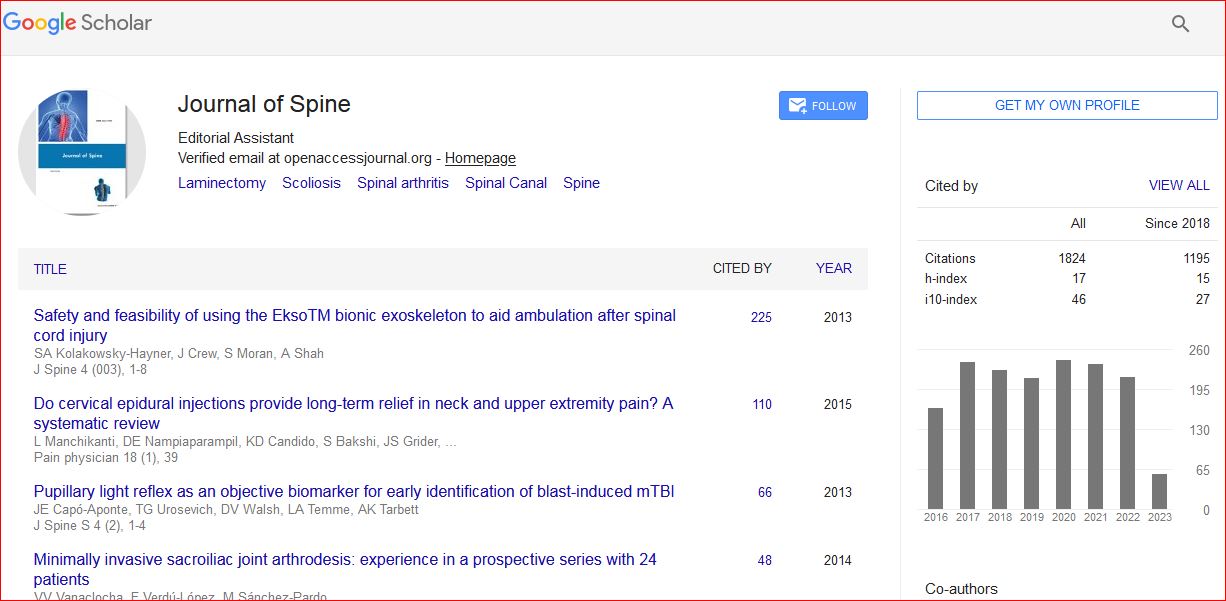
Journal of Spine received 2022 citations as per Google Scholar report