Perspective - (2025) Volume 14, Issue 5
Received: 02-Oct-2025, Manuscript No. jsp-26-182277;
Editor assigned: 06-Oct-2025, Pre QC No. P-182277;
Reviewed: 20-Oct-2025, QC No. Q-182277;
Revised: 23-Oct-2025, Manuscript No. R-182277;
Published:
30-Oct-2025
, DOI: 10.37421/2165-7939.2025.14.745
Citation: Hassan, Mohamed Z.. ”Spinal Instability: Assessment, Biomechanics, and Management.” J Spine 14 (2025):745.
Copyright: © 2025 Hassan Z. Mohamed This is an open-access article distributed under the terms of the Creative Commons Attribution License, which permits unrestricted use, distribution and reproduction in any medium, provided the original author and source are credited.
The clinical assessment of spinal stability and instability is a paramount concern for orthopedic spine specialists, demanding a comprehensive and systematic approach to ensure accurate diagnosis and effective management. This involves a meticulous evaluation of the patient's history and physical examination, which are foundational to identifying potential biomechanical derangements [1].
The importance of a thorough history cannot be overstated, as it can reveal patterns of pain, exacerbating factors, and neurological symptoms that hint at underlying instability. These subjective findings are then systematically explored and validated through objective physical examination maneuvers [4].
Understanding spinal instability requires recognizing it not merely as a radiographic finding but as a functional problem that manifests as pain and potential neurological compromise. A multitude of factors can contribute to this instability, ranging from degenerative processes inherent to aging to acute traumatic injuries and even iatrogenic causes resulting from surgical interventions [2].
The interplay between these etiologies and the spine's structural integrity forms the basis of clinical suspicion and guides further diagnostic steps. Differentiating between true instability and other sources of back pain necessitates a structured approach [2].
The biomechanical principles that govern spinal stability are complex, involving the intricate interplay of bony structures, intervertebral discs, facet joints, and the surrounding ligamentous complex. A disruption in any of these components can compromise the spine's ability to withstand physiological loads, leading to instability. Clinical assessment aims to identify the manifestations of this biomechanical failure, which can present as pain with specific movements, palpable instability, or neurological deficits [3].
Specific physical examination techniques are crucial for eliciting signs of spinal instability. Maneuvers such as palpation for muscle spasm, assessment of range of motion, and the performance of specific provocative tests can help identify segments that are excessively mobile or painful during movement. A detailed neurological examination is also indispensable to assess for nerve root compression or spinal cord involvement [4].
While static imaging modalities like conventional X-rays provide a baseline assessment, they may not always reveal subtle forms of instability. Dynamic radiographic assessments, which involve imaging the spine in various positions of flexion and extension, can highlight abnormal segmental motion that is not apparent on static views. This technique is particularly valuable for identifying ligamentous injuries or facet joint subluxation [5].
The elderly population presents unique challenges in the assessment of spinal instability. Degenerative changes are prevalent, and conditions such as osteoporosis and spondylolisthesis can predispose individuals to instability. Clinical evaluations in this demographic require modifications to account for comorbidities and the potential for atypical presentations, emphasizing a judicious use of diagnostic tools [6].
Classification systems play a vital role in standardizing the description and understanding of spinal instability. These systems, often based on biomechanical principles, help clinicians categorize the type and severity of instability, facilitating consistent communication and guiding treatment planning. Understanding these classifications is essential for predicting instability patterns and selecting appropriate interventions [7].
Provocative tests are specifically designed to stress spinal segments and reproduce symptoms suggestive of instability. These maneuvers, when performed correctly and interpreted in conjunction with other clinical findings, can enhance diagnostic accuracy. The sensitivity and specificity of these tests are important considerations, and their application should be integrated with a comprehensive evaluation [8].
Spinal instability can have significant neurological consequences, including nerve root compression and spinal cord impingement, leading to symptoms of radiculopathy or myelopathy. A thorough neurological examination is critical for assessing the extent and location of these deficits. Early recognition and intervention are crucial to prevent permanent neurological damage [9].
Despite advancements, challenges remain in the precise quantification and diagnosis of spinal instability. Emerging technologies, including advanced imaging techniques and biomechanical modeling, offer promising avenues for improving diagnostic accuracy and providing more objective measures of spinal function. These innovations aim to enhance the clinician's ability to precisely identify and quantify instability, leading to more tailored treatment strategies [10].
The clinical evaluation of spinal stability and instability requires a multifaceted approach, beginning with a thorough history and physical examination to identify potential underlying issues. Orthopedic spine specialists must systematically gather information regarding the patient's symptoms, including the nature of pain, aggravating and alleviating factors, and any neurological complaints. This detailed history serves as the initial step in formulating a differential diagnosis and guiding the subsequent physical assessment [1].
The physical examination then aims to objectively assess the spineâ??s integrity and function. Specific maneuvers are employed to evaluate ligamentous integrity, assess muscle strength and reflexes, and identify any palpable abnormalities or signs of nerve root irritation [4].
It is crucial to recognize that spinal instability is fundamentally a functional problem that can manifest as pain and neurological compromise, rather than solely a radiographic diagnosis. Various etiologies can contribute to this instability, encompassing degenerative changes associated with aging, acute trauma, and iatrogenic factors arising from previous medical interventions. A structured clinical evaluation is paramount for identifying patients who might benefit from surgical or conservative management strategies [2].
The underlying biomechanical framework of the spine is central to understanding stability and instability. This framework involves the coordinated function of bony elements, intervertebral discs, facet joints, and the surrounding ligamentous structures. When these components are compromised, the spineâ??s ability to maintain its structural integrity under physiological stress is diminished, leading to instability. Clinical assessment aims to detect the signs and symptoms arising from this biomechanical compromise [3].
Dedicated physical examination techniques are instrumental in diagnosing spinal instability. These techniques include assessing the range of motion, evaluating motor and sensory deficits, and performing specific provocative maneuvers designed to elicit pain or abnormal movement. A systematic approach to these examinations ensures that all relevant aspects of spinal function are evaluated [4].
While conventional radiographic imaging is a standard component of spinal assessment, its limitations in detecting subtle instability are well-recognized. Dynamic radiographic views, such as flexion-extension X-rays, offer a more sensitive method for identifying abnormal segmental motion, ligamentous laxity, and facet joint subluxation, thereby complementing static imaging [5].
The assessment of spinal instability in the geriatric population presents unique considerations. Degenerative conditions are common, and factors like osteoporosis and spondylolisthesis can increase the risk of instability. Clinicians must adapt their assessment strategies to account for comorbidities and potential atypical presentations, employing imaging judiciously and considering conservative management options [6].
Classification systems are essential tools for standardizing the description and understanding of spinal instability. These systems provide a common language for clinicians, aiding in consistent communication and the development of targeted treatment plans. Familiarity with these classifications assists in predicting the biomechanical behavior of an unstable spine [7].
Provocative tests are specifically designed to stress particular spinal segments and reproduce symptoms indicative of instability. The appropriate application and interpretation of these tests, considering their sensitivity and specificity, are vital for enhancing diagnostic accuracy. These maneuvers are best utilized in conjunction with other clinical and radiographic findings [8].
Spinal instability can have profound implications for neurological function. Compression of nerve roots or the spinal cord can lead to radiculopathy or myelopathy, respectively. A comprehensive neurological examination is critical for identifying and quantifying these deficits, and for correlating them with the extent and location of the underlying instability [9].
Ongoing advancements in the clinical assessment of spinal instability are continually refining diagnostic capabilities. Emerging technologies, including sophisticated imaging techniques and biomechanical modeling, promise to provide more objective and precise measures of spinal function. These innovations aim to improve the accurate identification and quantification of instability, ultimately leading to more effective patient management strategies [10].
Spinal instability is a functional problem characterized by pain and potential neurological compromise, necessitating a comprehensive clinical assessment. This involves a detailed history, systematic physical examination including specific maneuvers, and the judicious use of imaging modalities. Biomechanical principles underpin spinal stability, and their disruption leads to instability. Dynamic imaging and provocative tests enhance diagnostic accuracy. Specific considerations apply to the geriatric population. Classification systems aid in standardization, while neurological assessment is crucial for identifying deficits. Advancements in technology are improving the objective measurement of instability. The goal is to precisely identify and quantify instability to guide effective treatment strategies.
None
None
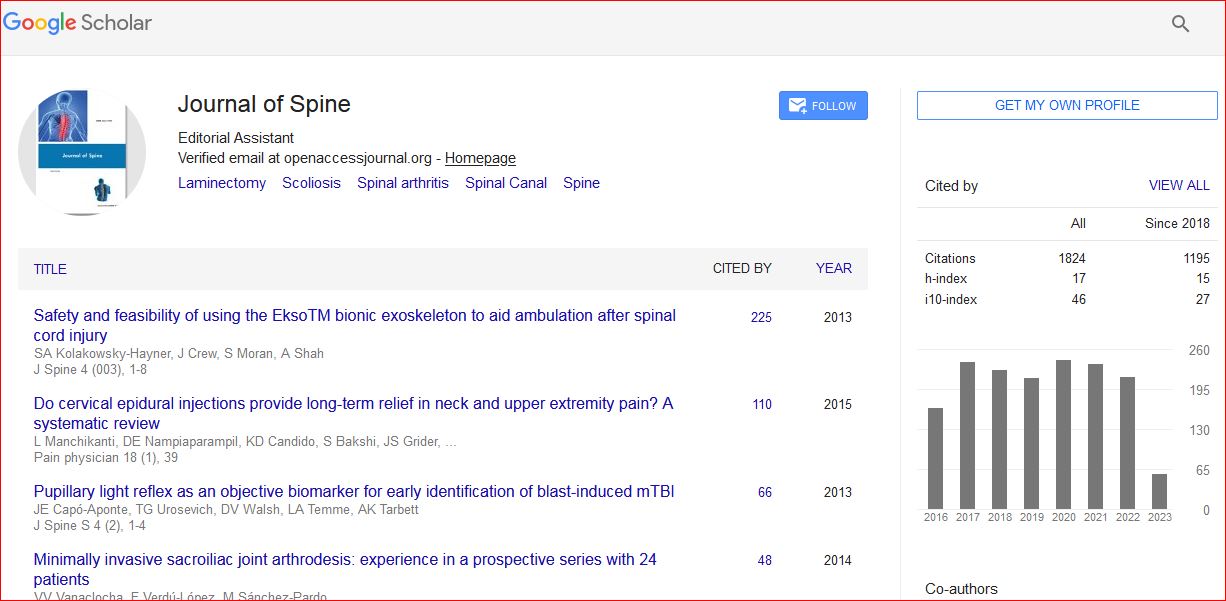
Journal of Spine received 2022 citations as per Google Scholar report