Opinion - (2025) Volume 13, Issue 3
Received: 01-May-2025, Manuscript No. economics-26-186049;
Editor assigned: 05-May-2025, Pre QC No. P-186049;
Reviewed: 19-May-2025, QC No. Q-186049;
Revised: 22-May-2025, Manuscript No. R-186049;
Published:
29-May-2025
, DOI: 10.37421/2375-4389.2025.13.525
Citation: Berger, Matthias. ”Sovereign Debt Challenges: Navigating
21st Century Risks.” J Glob Econ 13 (2025):525.
Copyright: © 2025 Berger M. This is an open-access article distributed under the terms of the Creative Commons Attribution License, which permits unrestricted use,
distribution and reproduction in any medium, provided the original author and source are credited.
The intricate relationship between debt sustainability and sovereign risk is a paramount concern in the 21st century, amplified by escalating global debt levels and deeply interconnected financial markets. These factors collectively heighten vulnerabilities for nations seeking to maintain economic stability while servicing their obligations [1].
The evolving landscape of sovereign debt crises reveals a significant shift from historically prominent banking crises to more multifaceted and persistent debt sustainability challenges. Understanding the drivers of sovereign default in recent decades is crucial for navigating current and future financial distress [2].
High levels of public debt present a tangible threat to economic growth, demonstrably leading to reduced investment, diminished productivity, and an increased probability of fiscal instability. A prudent approach to debt accumulation is therefore indispensable for long-term economic prosperity and financial resilience [3].
In the realm of sovereign debt, the effectiveness of restructuring mechanisms remains a critical area of study. Analyzing various approaches and their success in facilitating orderly debt workouts is essential for balancing the interests of debtors and creditors in a global context [4].
The influence of global monetary policy shifts on sovereign debt sustainability, particularly for emerging economies, cannot be overstated. Changes in interest rates and quantitative easing in major economies have profound effects on capital flows, exchange rates, and borrowing costs for developing countries [5].
Beyond economic factors, the role of institutions and governance in shaping sovereign risk and debt sustainability is increasingly recognized. Strong institutional frameworks, characterized by transparency and effective rule of law, foster lower borrowing costs and enhanced debt management capacity [6].
The pervasive threat of climate change introduces a novel dimension to sovereign debt sustainability and risk. Physical and transition risks associated with climate change can significantly impact a nation's fiscal position and increase contingent liabilities, leading to higher borrowing costs [7].
Financial technology, or FinTech, is poised to reshape sovereign debt markets and risk profiles. Innovations in payment systems, digital currencies, and crowdfunding platforms offer potential benefits such as increased financial inclusion, but also present new avenues for systemic vulnerabilities and illicit finance [8].
Geopolitical risk has emerged as a significant determinant of sovereign debt sustainability and financial market stability. International conflicts, political instability, and trade tensions can adversely affect investor sentiment, capital flows, and a country's access to international capital markets [9].
International financial institutions (IFIs) play a vital role in promoting debt sustainability and managing sovereign risk by providing policy advice, financial assistance, and debt restructuring support. Their effectiveness in crisis prevention and resolution remains critical in the face of evolving global financial landscapes [10].
The complex interplay between debt sustainability and sovereign risk in the 21st century is profoundly influenced by increasing global debt levels and the interconnectedness of financial markets, which collectively amplify national vulnerabilities. These dynamics necessitate careful consideration of macroeconomic shocks, fiscal policy decisions, and the existing international financial architecture when assessing a nation's capacity to service its debt without jeopardizing economic stability. Key insights underscore the imperative for prudent fiscal management, the development of effective debt restructuring mechanisms, and robust international cooperation to mitigate systemic risks [1].
The evolution of sovereign debt crises signifies a paradigm shift from traditional banking crises to more intricate debt sustainability challenges. A thorough analysis of the underlying drivers of sovereign default over recent decades, encompassing structural economic weaknesses, political instability, and contagion effects, is essential for developing effective strategies to avert or manage sovereign debt distress through timely and credible policy responses [2].
Excessive public debt levels demonstrably impede economic growth by curtailing investment, lowering productivity, and ultimately elevating the likelihood of fiscal distress. Consequently, the findings from empirical analyses strongly suggest that a judicious approach to debt accumulation is a fundamental prerequisite for achieving sustained long-term economic prosperity and maintaining financial stability [3].
The efficacy of sovereign debt restructuring mechanisms in the contemporary global financial environment warrants continuous examination. Various approaches, including exchange offers, pari passu clauses, and collective action clauses, are analyzed to assess their success in facilitating orderly debt workouts. A persistent challenge lies in establishing universally accepted and efficient restructuring frameworks that equitably balance the interests of both debtors and creditors [4].
Global monetary policy shifts exert a significant impact on sovereign debt sustainability, particularly for emerging economies. Changes in interest rates and quantitative easing policies implemented by major economies can directly influence capital flows, exchange rates, and borrowing costs for developing countries, thereby affecting their capacity to service debt and their overall sovereign risk profiles. This necessitates careful calibration of domestic policies in response to prevailing global financial conditions [5].
The intricate relationship between institutional quality, governance, and sovereign risk and debt sustainability is a critical area of research. Strong institutional frameworks, characterized by high levels of transparency and the effective enforcement of the rule of law, are found to contribute to lower borrowing costs and enhanced debt management capabilities. Conversely, inadequate governance and prevalent corruption can exacerbate fiscal vulnerabilities and increase the probability of sovereign default [6].
Climate change presents a new and significant frontier for sovereign debt sustainability and risk assessment. Both physical risks, such as extreme weather events, and transition risks, associated with the shift to a low-carbon economy, can negatively impact a nation's fiscal position, increase contingent liabilities, and lead to elevated borrowing costs. Therefore, integrating climate considerations into fiscal planning and debt management strategies is paramount [7].
Financial technology (FinTech) is increasingly influencing sovereign debt markets and associated risks. Innovations in areas such as payment systems, digital currencies, and crowdfunding platforms have the potential to alter debt issuance, management practices, and investor behavior. While FinTech offers benefits like enhanced financial inclusion, it also introduces risks, including new avenues for illicit finance and the potential for novel systemic vulnerabilities [8].
Geopolitical risk has emerged as a crucial factor influencing sovereign debt sustainability and the stability of financial markets. International conflicts, political instability, and trade tensions can significantly affect investor sentiment, disrupt capital flows, and constrain a country's access to international capital markets, thereby directly impacting its sovereign risk profile. The growing importance of geopolitical factors in assessing debt vulnerabilities cannot be understated [9].
International financial institutions (IFIs) play a pivotal role in fostering debt sustainability and managing sovereign risk through policy advice, financial assistance, and support for debt restructuring. The effectiveness of IFIs such as the IMF and World Bank in crisis prevention and resolution is well-established, though challenges remain in adapting their mandates to the evolving complexities of the global financial landscape and ensuring their interventions are optimally suited to diverse national contexts [10].
This collection of research explores the multifaceted challenges of sovereign debt sustainability and sovereign risk in the 21st century. It highlights the impact of global economic conditions, including rising debt levels and interconnected financial markets, on national vulnerabilities. The studies delve into the drivers of sovereign debt crises, the detrimental effects of high public debt on economic growth, and the effectiveness of debt restructuring mechanisms. Furthermore, the influence of global monetary policy shifts, institutional quality, climate change, financial technology, geopolitical risks, and the role of international financial institutions are examined. The overarching theme emphasizes the need for prudent fiscal management, robust governance, international cooperation, and adaptive strategies to ensure long-term economic stability and financial resilience.
None
None
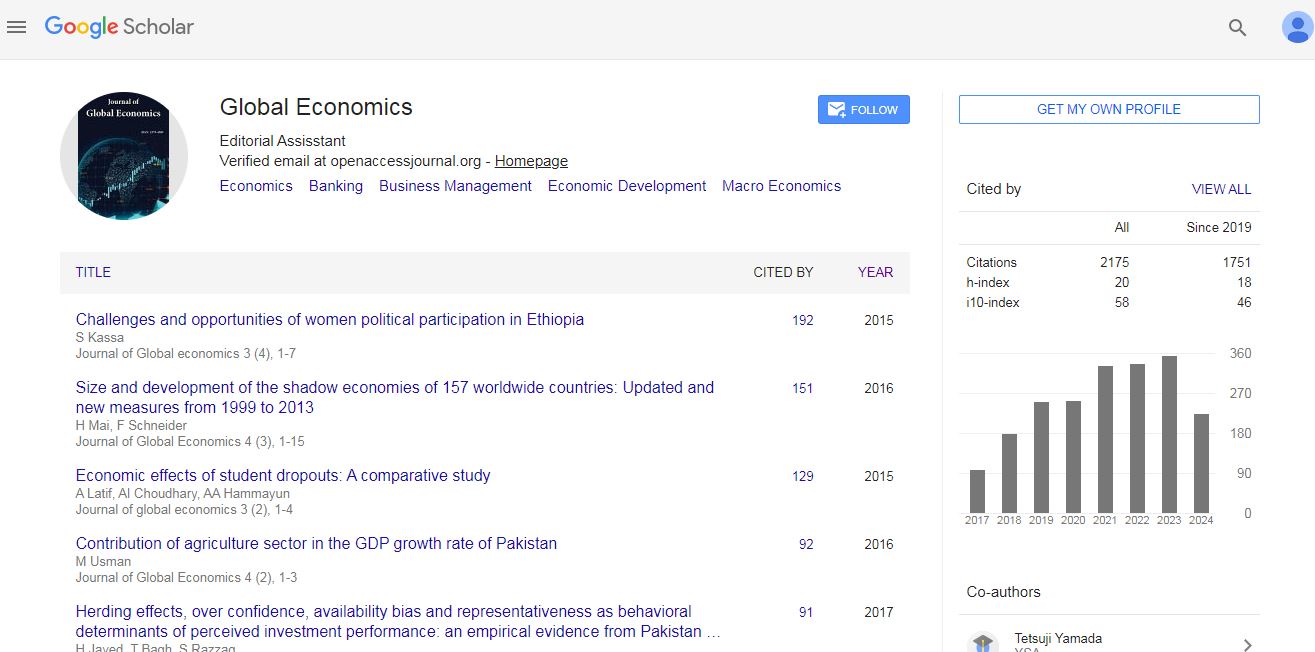
Journal of Global Economics received 2175 citations as per Google Scholar report