Short Communication - (2025) Volume 12, Issue 5
Received: 01-Oct-2025, Manuscript No. jreac-26-185833;
Editor assigned: 03-Oct-2025, Pre QC No. P-185833;
Reviewed: 17-Oct-2025, QC No. Q-185833;
Revised: 22-Oct-2025, Manuscript No. R-185833;
Published:
29-Oct-2025
, DOI: 10.37421/2380-2391.2025.12.448
Citation: Lindberg, Sofia. ”SERS: Powerful Tool For Environmental Monitoring.” J Environ Anal Chem 12 (2025):448.
Copyright: © 2025 Lindberg S. This is an open-access article distributed under the terms of the Creative Commons Attribution License, which permits unrestricted use,
distribution and reproduction in any medium, provided the original author and source are credited.
Surface-Enhanced Raman Spectroscopy (SERS) has emerged as a highly sensitive technique for the detection of trace environmental contaminants, offering unparalleled capabilities in real-time monitoring of diverse pollutants such as heavy metals, pesticides, and emerging contaminants in both water and air matrices. Its remarkable sensitivity is attributed to the plasmonic interactions between analyte molecules and nanostructured substrates, which significantly amplify weak Raman signals, enabling detection limits in the parts-per-billion or even parts-per-trillion range, thereby facilitating rapid and on-site environmental assessment [1].
The continuous advancement in SERS technology hinges on the development of novel and highly efficient substrates. Significant research efforts have been directed towards the synthesis and characterization of composite materials, such as silver-nanoparticle-decorated graphene oxide, which exhibit synergistic effects leading to substantially improved SERS enhancement factors. These innovative substrates hold great promise for practical field applications in the sensitive detection of pesticide residues and other organic pollutants [2].
Emerging contaminants, encompassing a wide array of substances like pharmaceuticals and personal care products, represent a growing concern for water quality worldwide. SERS-based approaches are being developed for the rapid and selective detection of these recalcitrant pollutants in wastewater. By employing specifically tailored plasmonic nanostructures and advanced chemometric analysis, these methods achieve high sensitivity and specificity, allowing for the simultaneous identification and quantification of multiple contaminants [3].
The practical utility of SERS in environmental monitoring is significantly enhanced by the portability and miniaturization of SERS systems. The development of integrated devices, such as smartphone-based SERS systems coupled with microfluidic chips, is crucial for on-site detection capabilities. These portable solutions offer a cost-effective and user-friendly platform for the rapid assessment of environmental pollutants, including heavy metal ions in river water [4].
A deep understanding of the intricate interactions between SERS substrates and target analytes is paramount for optimizing detection performance and achieving desired sensitivity and selectivity. Systematic investigations into the influence of substrate morphology and chemical functionalization are vital for tailoring SERS platforms for specific analytes. This is particularly important for the sensitive and selective detection of volatile organic compounds (VOCs) relevant to air quality monitoring [5].
The integration of microfluidic technologies with SERS detection platforms offers precise control over sample handling and analyte-substrate interactions, leading to enhanced detection reliability and reproducibility. Microfluidic SERS chips, often incorporating advanced plasmonic nanomaterials like gold nanostars, are being developed for the simultaneous detection of multiple targets, such as foodborne pathogens, enabling rapid and sensitive identification of microbial contaminants [6].
Ensuring the stability and reusability of SERS substrates is a critical factor for their widespread adoption in routine environmental monitoring. Research into novel substrate designs, such as those utilizing metal-organic frameworks (MOFs) as templating agents, is yielding substrates with enhanced stability and the capacity for multiple detections of pollutants. The robust structural integrity provided by MOFs supports plasmonic nanoparticles, leading to improved substrate durability and consistent performance over repeated uses [7].
The power of SERS can be further amplified by integrating it with other established analytical techniques, providing complementary information and enhancing the overall analytical performance. Hyphenated techniques, such as SERS coupled with Gas Chromatography-Mass Spectrometry (GC-MS), offer a comprehensive approach for the analysis of complex environmental matrices like petroleum-contaminated soil, enabling highly sensitive and selective identification and quantification of a broad spectrum of organic pollutants [8].
The application of SERS for the detection of airborne microplastics is an emerging yet crucial area of research, given the pervasive environmental impact of these ubiquitous pollutants. Developing SERS-based methods for identifying and quantifying microplastic particles directly in ambient air leverages the unique spectral fingerprints of different polymer types, allowing for their sensitive detection and differentiation at low concentrations [9].
Monitoring pharmaceutical residues in water bodies is of paramount importance due to their potential ecotoxicological effects on aquatic ecosystems. The development of highly sensitive SERS substrates specifically designed for the detection of antibiotics and other pharmaceutical residues in surface water is an active area of research. This work underscores the critical role of substrate design and surface modification in achieving low detection limits and good selectivity, thereby contributing significantly to effective water quality management strategies [10].
Surface-Enhanced Raman Spectroscopy (SERS) represents a significant advancement in analytical chemistry, particularly for its application in environmental monitoring due to its exceptional sensitivity in detecting trace pollutants. The fundamental principle involves the amplification of Raman scattering signals from analyte molecules adsorbed onto or in close proximity to nanostructured metallic surfaces, primarily gold and silver. This plasmonic enhancement allows for detection limits that are orders of magnitude lower than conventional Raman spectroscopy, making it suitable for identifying contaminants present at very low concentrations in water and air. The ability to perform real-time, on-site analyses further enhances its utility for rapid environmental assessment and emergency response scenarios [1].
The efficacy of SERS in environmental applications is intrinsically linked to the design and performance of the SERS substrates. Researchers are actively exploring composite materials that leverage synergistic effects to maximize signal enhancement. For instance, the combination of noble metal nanoparticles with high-surface-area materials like graphene oxide has proven effective. This approach not only enhances the SERS signal but also provides a stable and versatile platform for immobilizing analytes, crucial for the sensitive detection of pesticide residues and other organic contaminants in environmental samples [2].
Addressing the challenge of emerging contaminants, which include a vast and growing number of synthetic chemicals like pharmaceuticals and personal care products, requires sophisticated analytical tools. SERS is emerging as a powerful technique for this purpose, enabling the detection of these compounds even at trace levels in complex matrices such as wastewater. By employing advanced substrate designs, such as precisely engineered plasmonic nanostructures, and sophisticated data analysis techniques like chemometrics, researchers can achieve both high sensitivity and selectivity, facilitating the identification of multiple emerging pollutants simultaneously [3].
The transition of SERS from laboratory settings to practical field applications necessitates the development of portable and user-friendly instrumentation. The integration of SERS technology with portable devices, including smartphones, represents a significant step towards democratizing environmental monitoring. These smartphone-based SERS systems, often incorporating microfluidic components for sample handling, provide a cost-effective and accessible means for on-site detection of various environmental pollutants, such as heavy metal ions, directly in the field [4].
Optimizing the performance of SERS substrates requires a thorough understanding of the underlying plasmonic and chemical interactions. Investigating how substrate morphology, such as the size, shape, and arrangement of nanoparticles, and surface functionalization influence the SERS signal is crucial for enhancing detection capabilities. This knowledge is particularly important for targeting specific analytes, such as volatile organic compounds (VOCs) in air, enabling the development of highly sensitive and selective sensors for air quality monitoring [5].
Microfluidic platforms have become indispensable tools in modern analytical chemistry, offering precise control over fluid dynamics and reaction conditions. When integrated with SERS, microfluidics enables efficient sample concentration, analyte-substrate interaction, and multiplexed detection. These microfluidic SERS devices are being developed for the rapid and sensitive identification of a wide range of targets, including biological contaminants like foodborne pathogens, by utilizing advanced plasmonic nanomaterials with tailored optical properties [6].
For SERS to be widely adopted in environmental monitoring, the substrates must exhibit long-term stability and reusability. Strategies to improve substrate durability include the development of robust composite materials. For example, the use of metal-organic frameworks (MOFs) as structural templates for plasmonic nanoparticles has shown promise in creating SERS substrates with enhanced stability and the ability to withstand multiple detection cycles, making them more suitable for routine environmental analysis [7].
The analytical power of SERS can be significantly extended through hyphenation with other separation and detection techniques. Combining SERS with chromatographic methods, such as Gas Chromatography (GC) or Liquid Chromatography (LC), and mass spectrometry (MS) provides a powerful platform for the comprehensive analysis of complex environmental samples. This hyphenated approach allows for both the separation of mixture components and their highly sensitive and selective identification and quantification, as demonstrated in the analysis of organic pollutants in contaminated soil [8].
The increasing concern over microplastic pollution has spurred the development of novel detection methods. SERS offers a unique advantage for identifying and quantifying microplastic particles in various environmental compartments, including ambient air. By exploiting the distinct spectral signatures of different polymer types, SERS can provide a rapid and sensitive means for characterizing airborne microplastics, contributing to a better understanding of their sources, transport, and environmental impact [9].
Pharmaceuticals and their metabolites are increasingly detected in aquatic environments, posing potential risks to ecosystems and human health. SERS-based methods are being developed to address this challenge by creating highly sensitive substrates capable of detecting these compounds at environmentally relevant concentrations in surface water. The focus on substrate design and surface modification is key to achieving the low detection limits and high selectivity required for effective monitoring and management of water quality [10].
Surface-Enhanced Raman Spectroscopy (SERS) is a highly sensitive technique for detecting trace environmental contaminants in water and air, offering real-time monitoring capabilities. Advancements in SERS substrates, such as silver-nanoparticle-decorated graphene oxide, enhance detection of pollutants like pesticides. SERS is also effective for identifying emerging contaminants like pharmaceuticals in wastewater and for on-site detection of heavy metals using portable smartphone-based devices. Understanding substrate-analyte interactions is crucial for optimizing SERS for specific targets, including volatile organic compounds. Microfluidic SERS chips improve detection reliability, and strategies like using metal-organic frameworks enhance substrate stability and reusability. Hyphenated SERS techniques offer comprehensive analysis of complex samples, while SERS is also being applied to detect airborne microplastics and pharmaceutical residues in water bodies. Overall, SERS is a versatile and powerful tool for environmental monitoring and assessment.
None
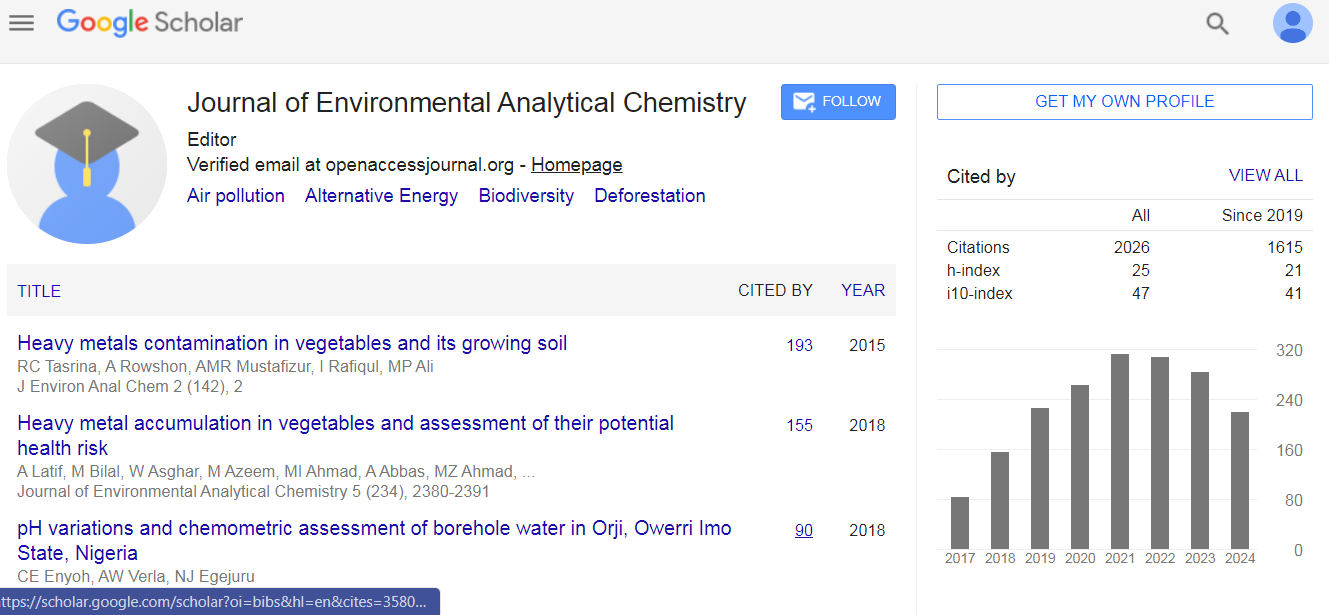
Journal of Environmental Analytical Chemistry received 1781 citations as per Google Scholar report