Perspective - (2025) Volume 14, Issue 5
Received: 01-Sep-2025, Manuscript No. jtsm-26-179586;
Editor assigned: 03-Sep-2025, Pre QC No. P-179586;
Reviewed: 17-Sep-2025, QC No. Q-179586;
Revised: 22-Sep-2025, Manuscript No. R-179586;
Published:
29-Sep-2025
, DOI: 10.37421/2167-0919.2025.14.516
Citation: Tanaka, Hiroshi. ”Securing Modern Telecommunications: Challenges and Strategies.” J Telecommun Syst Manage 14 (2025):516.
Copyright: © 2025 Tanaka H. This is an open-access article distributed under the terms of the Creative Commons Attribution License, which permits unrestricted use,
distribution and reproduction in any medium, provided the original author and source are credited.
The telecommunications sector is undergoing a profound transformation, driven by advancements in technology and the increasing demand for connectivity. This evolution has introduced a complex array of security and privacy challenges that require careful consideration and proactive solutions. The advent of fifth-generation (5G) mobile networks, the proliferation of the Internet of Things (IoT), and the rise of edge computing have significantly expanded the attack surface and created new vulnerabilities that need to be addressed to ensure the integrity and confidentiality of telecommunications infrastructure and user data. [1] Artificial intelligence (AI) and machine learning (ML) are emerging as powerful tools for enhancing cybersecurity within telecommunications. These technologies offer the potential for sophisticated anomaly detection, real-time threat identification, and predictive analysis of cyberattacks. However, the application of AI/ML also raises privacy concerns due to the vast amounts of data involved, necessitating the development of privacy-preserving techniques to mitigate these risks. [2] The mobile telecommunications industry faces significant privacy challenges related to the collection and usage of user data. Regulations such as the General Data Protection Regulation (GDPR) impose strict requirements on operators, emphasizing the need for robust data anonymization methods and transparent data handling practices to foster user trust and ensure compliance. [3] The Internet of Things (IoT) ecosystem, increasingly integrated into telecommunications networks, presents unique security vulnerabilities. From device compromise to data interception and botnet attacks, the interconnected nature of IoT devices creates new threat vectors. Establishing secure communication protocols and robust authentication mechanisms is crucial for safeguarding this expanding network. [4] Fifth-generation (5G) networks, with their advanced features like network slicing and edge computing, introduce new security paradigms and potential attack surfaces. Managing security across distributed 5G infrastructure demands continuous monitoring and dynamic adaptation of security strategies to counter emerging threats and ensure network resilience. [5] Privacy-enhancing technologies (PETs) are vital for protecting user data in telecommunications. Techniques such as differential privacy, homomorphic encryption, and secure multi-party computation offer robust solutions for data anonymization and secure processing, although they often involve trade-offs between privacy guarantees and performance overhead. [6] Cloud-based telecommunications services introduce their own set of security considerations. Common cloud threats necessitate comprehensive strategies for securing data both at rest and in transit. This includes implementing encryption, stringent access controls, and intrusion detection systems, while also understanding the shared responsibility model inherent in cloud security. [7] The landscape of telecommunications security is also being reshaped by the advent of quantum computing. The potential of quantum algorithms to break current public-key cryptography standards poses a significant threat, driving the development and adoption of post-quantum cryptography (PQC) to secure future networks. [8] Big data analytics in telecommunications offers immense potential for insights but also presents significant privacy challenges. Extracting valuable information from massive datasets while ensuring individual privacy requires the implementation of techniques like data aggregation, k-anonymity, and l-diversity to mitigate privacy risks effectively. [9] Software-defined networking (SDN) offers flexibility and programmability in telecommunications but introduces its own set of security vulnerabilities, including controller compromise and flow manipulation. Enhancing SDN resilience requires robust security mechanisms such as distributed trust management and secure communication channels to protect the network infrastructure. [10]
The evolving telecommunications landscape, characterized by the integration of 5G, IoT, and edge computing, presents a complex tapestry of security and privacy challenges. These advancements, while offering enhanced capabilities, simultaneously expand the potential attack surface, necessitating a multi-layered approach to security. Proactive strategies, including robust data anonymization, stringent access controls, and effective threat intelligence sharing, are paramount to protecting sensitive user information and maintaining network integrity against increasingly sophisticated cyber threats. [1] Artificial intelligence (AI) and machine learning (ML) are being harnessed to bolster security within telecommunications networks. Their capabilities in anomaly detection, intrusion prevention, and predictive threat analysis offer significant advantages. However, the ethical and practical deployment of AI/ML necessitates a careful examination of privacy implications, with a focus on developing and implementing privacy-preserving techniques to manage the vast datasets involved without compromising user confidentiality. [2] Privacy preservation in mobile telecommunications is a critical concern, particularly regarding the collection and utilization of user data. Regulatory frameworks such as GDPR are shaping operational practices, compelling operators to adopt advanced data anonymization methods and champion transparency in data handling to build and maintain user trust. [3] The Internet of Things (IoT) presents a unique set of security vulnerabilities within the broader telecommunications infrastructure. Key threat vectors include device compromise, interception of data streams, and the exploitation of devices for botnet activities. Addressing these threats requires a comprehensive framework for securing IoT devices and their associated data, emphasizing secure communication protocols and strong authentication mechanisms. [4] 5G networks, with their inherent architectural complexities such as network slicing and edge computing, necessitate a reevaluation of security strategies. The distributed nature of 5G infrastructure creates new attack surfaces that demand continuous monitoring and dynamic adjustments to security protocols to ensure robust protection against evolving threats. [5] Privacy-enhancing technologies (PETs) are indispensable tools for telecommunications operators aiming to protect user data. A variety of PETs, including differential privacy, homomorphic encryption, and secure multi-party computation, are being explored and implemented. These technologies offer different levels of privacy protection, often with associated performance trade-offs that must be carefully managed. [6] Securing cloud-based telecommunications services is a growing imperative. Common cloud security threats, ranging from data breaches to service disruptions, must be addressed through comprehensive strategies. These include robust encryption for data at rest and in transit, rigorous access control policies, and effective intrusion detection systems, all within the context of a shared responsibility model. [7] The disruptive potential of quantum computing on existing telecommunications encryption standards cannot be overstated. The threat to current public-key cryptography necessitates a transition towards post-quantum cryptography (PQC). Research and development in PQC are crucial for ensuring the long-term security and confidentiality of telecommunication networks. [8] Big data analytics in telecommunications offers unprecedented opportunities for service improvement and network optimization. However, unlocking these benefits requires diligent attention to privacy. Techniques such as data aggregation, k-anonymity, and l-diversity are essential for mitigating privacy risks associated with the analysis of large datasets, ensuring that valuable insights are gained without compromising individual privacy. [9] Software-defined networking (SDN) provides a flexible and programmable infrastructure for telecommunications but introduces novel security challenges. Vulnerabilities such as controller compromise and unauthorized flow manipulation must be addressed through robust security mechanisms. The implementation of distributed trust management and secure communication channels is vital for enhancing the resilience and security of SDN environments. [10]
This collection of research papers explores the multifaceted security and privacy challenges facing modern telecommunications networks. Advancements like 5G, IoT, and edge computing introduce complex vulnerabilities that necessitate proactive, multi-layered security strategies. The application of AI and machine learning offers powerful tools for threat detection but requires careful consideration of privacy implications. Regulations like GDPR emphasize the importance of data anonymization and transparency in mobile networks. Research also delves into securing IoT ecosystems, the unique security architecture of 5G, and the role of privacy-enhancing technologies. Furthermore, the papers address cloud security for telecommunication services, the looming threat of quantum computing to current encryption, privacy-preserving big data analytics, and security challenges within software-defined networking. Collectively, these works highlight the critical need for robust, adaptive, and privacy-conscious security measures to ensure the integrity and confidentiality of telecommunications systems.
None
None
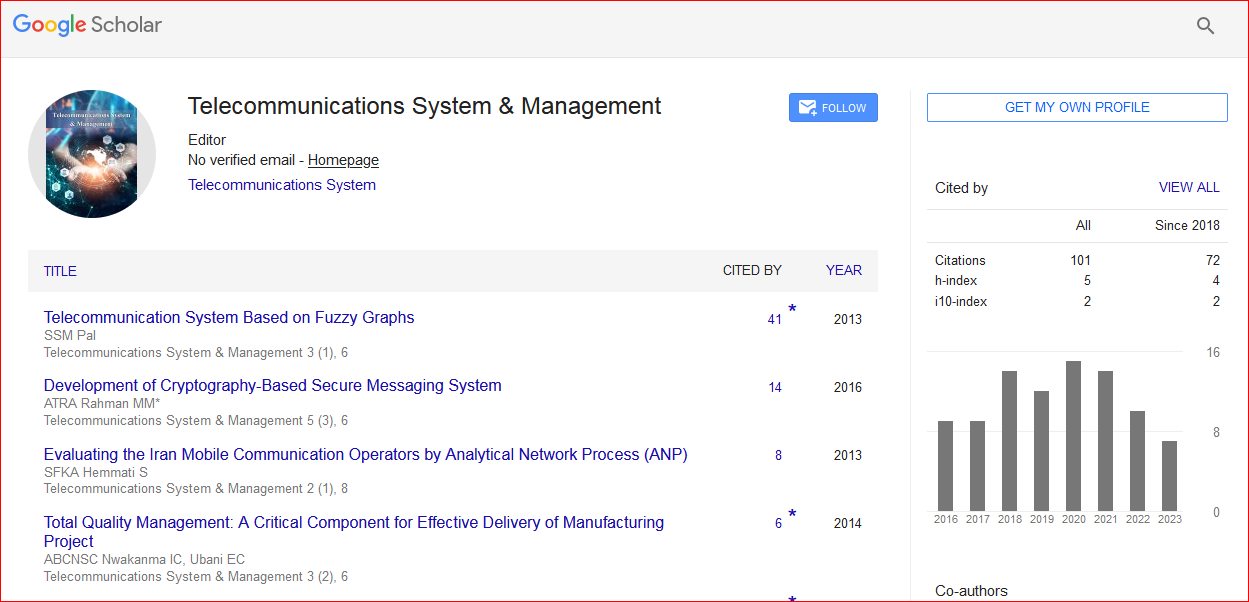
Telecommunications System & Management received 109 citations as per Google Scholar report