Brief Report - (2025) Volume 10, Issue 2
Received: 01-Apr-2025, Manuscript No. arwm-26-182703;
Editor assigned: 03-Apr-2025, Pre QC No. P-182703;
Reviewed: 17-Apr-2025, QC No. Q-182703;
Revised: 22-Apr-2025, Manuscript No. R-182703;
Published:
29-Apr-2025
Citation: Wei, Li. ”Advanced Strategies for Tackling Plastic Waste.” Advances in Recycling & Waste Management 10 (2025):393.
Copyright: © 2025 Wei L. This is an open-access article distributed under the terms of the Creative Commons Attribution License, which permits unrestricted use, distribution and reproduction in any medium, provided the original author and source are credited.
The escalating global challenge of plastic waste necessitates innovative and sustainable management strategies. Recent advancements have focused on enhancing recycling processes through technological integration and the exploration of novel degradation methods. Machine learning, when combined with advanced sorting technologies, promises to significantly improve the accuracy of plastic waste categorization, particularly for complex mixed streams. This increased sorting precision is crucial for boosting the quality and economic viability of recycled materials, overcoming limitations in current recycling infrastructure [1].
Beyond mechanical recycling, chemical recycling techniques such as pyrolysis and solvolysis are emerging as viable solutions for processing mixed plastic waste that is difficult to recycle mechanically. These advanced approaches offer a pathway to break down polymers into valuable chemical feedstocks, supporting a circular economy by transforming waste into resources [2].
The biological realm also presents promising avenues for plastic waste management, with enzymatic degradation showing significant potential, especially for specific polymers like polyethylene terephthalate (PET). Research is actively focused on discovering and engineering more efficient enzymes, though scaling up these biological processes for industrial applications remains a key challenge in achieving widespread adoption for sustainable plastic management [3].
Microplastic pollution is another critical environmental concern, and advanced oxidation processes (AOPs) are being investigated for their effectiveness in treating microplastic-contaminated wastewater. Techniques like ozonation and Fenton processes are evaluated for their ability to degrade various microplastic types, with careful consideration given to the byproducts and their potential environmental impact [4].
Mechanical recycling, the most established method, continues to evolve with a focus on improving the processing of challenging waste streams. Innovations in shredding, washing, and compounding are being developed to enhance the quality and usability of recycled materials derived from complex packaging waste, such as multilayer plastic films, thereby contributing to a more circular economy for flexible plastics [5].
Supercritical fluid technology is also being explored for its potential in plastic waste depolymerization. Utilizing supercritical water or CO2 offers a cleaner and potentially more efficient alternative to conventional chemical recycling, enabling the breakdown of polymers into valuable monomers or oligomers for a wide range of plastic types [6].
Plasma technology is another advanced method being investigated for its capacity to degrade recalcitrant plastic waste, including microplastics. Different plasma treatments are assessed for their effectiveness in breaking down plastic polymers and for their energy efficiency and scalability as recycling solutions [7].
Photocatalytic degradation presents a promising approach for environmental remediation by utilizing light irradiation to break down various plastic waste types. Research into the mechanisms, photocatalysts, and efficiency of these processes is ongoing, aiming to overcome challenges and identify opportunities for real-world implementation in plastic recycling [8].
Additive manufacturing, or 3D printing, is being explored as a method for utilizing recycled plastic waste as feedstock. The development of techniques to process recycled plastics into filaments or powders suitable for 3D printing enables the creation of new products from waste, fostering a closed-loop system for plastic reuse and waste valorization [9].
Innovations in the mechanical recycling of post-consumer plastic packaging are crucial for addressing widespread contamination and degradation issues. Advances in washing, purification, and compounding technologies are leading to the production of higher-quality recycled materials, making them suitable for more demanding applications and improving the overall sustainability of plastic packaging [10].
The integration of machine learning with advanced sorting technologies represents a significant leap forward in plastic waste management. This approach enhances the accuracy of categorizing diverse plastic types, particularly within complex mixed waste streams, which is paramount for improving the quality and economic value of recycled materials. These sophisticated sorting methods aim to overcome existing limitations in current recycling infrastructure, paving the way for more efficient resource recovery [1].
Chemical recycling techniques, including pyrolysis and solvolysis, are gaining traction as vital tools for processing mixed plastic waste that is resistant to traditional mechanical recycling. These processes decompose plastics into their constituent chemical components, offering a pathway to valuable feedstocks and promoting a circular economy by converting waste into new materials and fuels [2].
Biological recycling methods, such as enzymatic degradation, are being actively researched for their targeted breakdown of specific plastics, notably PET. Efforts are concentrated on identifying and engineering highly efficient enzymes, with the primary challenge being the successful scaling of these biological processes to industrial levels for effective and sustainable plastic management [3].
In the fight against microplastic pollution, advanced oxidation processes (AOPs) are being evaluated for their efficacy in treating contaminated wastewater. Various AOPs are assessed for their ability to degrade diverse microplastic types, with a critical focus on understanding the resulting byproducts and their potential environmental consequences [4].
Significant advancements are also being made in mechanical recycling, particularly for challenging materials like multilayer plastic films. Novel shredding, washing, and compounding techniques are being developed to improve the quality and applicability of recycled plastics derived from complex packaging waste, thereby fostering greater circularity in the flexible plastics sector [5].
Supercritical fluid technology offers a promising, environmentally benign method for the depolymerization of plastic waste. By employing supercritical water or carbon dioxide, polymers can be efficiently broken down into valuable monomers or oligomers, presenting a cleaner alternative to conventional chemical recycling pathways for a variety of plastic polymers [6].
Plasma technology is emerging as a potent technique for the degradation of challenging plastic waste, including microplastics. Research is focused on optimizing different plasma treatments to effectively break down plastic polymers and on evaluating the energy efficiency and scalability of these plasma-based recycling solutions for practical application [7].
Photocatalytic degradation is being explored as a green approach for plastic waste remediation. This method leverages light-activated catalysts to break down plastic polymers, with ongoing studies aiming to elucidate mechanisms, optimize catalyst performance, and identify viable strategies for its implementation in real-world recycling scenarios [8].
The application of recycled plastic waste as feedstock for additive manufacturing, commonly known as 3D printing, is a burgeoning field. The development of processes to convert recycled plastics into printable filaments or powders facilitates the creation of new products from waste materials, thereby establishing a robust closed-loop system for plastic reuse and valorization [9].
Addressing contamination and degradation are key focuses in the mechanical recycling of post-consumer plastic packaging. Innovations in washing, purification, and compounding are continuously improving the quality of recycled materials, making them suitable for a wider range of high-value applications and enhancing the overall sustainability of plastic packaging recycling efforts [10].
This collection of research highlights diverse and advanced strategies for tackling plastic waste. Innovations include using machine learning for improved sorting accuracy in mechanical recycling, and developing chemical recycling methods like pyrolysis and solvolysis to process difficult-to-recycle plastics. Biological approaches using enzymatic degradation and advanced physical/chemical treatments such as supercritical fluid technology, plasma, and photocatalysis are also explored for breaking down plastics. Furthermore, advancements in mechanical recycling focus on complex materials like multilayer films and post-consumer packaging, while additive manufacturing offers new avenues for utilizing recycled plastics. The overarching goal across these studies is to enhance recycling efficiency, improve the quality of recycled materials, and promote a more circular economy for plastics.
None
None
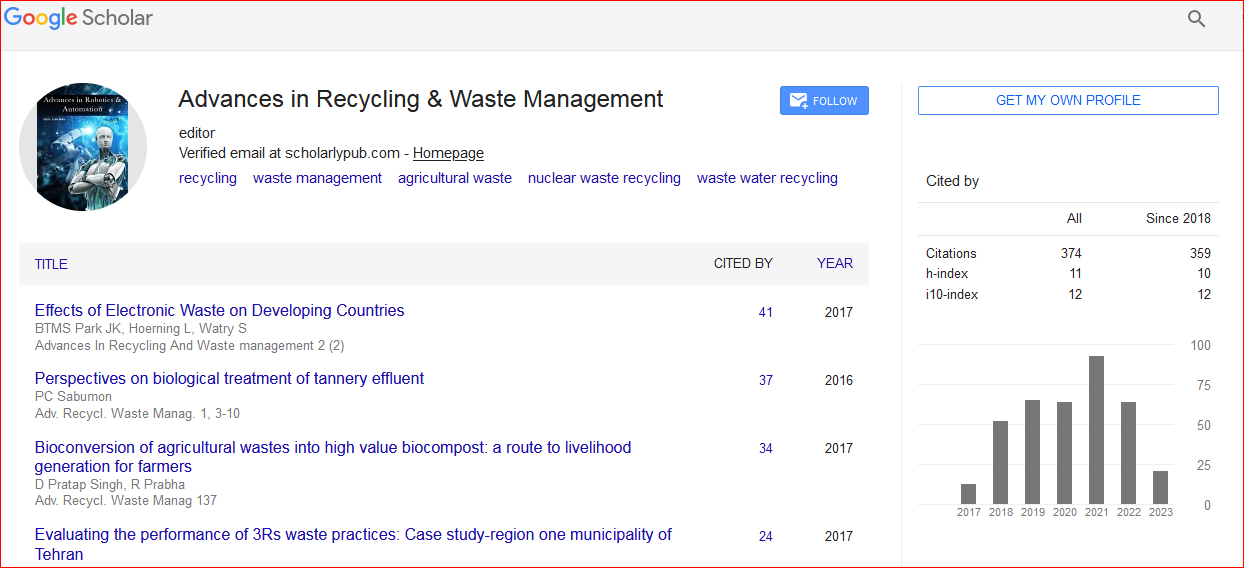
Advances in Recycling & Waste Management received 438 citations as per Google Scholar report