Brief Report - (2025) Volume 14, Issue 3
Received: 02-Jun-2025, Manuscript No. jhoa-26-187786;
Editor assigned: 04-Jun-2025, Pre QC No. P-187786;
Reviewed: 18-Jun-2025, QC No. Q-187786;
Revised: 23-Jun-2025, Manuscript No. R-187786;
Published:
30-Jun-2025
, DOI: 10.37421/2167-1095.2025.14.518
Citation: Al-Farsi, Fatima. ”Salt Intake: A Major Cause Of Hypertension.” J Hypertens 14 (2025):518.
Copyright: © 2025 Al-Farsi F. This is an open-access article distributed under the terms of the Creative Commons Attribution License, which permits unrestricted use, distribution and reproduction in any medium, provided the original author and source are credited.
Excessive salt intake is a well-established dietary factor that significantly contributes to the development and worsening of hypertension. Sodium plays a critical role in promoting fluid retention, which directly increases blood volume and, consequently, elevates blood pressure. Furthermore, sodium influences the function of vascular smooth muscle and the activity of the sympathetic nervous system, both of which are key drivers in the progression of hypertension. For these reasons, reducing dietary sodium is considered a fundamental strategy in both the management and prevention of hypertension [1].
This study delves into the specific impact of restricting dietary sodium on blood pressure within populations identified as having salt-sensitive hypertension. The findings unequivocally demonstrate a substantial reduction in both systolic and diastolic blood pressure levels following a dedicated period of reduced sodium consumption. This reinforces the clear causal relationship that exists between high salt consumption and the manifestation of elevated blood pressure [2].
Further research has explored the intricate genetic predispositions that can modulate an individual's blood pressure response to dietary salt. This investigation has successfully identified specific gene variants that are strongly associated with an increased susceptibility to salt sensitivity. The findings underscore the profound influence that an individual's unique genetic makeup has on their susceptibility to developing hypertension in response to varying levels of dietary salt intake [3].
Comprehensive reviews have been conducted to synthesize the current body of evidence concerning the multifaceted mechanisms through which high sodium intake exerts its detrimental effects on the cardiovascular system. These mechanisms include its significant role in promoting endothelial dysfunction, fostering chronic inflammation, and dysregulating sympathetic nervous system activation, all of which are implicated in the pathogenesis of hypertension [4].
A large-scale population-based study has meticulously examined the relationship between habitual dietary salt intake and the overall prevalence of hypertension across a diverse spectrum of age groups. The study's results revealed a robust positive correlation, indicating that higher levels of salt consumption are associated with a markedly greater likelihood of developing hypertension, with a particularly pronounced effect observed in younger adult demographics [5].
The critical role of the renin-angiotensin-aldosterone system (RAAS) in mediating the complex effects of dietary salt on blood pressure regulation has been thoroughly discussed. It has been observed that in certain individuals, high salt intake can paradoxically lead to the activation of the RAAS, resulting in increased vasoconstriction and enhanced sodium retention, thereby contributing to the development or exacerbation of hypertension [6].
Significant attention has been directed towards evaluating the effectiveness of various public health interventions that are specifically designed to reduce population-level salt intake. These interventions encompass a range of strategies, including the implementation of policy changes, the execution of public awareness campaigns, and the efforts by the food industry to reformulate products, all aimed at reducing overall salt consumption and mitigating hypertension rates [7].
An investigation has been undertaken to explore the intricate interplay between dietary salt consumption and other critical lifestyle factors known to influence cardiovascular health. These factors include the presence of obesity and the level of physical activity. The research suggests that high salt intake may act synergistically with these other established risk factors, potentially accelerating the onset and progression of hypertension [8].
Specific attention has been given to examining the direct impact of processed foods, which are notoriously high in sodium content, on overall blood pressure regulation. The findings highlight how the pervasive and widespread consumption of these processed food products significantly contributes to an elevated population-level salt intake, which in turn is associated with higher rates of hypertension [9].
Recent reviews have focused on the development and exploration of novel therapeutic targets that hold promise for the effective management of salt-sensitive hypertension. This work emphasizes how a deeper understanding of the intricate biological pathways influenced by salt intake can pave the way for the development of more personalized and highly effective treatments for individuals suffering from salt-dependent forms of hypertension [10].
Excessive sodium consumption is a primary dietary contributor to the onset and exacerbation of hypertension. Sodium's physiological effects include promoting fluid retention, which elevates blood volume and consequently increases blood pressure. It also modulates vascular smooth muscle function and sympathetic nervous system activity, both integral to blood pressure regulation. Therefore, reducing dietary sodium is a crucial element in managing and preventing hypertension [1].
Research examining the effects of dietary sodium restriction in individuals with salt-sensitive hypertension has yielded significant findings. Studies indicate a marked decrease in both systolic and diastolic blood pressure following a period of reduced sodium intake. This provides strong empirical support for the causal link between high salt consumption and elevated blood pressure [2].
The genetic underpinnings of salt sensitivity and hypertension risk have been a focus of investigation. Studies have identified specific gene variants that are associated with increased salt sensitivity, highlighting how individual genetic makeup influences the development of hypertension in response to dietary salt intake [3].
Contemporary evidence synthesizing the mechanisms by which high sodium intake impacts the cardiovascular system reveals its role in endothelial dysfunction, inflammation, and sympathetic nervous system activation. These pathways are all implicated in the development of hypertension [4].
A population-based study exploring the association between dietary salt intake and hypertension prevalence across different age demographics found a strong positive correlation. Higher salt consumption was linked to a greater likelihood of developing hypertension, particularly in younger adults [5].
The Renin-Angiotensin-Aldosterone System (RAAS) is a key mediator in the salt-blood pressure relationship. High salt intake can paradoxically activate RAAS in some individuals, leading to vasoconstriction and sodium retention, thus contributing to hypertension [6].
Public health strategies aimed at reducing population-level salt intake have been critically evaluated. These strategies include policy interventions, public awareness campaigns, and food industry reformulation efforts, all assessing their impact on salt consumption and hypertension rates [7].
The interplay between dietary salt and other lifestyle factors like obesity and physical activity in hypertension development is being studied. Findings suggest that high salt intake may synergize with other risk factors, accelerating hypertension onset [8].
Processed foods, often laden with sodium, have a specific impact on blood pressure. Their widespread consumption contributes to increased population salt intake and, consequently, higher rates of hypertension [9].
Novel therapeutic targets for managing salt-sensitive hypertension are being reviewed. Understanding the complex pathways influenced by salt intake is essential for developing personalized and effective treatments for salt-dependent hypertension [10].
Excessive salt intake is a significant dietary factor contributing to hypertension by promoting fluid retention, increasing blood volume, and affecting vascular and nervous system functions. Reducing sodium intake is a cornerstone of hypertension management and prevention. Studies demonstrate that dietary sodium restriction effectively lowers blood pressure in salt-sensitive individuals, reinforcing the causal link between high salt consumption and elevated blood pressure. Genetic factors also play a role, with specific gene variants influencing salt sensitivity and hypertension risk. High sodium intake impacts the cardiovascular system through mechanisms like endothelial dysfunction, inflammation, and sympathetic nervous system activation. Population studies consistently show a positive correlation between salt intake and hypertension prevalence across age groups. The Renin-Angiotensin-Aldosterone System (RAAS) is a key mediator, and high salt intake can paradoxically activate it. Public health strategies and interventions are being implemented to reduce population-level salt intake. Salt intake interacts with other lifestyle factors such as obesity and physical activity, potentially accelerating hypertension onset. Processed foods, being high in sodium, contribute significantly to increased salt intake and hypertension rates. Research is also focusing on novel therapeutic approaches for salt-sensitive hypertension by understanding the intricate pathways affected by salt.
None
None
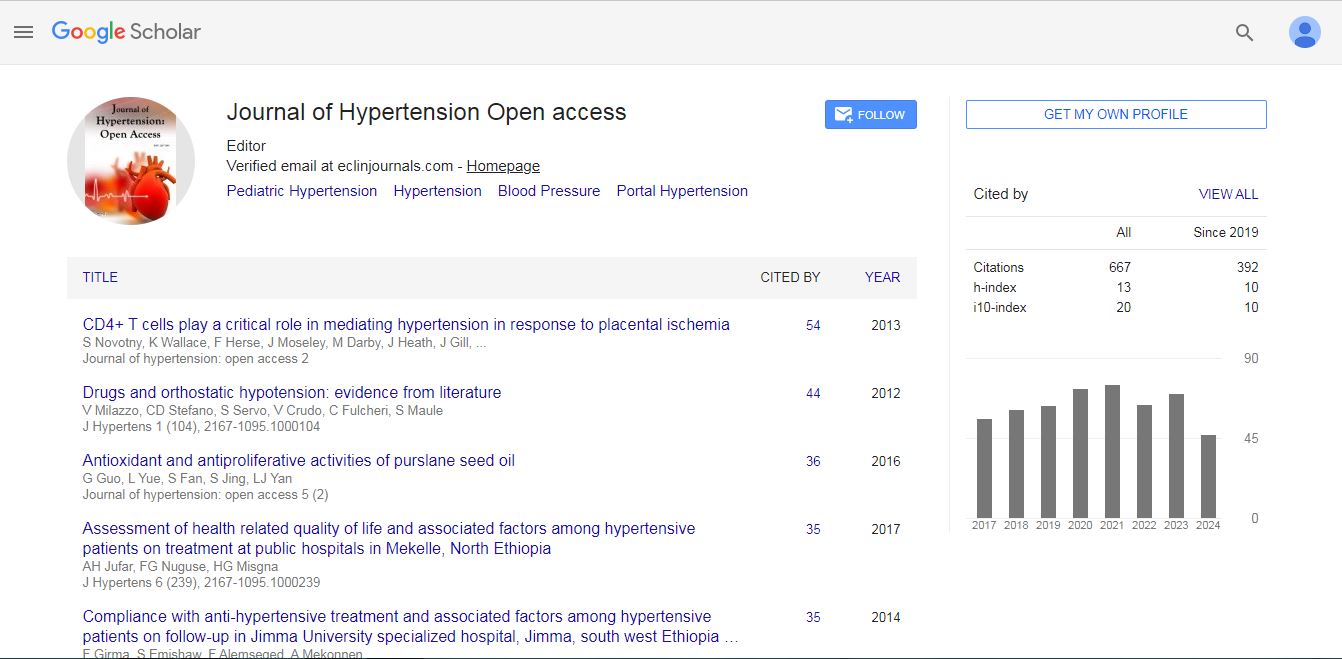
Journal of Hypertension: Open Access received 614 citations as per Google Scholar report