Commentary - (2025) Volume 16, Issue 4
Received: 02-Jul-2025, Manuscript No. jch-26-178768;
Editor assigned: 04-Jul-2025, Pre QC No. P-178768;
Reviewed: 17-Jul-2025, QC No. Q-178768;
Revised: 23-Jul-2025, Manuscript No. R-178768;
Published:
30-Jul-2025
, DOI: 10.37421/2157-7099.2025.16.803
Citation: Coleman, David R.. ”Salivary Gland Lesion Diagnostics: Fine Needle Aspiration’s Role.” J Cytol Histol 16 (2025):803.
Copyright: © 2025 Coleman R. David This is an open-access article distributed under the terms of the Creative Commons Attribution License, which permits unrestricted use, distribution and reproduction in any medium, provided the original author and source are credited.
The field of salivary gland lesion diagnosis has seen significant advancements, with fine needle aspiration (FNA) cytology playing an increasingly pivotal role in guiding patient management. This minimally invasive technique, when expertly performed and interpreted, offers a crucial first step in evaluating these diverse lesions. Integrating cytomorphological features with ancillary techniques is paramount for precise classification of both benign and malignant neoplasms, underscoring the evolution of diagnostic paradigms in cytopathology. The review highlights the increasing role of fine needle aspiration (FNA) cytology in guiding patient management and emphasizes the importance of integrating cytomorphological features with ancillary techniques, such as immunocytochemistry and molecular studies, for precise classification of both benign and malignant neoplasms [1].
The utility of FNA cytology in the preoperative diagnosis of salivary gland tumors is a subject of ongoing study, with efforts focused on comparing cytological findings with histopathological results to refine diagnostic accuracy. Identifying key cytomorphological criteria for differentiating common benign and malignant salivary gland neoplasms remains a core objective, alongside acknowledging the challenges in diagnosing certain entities solely on cytology, indicating areas where further refinement in diagnostic criteria is needed [2].
The molecular landscape of salivary gland carcinomas is a rapidly evolving area, with genetic alterations increasingly impacting their classification and management strategies. Understanding common oncogenic drivers in various subtypes, such as MYB-NFIB fusions in adenoid cystic carcinoma and NTRK fusions in secretory carcinoma, has direct implications for targeted therapy development and patient stratification. The integration of molecular diagnostics into routine cytopathology and histopathology practice is advocated for achieving more precise diagnoses and personalized treatment approaches [3].
Immunocytochemistry has emerged as an indispensable tool in the cytological diagnosis of salivary gland lesions, significantly enhancing diagnostic confidence. The utility of specific markers, such as p63, S100, and various myoepithelial markers, is crucial in differentiating epithelial and myoepithelial cell components within tumors. Demonstrating how immunocytochemistry helps resolve diagnostic ambiguities in challenging cases improves accuracy and reduces the need for repeat procedures, thereby optimizing patient care pathways [4].
A comprehensive understanding of the cytological features of common benign salivary gland neoplasms, including pleomorphic adenoma, Warthin's tumor, and oncocytoma, is essential for accurate diagnosis. Detailed knowledge of characteristic architectural patterns, cellular morphology, and background material aids in their recognition on FNA cytology. Discussing differential diagnoses for each entity and emphasizing subtle cytological nuances are critical for distinguishing these tumors from each other and from their malignant counterparts [5].
The cytopathological diagnosis of malignant salivary gland tumors requires meticulous attention to key cytological findings that suggest malignancy, such as cellular atypia and nuclear pleomorphism, as well as specific architectural patterns. The role of ancillary techniques, including Ki-67 and p53 immunostaining, is vital in augmenting diagnostic confidence and improving prognostication for these aggressive neoplasms. This paper outlines the key cytological findings that suggest malignancy, including cellular atypia, nuclear pleomorphism, and the presence of specific architectural patterns, and discusses the role of ancillary techniques, such as Ki-67 and p53 immunostaining, in augmenting diagnostic confidence and prognostication [6].
Diagnostic challenges and pitfalls in salivary gland cytopathology, particularly in distinguishing reactive changes from neoplastic lesions and in categorizing uncertain cases, necessitate a systematic approach. Thorough clinical history, adequate sample collection, and meticulous cytological evaluation are emphasized. Correlation with imaging and subsequent histopathology is crucial when a definitive diagnosis cannot be reached on cytology alone, ensuring optimal patient management [7].
Advancements in salivary gland cytopathology are being driven by the application of ancillary techniques, notably liquid-based cytology (LBC) and molecular diagnostics. LBC offers advantages in improving cellularity and reducing background obscuration, thereby enhancing cytological assessment. Reviewing emerging molecular markers that aid in diagnosis and prognostication promises more personalized management strategies for salivary gland tumors [8].
The cytopathology of rare salivary gland neoplasms presents unique diagnostic challenges, requiring specific knowledge for their identification on fine needle aspiration. Coverage of entities such as secretory carcinoma, epithelial-myoepithelial carcinoma, and basal cell adenocarcinoma, detailing their distinctive cytomorphological characteristics and relevant immunohistochemical findings, equips cytopathologists to recognize these less common but clinically significant tumors [9].
Finally, the evolving role of FNA extends to salivary gland cysts and benign non-neoplastic lesions, where accurate cytological assessment is vital to rule out cystic neoplasms and guide appropriate clinical management. Understanding the typical cytological appearances of common cystic lesions, such as mucoceles and lymphoepithelial cysts, is essential for differentiating them from more serious pathologies [10].
The diagnostic accuracy and molecular profiling of salivary gland lesions using cytopathology, with a focus on the increasing role of FNA cytology in patient management, form the basis of current research. This approach emphasizes the integration of cytomorphological features with ancillary techniques like immunocytochemistry and molecular studies for precise classification of neoplasms. Advancements in understanding the cytological spectrum of common and rare salivary gland tumors are highlighted, including diagnostic pitfalls for entities such as pleomorphic adenoma, Warthin's tumor, mucoepidermoid carcinoma, and adenoid cystic carcinoma [1].
The utility of fine needle aspiration (FNA) cytology in the preoperative diagnosis of salivary gland tumors is evaluated by comparing cytological findings with histopathological results. This research identifies key cytomorphological criteria essential for differentiating common benign and malignant salivary gland neoplasms. It also acknowledges the inherent challenges in diagnosing certain entities, such as acinic cell carcinoma and basal cell adenocarcinoma, based solely on cytology, pointing to areas where diagnostic criteria require further refinement [2].
The molecular pathogenesis of salivary gland carcinomas is a critical area of study, revealing how genetic alterations increasingly influence their classification and therapeutic strategies. Common oncogenic drivers, including MYB-NFIB fusions in adenoid cystic carcinoma and NTRK fusions in secretory carcinoma, are discussed in terms of their implications for targeted therapy. The review advocates for the incorporation of molecular diagnostics into routine cytopathology and histopathology practices to achieve more precise diagnoses and personalized treatment plans [3].
Immunocytochemistry plays a significant role in the cytological diagnosis of salivary gland lesions, with specific markers like p63, S100, and myoepithelial markers proving valuable. These markers assist in differentiating various epithelial and myoepithelial cell components found in both benign and malignant tumors. The authors demonstrate how immunocytochemistry can effectively resolve diagnostic ambiguities in difficult cases, thereby enhancing diagnostic accuracy and minimizing the need for repeated procedures [4].
A comprehensive overview of the cytological features of common benign salivary gland neoplasms, such as pleomorphic adenoma, Warthin's tumor, and oncocytoma, is provided. This section details the characteristic architectural patterns, cellular morphology, and background material crucial for their identification on FNA cytology. The review also addresses the differential diagnoses for each entity, stressing the importance of subtle cytological nuances for accurate distinction from other tumors and malignant counterparts [5].
The cytopathological diagnosis of malignant salivary gland tumors, specifically mucoepidermoid carcinoma, adenoid cystic carcinoma, and adenocarcinoma not otherwise specified, is a key focus. The paper outlines crucial cytological findings indicative of malignancy, including cellular atypia, nuclear pleomorphism, and specific architectural patterns. Furthermore, it discusses the supportive role of ancillary techniques like Ki-67 and p53 immunostaining in improving diagnostic confidence and aiding prognostication [6].
Diagnostic challenges and common pitfalls encountered in salivary gland cytopathology are examined, with particular attention to differentiating reactive changes from neoplastic lesions and managing uncertain cases. The importance of comprehensive clinical history, adequate sample collection, and meticulous cytological evaluation is underscored. A systematic interpretation approach and the value of correlating cytological findings with imaging and subsequent histopathology are recommended when definitive diagnoses are elusive [7].
The application of ancillary techniques, specifically liquid-based cytology (LBC) and molecular diagnostics, in the evaluation of salivary gland lesions is explored. LBC offers benefits in terms of improved cellularity and reduced background obscuration, leading to enhanced cytological assessment. Emerging molecular markers that may assist in the diagnosis and prognostication of salivary gland tumors are also reviewed, paving the way for more tailored management strategies [8].
The cytopathology of rare salivary gland neoplasms is addressed, offering guidance for their identification through fine needle aspiration. This includes entities like secretory carcinoma, epithelial-myoepithelial carcinoma, and basal cell adenocarcinoma, with detailed descriptions of their distinct cytomorphological characteristics and relevant immunohistochemical findings. The aim is to equip cytopathologists with the necessary knowledge to recognize these less common yet significant tumors [9].
Finally, the role of FNA in managing salivary gland cysts and benign non-neoplastic lesions is discussed. Accurate cytological assessment is vital to exclude cystic neoplasms and guide appropriate clinical management, which can vary from observation to surgical intervention. The typical cytological appearances of common cystic lesions, such as mucoceles and lymphoepithelial cysts, are highlighted to differentiate them from neoplastic conditions [10].
This collection of articles explores the diagnostic landscape of salivary gland lesions, emphasizing the critical role of fine needle aspiration (FNA) cytology. Research highlights the integration of cytomorphology with ancillary techniques like immunocytochemistry and molecular diagnostics for accurate classification of both benign and malignant tumors. Key benign entities such as pleomorphic adenoma and Warthin's tumor are detailed, alongside the cytopathological features of malignant tumors including mucoepidermoid carcinoma and adenoid cystic carcinoma. The papers also address diagnostic pitfalls, the utility of liquid-based cytology, and the cytopathology of rare salivary gland neoplasms. Furthermore, the management of salivary gland cysts and benign non-neoplastic lesions through FNA is discussed, underscoring the overall importance of cytopathology in guiding patient care and treatment strategies.
None
None
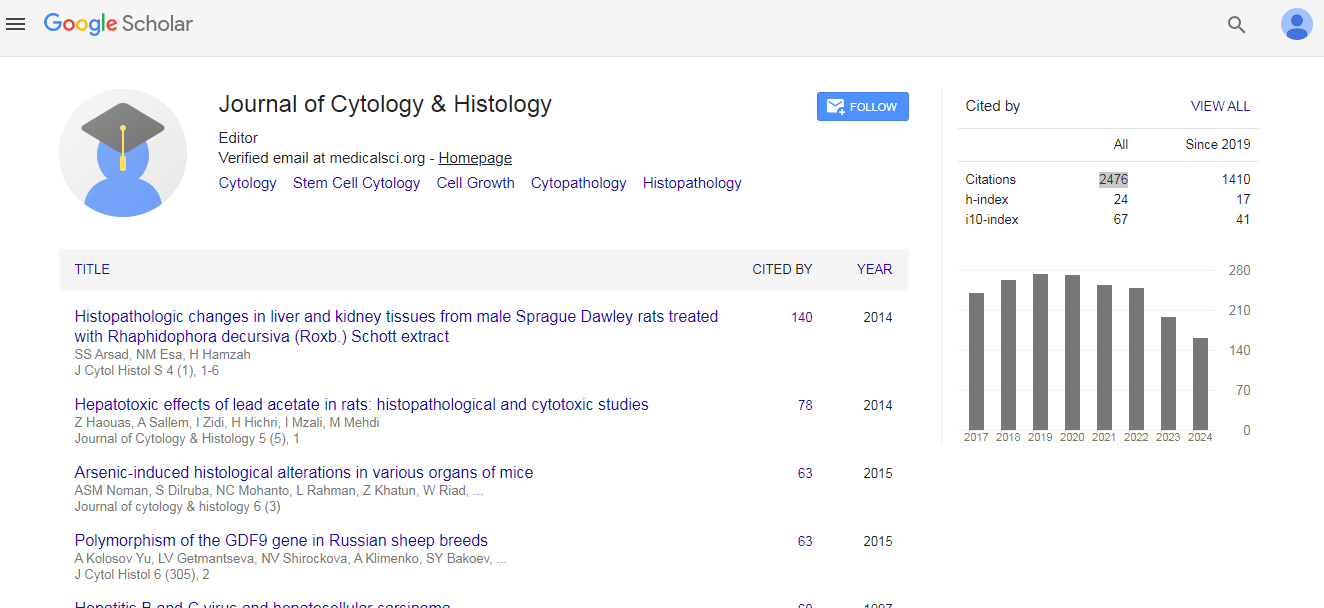
Journal of Cytology & Histology received 2476 citations as per Google Scholar report