Commentary - (2025) Volume 16, Issue 3
Received: 02-Jun-2025, Manuscript No. jvst-26-188031;
Editor assigned: 04-Jun-2025, Pre QC No. P-188031;
Reviewed: 18-Jun-2025, QC No. Q-188031;
Revised: 23-Jun-2025, Manuscript No. R-188031;
Published:
30-Jun-2025
, DOI: 10.37421/2157-7579.2025.16.305
Citation: Kim, Daniel. ”Rural Livestock Sustainability Through
Veterinary Services.” J Vet Sci Techno 16 (2025):305.
Copyright: © 2025 Kim D. This is an open-access article distributed under the terms of the Creative Commons Attribution License, which permits unrestricted use, distribution
and reproduction in any medium, provided the original author and source are credited.
Veterinary services are indispensable for fostering the development of rural livestock sectors, a critical component of many agrarian economies. Their role extends beyond mere animal treatment to encompass a comprehensive approach aimed at enhancing animal health, boosting productivity, and ensuring economic sustainability for farming communities. This multifaceted contribution begins with proactive disease prevention strategies, coupled with accurate diagnosis and timely treatment, all of which are foundational to improving herd management practices. Furthermore, veterinary expertise provides essential advisory services that guide farmers in adopting better breeding techniques and in effectively accessing lucrative markets for their livestock products. By focusing on these core areas, veterinary services directly and significantly impact the livelihoods of rural populations whose economic well-being is intrinsically tied to their livestock endeavors. [1]
Effective veterinary extension services act as crucial conduits for knowledge transfer, empowering smallholder farmers with vital information. This knowledge encompasses best practices in disease control, robust biosecurity measures, and refined husbandry techniques, all of which are essential for maintaining healthy livestock. The direct outcomes of implementing these practices include a notable reduction in animal mortality rates and a marked increase in fertility. Moreover, the quality of animal products is significantly improved, thereby strengthening the economic foundation of rural agrarian economies. Crucially, the success of these extension services is amplified through their integration with existing local community structures, ensuring wider reach and greater impact. [2] The adoption of modern veterinary technologies presents a significant opportunity to enhance disease management within rural livestock populations. These technologies, which span advanced diagnostics to innovative therapeutics, enable more precise and effective interventions. Veterinary services are instrumental in facilitating not only the introduction but also the widespread dissemination of these advanced tools and methodologies. This ensures that timely and appropriate interventions are implemented, which is paramount for preventing the widespread outbreaks of animal diseases and for substantially minimizing the associated economic losses that can cripple rural economies. [3] Sustainable livestock development in rural areas is inextricably linked to the rigorous control of zoonotic diseases, which pose risks to both animal and human health. Veterinary services assume a pivotal role in the surveillance, early detection, and containment of these diseases. Their efforts are vital in protecting both animal populations and human communities from the transmission of pathogens. Consequently, this proactive approach ensures the overall safety and integrity of the food supply chain, a fundamental aspect of public health and economic stability. [4] The economic viability of livestock enterprises operating in rural settings is heavily contingent upon the availability and accessibility of effective veterinary care. This encompasses ensuring that farmers have access to affordable medicines, essential vaccines, and crucial professional advice. Such provisions are vital for minimizing production losses that can arise from disease outbreaks and for optimizing the utilization of available resources. The economic benefits derived from robust disease prevention measures, facilitated by veterinary services, are demonstrably substantial and contribute significantly to the profitability of rural livestock farming. [5] Community-based veterinary services have proven to be particularly effective in reaching livestock farmers in remote rural areas where conventional veterinary infrastructure is often limited or inaccessible. By empowering local individuals to serve as para-vets and by establishing accessible service points within communities, these programs ensure that livestock farmers receive timely and appropriate animal healthcare. This decentralized approach not only fosters better animal welfare but also directly contributes to increased livestock productivity, thereby enhancing the economic well-being of these often-underserved regions. [6] The development of livestock breeds that are resilient and well-suited to local environmental conditions is of paramount importance for the sustenance of rural economies. Veterinary services contribute significantly to this objective by offering expert advice on genetic improvement strategies. They also provide crucial support in reproductive health management and in formulating effective disease resistance strategies tailored to specific local breeds. These contributions are essential for enhancing the overall sustainability and productivity of livestock populations in diverse rural environments. [7] Ensuring the safety and quality of animal products is a fundamental function of veterinary services, impacting both domestic consumption and international export markets. This critical role involves rigorous disease monitoring, comprehensive residue testing of animal products, and strict adherence to established international standards. By upholding these stringent measures, veterinary services build essential consumer confidence and, in turn, unlock new and expanded market opportunities for rural livestock producers, thereby boosting their economic prospects. [8] The integration of digital technologies into veterinary services represents a transformative advancement in supporting rural livestock development. Tools such as telemedicine for remote consultations and sophisticated data management systems significantly enhance the reach and operational efficiency of veterinary support. These digital innovations facilitate faster and more accurate diagnoses, enable better record-keeping for individual animals and herds, and allow for more targeted and effective interventions, ultimately improving livestock health outcomes. [9] Addressing the complex challenge of antimicrobial resistance (AMR) is a critical imperative for contemporary veterinary practice, particularly in rural livestock settings. Veterinary services play an indispensable role in promoting the responsible use of antimicrobial agents. They are also central to developing effective surveillance programs aimed at monitoring AMR prevalence and implementing alternative strategies to mitigate its spread. These efforts are vital for safeguarding both animal and human health in the long term. [10]Veterinary services are fundamental to the advancement of rural livestock development, playing a crucial role in bolstering animal health, increasing productivity, and ensuring the economic sustainability of these sectors. This essential support system encompasses a broad spectrum of activities, including proactive disease prevention, precise diagnosis, effective treatment, and invaluable advisory services. These services collectively enhance herd management practices, refine breeding techniques, and improve farmers' access to markets, directly benefiting the livelihoods of rural communities dependent on livestock. [1]
The dissemination of knowledge through effective veterinary extension services is vital for empowering smallholder farmers. These services equip farmers with critical understanding in areas such as disease control protocols, the implementation of biosecurity measures, and the adoption of improved husbandry techniques. The practical application of this knowledge results in a tangible decrease in livestock mortality and a notable rise in fertility rates. Furthermore, the overall quality of animal products is enhanced, leading to a strengthened economic base for rural agrarian economies. The integration of these services with local community structures is a key factor in their widespread success. [2] Advancements in veterinary technologies, including sophisticated diagnostic tools and novel therapeutic agents, offer significant potential for improving disease management within rural livestock populations. Veterinary services are instrumental in championing the introduction and widespread adoption of these modern innovations. By ensuring that these technologies are accessible and that veterinarians are trained in their use, timely interventions can be implemented, effectively preventing large-scale disease outbreaks and minimizing the economic repercussions for farmers. [3] The control of zoonotic diseases is intrinsically linked to the goal of achieving sustainable livestock development in rural regions. Veterinary services are pivotal in establishing and maintaining robust surveillance systems for identifying and tracking potential zoonotic threats. Their capacity for early detection and rapid containment is crucial for protecting both animal health and public health. This vigilance is essential for ensuring the safety and security of the food supply chain, a cornerstone of community well-being. [4] The economic prosperity of livestock enterprises in rural environments is profoundly dependent on the consistent availability of high-quality veterinary care. This includes ensuring access to reasonably priced veterinary medicines, essential vaccines, and expert professional guidance. Such access is critical for mitigating production losses caused by diseases and for maximizing the efficient use of farm resources. The economic impact of investing in disease prevention through veterinary services is substantial and contributes directly to the profitability and stability of rural farms. [5] In areas where traditional veterinary infrastructure is scarce, community-based veterinary service models have demonstrated exceptional efficacy. These programs focus on training and empowering local individuals to act as veterinary paraprofessionals, thereby extending essential services to remote areas. By establishing accessible points of care, these initiatives ensure that livestock farmers receive prompt and appropriate attention for their animals, leading to improved animal welfare and enhanced productivity. [6] For rural economies to thrive, the development of livestock breeds resilient to local environmental conditions is essential. Veterinary services play a crucial role in this endeavor by providing expert advice on genetic improvement programs. They also offer vital support in reproductive health management and in devising strategies to enhance disease resistance within specific breeds. These contributions are key to building more sustainable and productive livestock populations. [7] Veterinary services are central to upholding the safety and quality of animal products, which is vital for both domestic consumption and international trade. Their responsibilities include continuous disease monitoring in livestock populations, conducting thorough residue testing of animal products, and ensuring compliance with global standards. These rigorous quality control measures not only build consumer trust but also open up expanded market opportunities for rural producers. [8] The integration of digital technologies, such as telemedicine and advanced data management systems, is revolutionizing veterinary services and significantly enhancing their support for rural livestock development. These innovations allow for more efficient and widespread veterinary care, enabling quicker diagnoses, improved record-keeping, and the implementation of more precise and effective treatment plans, ultimately leading to better animal health outcomes. [9] Combating the growing threat of antimicrobial resistance (AMR) is a critical responsibility of modern veterinary practice, especially within rural livestock systems. Veterinary services are at the forefront of promoting responsible antimicrobial use among farmers and developing targeted surveillance programs to monitor AMR trends. Their efforts in implementing alternative disease control strategies are vital for preserving the efficacy of antimicrobials for both animal and human health. [10]Veterinary services are crucial for the development and sustainability of rural livestock sectors. They enhance animal health, boost productivity, and ensure economic stability through disease prevention, diagnosis, treatment, and advisory services. Effective extension programs empower farmers with knowledge on disease control and husbandry, leading to reduced mortality and increased fertility. Modern technologies and digital tools improve diagnostic accuracy and service efficiency. Community-based services extend care to remote areas, while efforts in genetic improvement and zoonotic disease control ensure resilience and public health. Ensuring product safety and quality builds consumer confidence and market access. Addressing antimicrobial resistance through responsible use is also a key function, safeguarding both animal and human health for long-term economic viability.
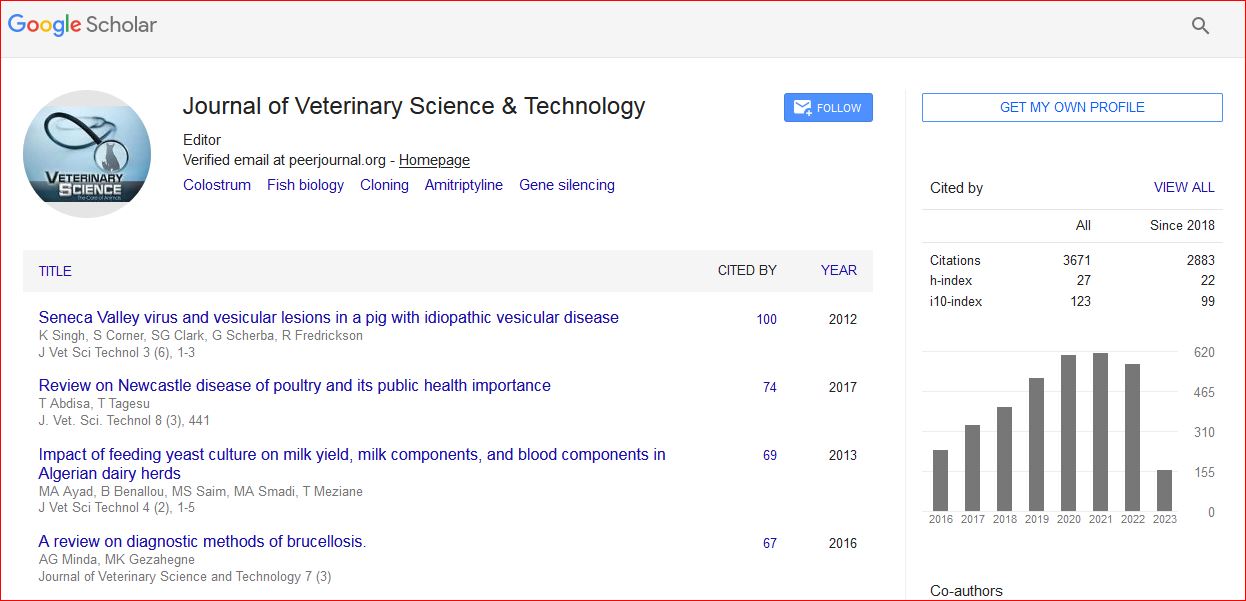
Veterinary Science & Technology received 4472 citations as per Google Scholar report