Commentary - (2025) Volume 16, Issue 2
Received: 28-Mar-2025, Manuscript No. gjto-25-175377;
Editor assigned: 31-Mar-2025, Pre QC No. P-175377;
Reviewed: 14-Apr-2025, QC No. QC-175377;
Revised: 21-Apr-2025, Manuscript No. R-175377;
Published:
28-Apr-2025
, DOI: 10.37421/2229-8711.2025.16.437
Citation: Duarte, Sofia. ”Robust Optimization for Diverse Real-World Challenges.” Global J Technol Optim 16 (2025):437.
Copyright: © 2025 Duarte S. This is an open-access article distributed under the terms of the Creative Commons Attribution License, which permits unrestricted use, distribution
and reproduction in any medium, provided the original author and source are credited.
This paper tackles the challenge of operating room scheduling, which is notoriously complex due to demand uncertainty and resource constraints. It introduces a data-driven robust optimization approach, specifically using distributionally robust chance-constrained programming, to create schedules that are resilient against unforeseen variations. The model helps hospitals manage resource allocation and patient flow more effectively, leading to improved efficiency and reduced costs even when facing unpredictable patient arrivals or procedure durations[1]. Focusing on resilient supply chains, this research develops a framework for integrated production and distribution planning under uncertain demand. The model employs a multi-objective approach to balance cost efficiency with supply chain responsiveness and resilience. By considering various disruption scenarios and incorporating stochastic demand, the study provides a robust solution for businesses to maintain operations and customer satisfaction even when faced with significant market volatility or supply chain disruptions[2]. This article presents a multi-objective optimization model designed for planning integrated energy systems. It specifically addresses how to combine demand-side management strategies with renewable energy sources to achieve optimal system performance. The research offers a methodology for policymakers and energy planners to design more sustainable and cost-effective energy infrastructures, balancing economic goals with environmental concerns in a comprehensive manner[3]. This study delves into urban traffic signal control by proposing an optimization method that leverages deep reinforcement learning with multi-agent coordination. The goal is to enhance traffic flow and reduce congestion in urban environments. The research showcases how advanced AI techniques can be applied in real-time to complex transportation networks, providing adaptive solutions that improve efficiency and minimize travel times for commuters[4].
This paper explores robust portfolio optimization, specifically addressing the practical constraints of transaction costs and drawdown limits in financial markets. It offers a sophisticated model for investors seeking to construct portfolios that are not only profitable but also resilient to market downturns and efficient in terms of trading expenses. The methodology provides a practical framework for risk-averse financial managers to navigate volatile markets more effectively[5]. The article focuses on integrated production and preventive maintenance scheduling, incorporating the often-overlooked aspect of human factors and workforce assignment. It presents an optimization model that aims to improve system reliability and efficiency by synchronizing production plans with maintenance activities while considering worker capabilities and limitations. This holistic approach helps manufacturing firms reduce downtime and boost productivity by creating more realistic and sustainable operational schedules[6].
This research addresses the critical problem of humanitarian logistics network design for disaster relief operations, particularly under conditions of stochastic demand and supply. It introduces a multi-period model to optimize the placement of relief centers and the distribution of aid, aiming to minimize response times and maximize affected population coverage. The findings offer valuable insights for improving the efficacy and resilience of disaster response efforts globally[7]. The paper investigates the optimization of resource allocation for various smart city services using a multi-objective approach. It tackles the challenge of distributing limited resources among competing urban needs, such as transportation, energy, and waste management, to maximize overall city performance and citizen well-being. This work provides a framework for urban planners to make data-driven decisions that enhance sustainability and quality of life in smart cities[8]. This research focuses on the course timetabling problem, a complex scheduling challenge in educational institutions. It introduces a multi-objective optimization model that balances student preferences with faculty workload equity. The methodology offers a practical solution for universities to create efficient and fair academic timetables, which in turn improves student satisfaction and faculty morale by considering their specific needs and constraints[9]. This paper addresses the design of integrated solid waste management systems through a multi-objective robust optimization approach. It provides a comprehensive model for managing waste streams, from collection to disposal and recycling, with the goal of minimizing environmental impact and economic costs while ensuring system robustness against uncertainties. The work offers a valuable tool for municipalities and waste management companies to develop more sustainable and resilient waste infrastructure[10].
Real-world operational challenges are often characterized by significant complexity, demand uncertainty, and strict resource constraints. This is evident in operating room scheduling, where unforeseen variations in patient arrivals or procedure durations can severely impact efficiency and costs [1]. To address such issues, data-driven robust optimization, including distributionally robust chance-constrained programming, offers solutions for creating resilient schedules [1]. Similarly, in supply chain management, developing integrated production and distribution plans under uncertain demand is crucial for resilience. Multi-objective approaches help balance cost efficiency with responsiveness and robustness against disruptions and market volatility [2]. Financial markets also grapple with uncertainty; robust portfolio optimization models are developed to account for transaction costs and drawdown limits, providing frameworks for investors to manage volatile markets effectively and build profitable, resilient portfolios [5].
Integrated planning is a critical theme, particularly for designing sustainable systems. For instance, multi-objective optimization models are vital for planning integrated energy systems, combining demand-side management strategies with renewable energy sources. This methodology guides policymakers in creating cost-effective and environmentally conscious energy infrastructures [3]. In manufacturing, integrated production and preventive maintenance scheduling benefits from considering human factors and workforce assignment. An optimization model improves system reliability and efficiency by synchronizing production and maintenance while accounting for worker capabilities, leading to more realistic and sustainable operational schedules [6].
Optimizing resource allocation is key for improving quality of life and response efforts. Smart cities utilize multi-objective approaches to distribute limited resources among competing urban needs like transportation, energy, and waste management. This framework helps urban planners make data-driven decisions to enhance sustainability and well-being [8]. Furthermore, humanitarian logistics network design faces critical challenges under stochastic demand and supply during disaster relief operations. Multi-period models are developed to optimize relief center placement and aid distribution, minimizing response times and maximizing population coverage, thereby improving disaster response efficacy and resilience globally [7].
Advanced techniques are applied to specific scheduling and control challenges. Urban traffic signal control, for example, is being revolutionized by optimization methods that leverage deep reinforcement learning with multi-agent coordination. The goal here is to enhance traffic flow and reduce congestion in real-time, improving efficiency and minimizing travel times for commuters [4]. Educational institutions also face complex scheduling in the form of course timetabling. Multi-objective optimization models are introduced to balance student preferences with faculty workload equity, providing practical solutions for creating efficient and fair academic timetables that improve satisfaction and morale [9].
Finally, the challenge of integrated solid waste management systems is tackled through multi-objective robust optimization. This comprehensive model manages waste streams from collection to disposal and recycling, with the overarching goal of minimizing environmental impact and economic costs. It also ensures system robustness against various uncertainties, providing municipalities and waste management companies with valuable tools for developing sustainable and resilient waste infrastructure [10].
This collection of research explores diverse applications of optimization techniques to address complex real-world problems marked by uncertainty and resource limitations. Papers tackle challenges in operating room scheduling by using data-driven robust optimization to create resilient schedules, enhancing efficiency and reducing costs in healthcare [1]. Resilient supply chains are a focus, with studies developing integrated production and distribution planning under uncertain demand, balancing cost efficiency with responsiveness and robustness [2]. Financial management also benefits from robust portfolio optimization that considers transaction costs and drawdown constraints, helping investors navigate volatile markets [5].
Integrated systems are a recurring theme, seen in models for energy systems planning that combine demand-side management with renewable sources for sustainability [3], and in manufacturing, where integrated production and preventive maintenance scheduling incorporates human factors for improved reliability and productivity [6]. Resource allocation in smart cities is optimized using multi-objective approaches to enhance urban performance and citizen well-being [8]. Humanitarian logistics network design addresses disaster relief with multi-period models that optimize aid distribution under stochastic conditions [7]. Additionally, advanced AI techniques like deep reinforcement learning are applied to urban traffic signal control to reduce congestion [4], and multi-objective models solve course timetabling problems in education, balancing preferences and workloads [9]. Finally, robust multi-objective optimization guides the design of integrated solid waste management systems, aiming for sustainable and resilient waste infrastructure [10]. Overall, these studies offer sophisticated analytical frameworks to improve efficiency, resilience, and decision-making across critical sectors.
None
None
Mengqi H, Guang W, Xin W. "Data-driven robust optimization for operating room scheduling under uncertainty".Eur. J. Oper. Res. 304 (2023):181-193.
Indexed at, Google Scholar, Crossref
Mahdi F, Mohammad RG, Amir MF. "Integrated production and distribution planning under demand uncertainty for resilient supply chains".Comput. Ind. Eng. 175 (2023):108871.
Indexed at, Google Scholar, Crossref
Hamed N, Payam N, Mohammad AY. "A multi-objective optimization model for integrated energy systems planning with demand-side management and renewable energy sources".Appl. Energy 312 (2022):118742.
Indexed at, Google Scholar, Crossref
Yuze W, Jie Z, Wei Q. "Urban traffic signal control optimization based on deep reinforcement learning with multi-agent coordination".Transp. Res. Part C: Emerg. Technol. 153 (2023):104217.
Indexed at, Google Scholar, Crossref
Chengyu Z, Yanling Y, Guang Y. "Robust portfolio optimization with transaction costs and drawdown constraints".Eur. J. Oper. Res. 298 (2022):367-380.
Indexed at, Google Scholar, Crossref
Saeed H, Mohammad RA, Mohsen S. "Integrated production and preventive maintenance scheduling with workforce assignment considering human factors".Comput. Ind. Eng. 169 (2022):108307.
Indexed at, Google Scholar, Crossref
Jiarui L, Mingzhe L, Ziyang D. "A multi-period humanitarian logistics network design problem for disaster relief with stochastic demand and supply".Omega 119 (2023):102872.
Indexed at, Google Scholar, Crossref
Rahul S, Rajesh S, Sumit G. "Optimizing resource allocation for smart city services: A multi-objective approach".Cities 129 (2022):103859.
Indexed at, Google Scholar, Crossref
Negin G, Mohammad HFZ, Vahid R. "A multi-objective optimization model for course timetabling problem with student preferences and faculty workload balance".Appl. Soft Comput. 147 (2023):110757.
Indexed at, Google Scholar, Crossref
Mohammad RA, Saeid J, Ali AS. "Integrated solid waste management system design: A multi-objective robust optimization approach".J. Clean. Prod. 379 (2022):134599.
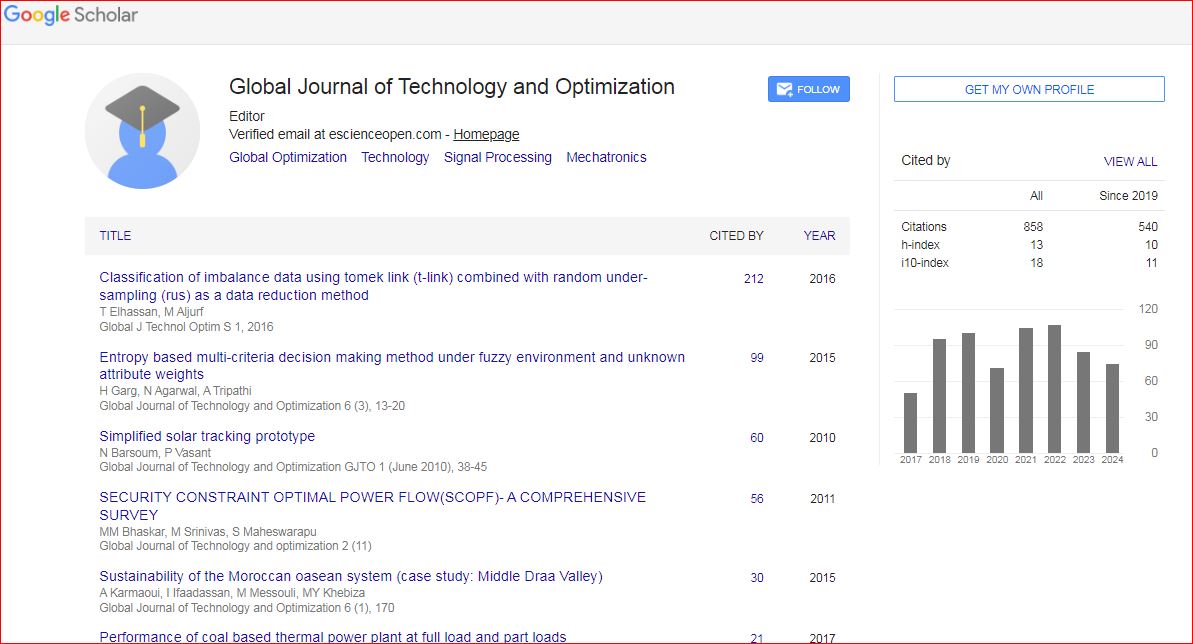
Global Journal of Technology and Optimization received 847 citations as per Google Scholar report