Perspective - (2025) Volume 16, Issue 2
Received: 01-Apr-2025, Manuscript No. jmbd-26-179368;
Editor assigned: 03-Apr-2025, Pre QC No. P-179368;
Reviewed: 14-Apr-2025, QC No. Q-179368;
Revised: 22-Apr-2025, Manuscript No. R-179368;
Published:
29-Apr-2025
, DOI: 10.37421/2155-9929.2025.16.693
Citation: García, Mateo. ”RNA Biomarkers: Revolutionizing Precision Medicine and Therapeutics.” J Mol Biomark Diagn 16 (2025): 693.
Copyright: © 2025 García M. This is an open-access article distributed under the terms of the Creative Commons Attribution License, which permits unrestricted use,
distribution and reproduction in any medium, provided the original author and source are credited.
RNA-based biomarkers are at the forefront of revolutionizing precision medicine, offering potent tools for early disease diagnosis, predicting disease progression, and anticipating patient response to therapies. MicroRNAs (miRNAs), long non-coding RNAs (lncRNAs), and circular RNAs (circRNAs) represent particularly promising classes of biomarkers, with their aberrant expression patterns strongly linked to a spectrum of diseases including various cancers, cardiovascular disorders, and neurological conditions. The inherent stability of these RNA molecules within biofluids positions them as ideal candidates for non-invasive diagnostic approaches. The sophisticated integration of RNA biomarker data with other omics information and comprehensive clinical data is pivotal for achieving more accurate patient stratification and for the development of truly personalized therapeutic strategies [1].
Circular RNAs (circRNAs) have increasingly emerged as significant regulators of gene expression and are now widely recognized for their diagnostic and prognostic potential in diverse oncological settings. The distinctive circular topology of these molecules confers remarkable stability, rendering them exceptionally suitable for liquid biopsy applications. Emerging research consistently highlights specific circRNAs capable of differentiating between various cancer subtypes and accurately predicting patient survival outcomes, thereby paving the way for novel non-invasive diagnostic assays and the development of targeted therapeutic interventions [2].
Long non-coding RNAs (lncRNAs) play crucial roles as key regulators of fundamental cellular processes and have demonstrated significant utility as potential biomarkers, particularly in the context of neurodegenerative diseases. Aberrant expression patterns of lncRNAs have been consistently observed in conditions such as Alzheimer's and Parkinson's disease, often correlating with disease severity and progression. The development of robust lncRNA-based diagnostic assays holds the promise of facilitating earlier disease detection and enabling more effective monitoring of therapeutic efficacy, ultimately contributing to the advancement of precision neurology [3].
MicroRNAs (miRNAs) are deeply implicated in the pathogenesis of cardiovascular diseases, and their circulating levels have proven to be sensitive indicators for both diagnosis and prognosis in patients. Specific miRNA profiles have demonstrated the ability to predict the risk of significant cardiovascular events such as myocardial infarction, heart failure, and stroke. Furthermore, miRNAs possess the potential to guide personalized treatment decisions by indicating patient response to specific pharmacological interventions, thereby underscoring their critical role in the advancement of precision cardiology [4].
The proliferation and refinement of robust RNA sequencing technologies have substantially accelerated the identification and validation processes for RNA biomarkers. Advanced next-generation sequencing (NGS) platforms provide the capability for comprehensive transcriptome profiling, thereby enabling the discovery of novel diagnostic and prognostic signatures. While challenges related to standardization and the complexity of bioinformatic analysis persist, ongoing dedicated efforts are actively addressing these issues with the ultimate goal of facilitating their seamless clinical translation [5].
Exosomal RNAs, encompassing miRNAs, lncRNAs, and circRNAs, represent a critical and rapidly advancing frontier within the field of liquid biopsy for precision medicine applications. These RNA molecules are inherently protected within extracellular vesicles, a feature that confers significant stability and enables their reliable detection in a variety of body fluids. The analysis of exosomal RNA profiles is increasingly being leveraged for early cancer detection, for monitoring treatment response, and for assessing patient prognosis, offering a minimally invasive yet highly informative approach to personalized patient care [6].
The integration of RNA biomarker data with sophisticated artificial intelligence (AI) and machine learning (ML) algorithms is poised to significantly accelerate the translation of these promising biomarkers into routine clinical practice. AI and ML algorithms possess the capability to analyze complex RNA expression patterns, identify subtle yet significant diagnostic signatures, and predict treatment outcomes with a high degree of accuracy. This synergistic and powerful approach is absolutely crucial for effective patient stratification and for the optimization of therapeutic decisions within the framework of precision medicine [7].
Epigenetic modifications of RNA, such as N6-methyladenosine (m6A) methylation, are increasingly recognized as critical regulators of gene expression and are significantly implicated in the pathogenesis of various diseases. Circulating modified RNAs are actively being explored as novel biomarkers for the early diagnosis and prognosis of a wide range of conditions. A deeper understanding of these epitranscriptomic changes offers entirely new avenues for therapeutic intervention and the advancement of personalized medicine [8].
The clinical implementation of RNA biomarkers is currently facing several significant hurdles that need to be addressed for widespread adoption. These include the critical need for standardization of analytical methods, the requirement for robust validation across diverse patient populations, and the complex process of obtaining regulatory approval. Addressing these challenges is absolutely essential for the successful translation of promising research findings into reliable and actionable diagnostic and prognostic tools for precision medicine. Collaborative efforts between academic institutions and industry partners are deemed crucial for overcoming these significant obstacles [9].
RNA therapeutics, including revolutionary modalities such as mRNA vaccines and RNA interference (RNAi) drugs, are rapidly transforming the landscape of modern medicine. The in-depth understanding gained from the extensive study of RNA as biomarkers directly complements and informs the development of these advanced therapeutic modalities. By accurately identifying disease-specific RNA signatures, researchers are empowered to tailor RNA-based treatments more effectively, aiming for enhanced therapeutic efficacy and minimizing the occurrence of adverse side effects, thereby fully realizing the profound potential of precision medicine [10].
RNA-based biomarkers are revolutionizing precision medicine by providing powerful tools for early diagnosis, disease prognosis, and prediction of treatment response. Key molecules such as microRNAs (miRNAs), long non-coding RNAs (lncRNAs), and circular RNAs (circRNAs) are particularly promising due to their dysregulation in numerous diseases, including cancer, cardiovascular disorders, and neurological conditions. Their remarkable stability in biofluids makes them ideal for non-invasive diagnostics. Integrating RNA biomarker data with other omics and clinical information allows for more accurate patient stratification and personalized therapeutic strategies [1].
Circular RNAs (circRNAs) are increasingly recognized for their significant role in gene regulation and their diagnostic and prognostic value in various cancers. Their unique stable circular structure makes them excellent candidates for liquid biopsy. Studies have identified specific circRNAs that can differentiate cancer subtypes and predict patient survival, facilitating the development of novel non-invasive diagnostic assays and targeted therapies [2].
Long non-coding RNAs (lncRNAs) are key regulators of cellular processes and have shown utility as biomarkers in neurodegenerative diseases. Aberrant lncRNA expression is observed in conditions like Alzheimer's and Parkinson's disease, correlating with disease progression and severity. Developing lncRNA-based assays could enable early diagnosis and monitoring of therapeutic efficacy, advancing precision neurology [3].
MicroRNAs (miRNAs) are deeply involved in the pathogenesis of cardiovascular disease, and their circulating levels serve as sensitive indicators for diagnosis and prognosis. Specific miRNA profiles can predict the risk of myocardial infarction, heart failure, and stroke. Furthermore, miRNAs can guide personalized treatment by indicating response to pharmacological interventions, highlighting their role in precision cardiology [4].
The development of robust RNA sequencing technologies has significantly advanced the identification and validation of RNA biomarkers. Next-generation sequencing (NGS) platforms enable comprehensive transcriptome profiling, allowing for the discovery of novel diagnostic and prognostic signatures. Ongoing efforts are addressing challenges in standardization and bioinformatic analysis to facilitate clinical translation [5].
Exosomal RNAs, including miRNAs, lncRNAs, and circRNAs, represent a critical frontier in liquid biopsy for precision medicine. Protected within extracellular vesicles, these stable RNA molecules can be detected in various body fluids. Exosomal RNA profiles are increasingly used for early cancer detection, monitoring treatment response, and assessing prognosis, offering a minimally invasive approach to personalized patient care [6].
The integration of RNA biomarker data with artificial intelligence (AI) and machine learning (ML) algorithms is poised to accelerate the translation of RNA biomarkers into clinical practice. AI/ML can analyze complex RNA expression patterns, identify subtle diagnostic signatures, and predict treatment outcomes with high accuracy, crucial for patient stratification and optimizing therapeutic decisions in precision medicine [7].
Epigenetic modifications of RNA, such as N6-methyladenosine (m6A), are critical regulators of gene expression and are implicated in disease. Circulating modified RNAs are being explored as novel biomarkers for early diagnosis and prognosis. Understanding these epitranscriptomic changes provides new avenues for therapeutic intervention and personalized medicine [8].
The clinical implementation of RNA biomarkers faces hurdles including standardization of analytical methods, robust validation across diverse populations, and regulatory approval. Addressing these challenges is essential for translating research into reliable diagnostic and prognostic tools for precision medicine. Collaborative efforts between academia and industry are crucial for overcoming these obstacles [9].
RNA therapeutics, such as mRNA vaccines and RNA interference (RNAi) drugs, are rapidly transforming medicine. The understanding gained from studying RNA as biomarkers complements the development of these therapies. Identifying disease-specific RNA signatures allows for tailored RNA-based treatments with enhanced efficacy and reduced side effects, realizing the full potential of precision medicine [10].
RNA-based biomarkers, including miRNAs, lncRNAs, and circRNAs, are revolutionizing precision medicine for early diagnosis, prognosis, and treatment response prediction. Their stability in biofluids makes them ideal for non-invasive diagnostics. CircRNAs show promise in cancer, lncRNAs in neurodegenerative diseases, and miRNAs in cardiovascular conditions. Advanced RNA sequencing technologies and exosomal RNA analysis are key to biomarker discovery. Integration with AI/ML and understanding epitranscriptomic modifications are accelerating clinical translation. Challenges in standardization, validation, and regulation must be overcome for widespread adoption. The knowledge gained from RNA biomarkers also informs the development of novel RNA therapeutics, driving a new era in personalized medicine.
None
None
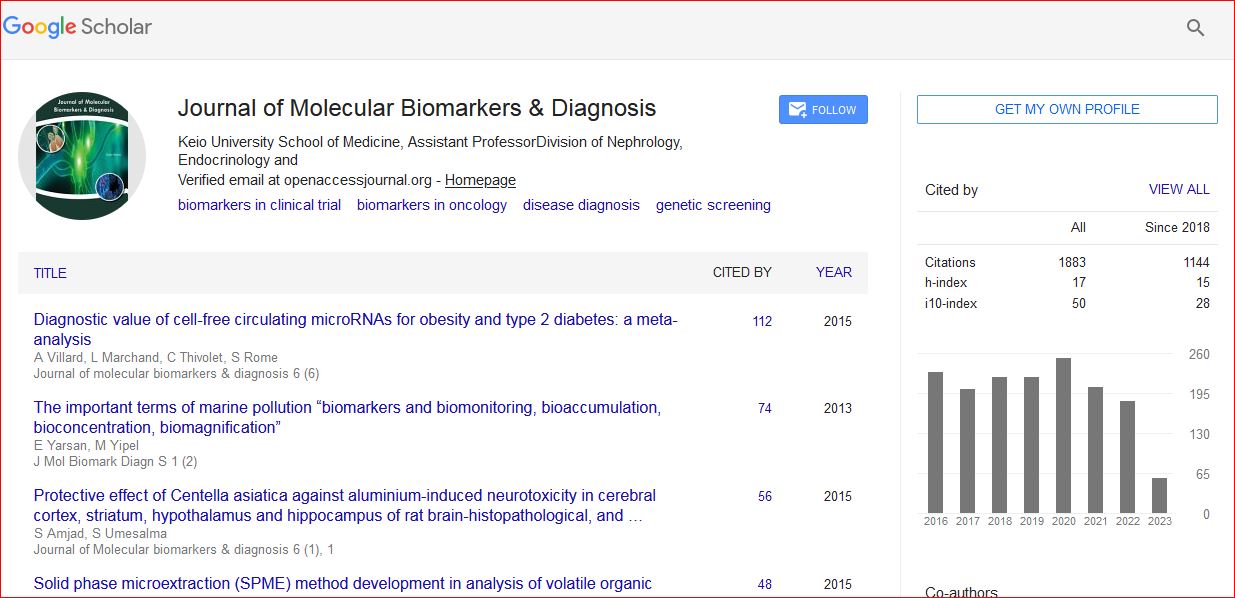
Journal of Molecular Biomarkers & Diagnosis received 2054 citations as per Google Scholar report