Short Communication - (2025) Volume 14, Issue 6
Received: 01-Nov-2025, Manuscript No. jtsm-26-179604;
Editor assigned: 03-Nov-2025, Pre QC No. P-179604;
Reviewed: 17-Nov-2025, QC No. Q-179604;
Revised: 24-Nov-2025, Manuscript No. R-179604;
Published:
29-Nov-2025
, DOI: 10.37421/2167-0919.2025.14.534
Citation: Dubois, Claire. ”Revolutionizing Networks with AI, Edge, and 5G.” J Telecommun Syst Manage 14 (2025):534.
Copyright: © 2025 Dubois C. This is an open-access article distributed under the terms of the Creative Commons Attribution License, which permits unrestricted use,
distribution and reproduction in any medium, provided the original author and source are credited.
The telecommunications industry is undergoing a profound transformation, driven by the relentless advancement of emerging technologies. The integration of 5G, Artificial Intelligence (AI), and the Internet of Things (IoT) is fundamentally reshaping telecommunications infrastructure and management, heralding an era of increased flexibility and automation through software-defined networking (SDN) and network function virtualization (NFV) [1].
The growing complexity of modern networks necessitates sophisticated management strategies. AI and Machine Learning (ML) are becoming indispensable tools in optimizing network performance, bolstering security, and automating operational tasks, paving the way for more efficient and responsive systems [2].
Architectural shifts are a hallmark of this evolution, with 5G and subsequent generations emphasizing the critical role of edge computing. This paradigm shift is crucial for reducing latency and enabling a new wave of innovative services by distributing intelligence closer to the user [3].
The security landscape of next-generation telecommunication networks, particularly those supporting the proliferation of IoT devices and massive connectivity, presents significant challenges. Advanced security mechanisms, including blockchain and AI-based threat detection, are paramount for safeguarding infrastructure and sensitive data [4].
Network slicing emerges as a cornerstone technology for 5G and beyond, enabling the management of diverse service requirements and ensuring optimal resource utilization. This capability allows for the creation of dedicated virtual networks tailored to specific needs, with AI playing a vital role in orchestrating these complex slices [5].
A major trend is the move towards autonomous networks, characterized by their ability to self-organize, self-heal, and self-optimize. AI, ML, and advanced automation are the driving forces behind this evolution, promising reduced operational costs and enhanced service quality [6].
Management and orchestration (MANO) frameworks are central to the effective operation of virtualized and cloud-native telecommunication networks. These frameworks facilitate the dynamic deployment and management of network functions, with AI and ML integration enhancing automation and intelligent decision-making [7].
The advent of quantum computing poses both challenges and opportunities for telecommunications, particularly in the realms of cryptography and network optimization. Proactive research and development are essential to adapt future networks to the quantum era [8].
The reliability and resilience of telecommunication networks are paramount, especially for mission-critical applications. AI-driven predictive analytics for fault detection and rapid recovery are crucial for minimizing service disruptions and ensuring continuous operation [9].
The convergence of cloud and edge computing presents both opportunities and challenges for telecommunications, enabling new services while demanding sophisticated management of distributed resources. AI-powered optimization is key to managing data processing and resource allocation across these hybrid environments [10].
The evolving landscape of telecommunications is being reshaped by the transformative impact of emerging technologies such as 5G, Artificial Intelligence (AI), and the Internet of Things (IoT). This evolution is characterized by a significant shift towards software-defined networking (SDN) and network function virtualization (NFV), which are crucial for achieving enhanced flexibility and automation in network management [1].
Within telecommunications management, the integration of AI and Machine Learning (ML) is increasingly explored for its capabilities in optimizing network performance, bolstering security measures, and automating a wide array of operational tasks. Specific applications include predictive maintenance, intelligent traffic management, and sophisticated anomaly detection [2].
Architectural advancements in 5G and beyond are placing a strong emphasis on the importance of edge computing. This technological trend is vital for reducing latency and enabling the deployment of novel services by bringing computation and data storage closer to the network edge [3].
Security in the next generation of telecommunication networks, especially those designed to support the vast expansion of IoT devices and massive connectivity, is a paramount concern. The article explores advanced security mechanisms, including blockchain and AI-based threat detection, to safeguard network infrastructure and data integrity [4].
Network slicing, a critical technology for 5G and future networks, is investigated for its role in managing diverse service requirements and ensuring efficient resource utilization. The complexities of managing multiple slices with varying quality of service (QoS) guarantees are addressed, highlighting the role of AI in slice orchestration [5].
The trend towards autonomous networks signifies a move towards self-organizing, self-healing, and self-optimizing telecommunications systems. AI, ML, and advanced automation are identified as the key enablers for reducing operational costs and significantly improving service quality [6].
The management and orchestration (MANO) frameworks for virtualized and cloud-native telecommunication networks are examined. These frameworks are essential for the dynamic deployment, scaling, and management of network functions, with AI and ML integration poised to enhance automation and intelligent decision-making [7].
The potential impact of quantum computing on telecommunications, particularly in the areas of cryptography and network optimization, is a subject of significant research. The article reviews current research and discusses the implications for future network security and design, emphasizing the need for adaptation [8].
The reliability and resilience of telecommunication networks are critical, especially in the context of demanding applications. AI-enabled predictive analytics for fault detection and rapid recovery are explored as vital tools for minimizing service disruptions and ensuring performance assurance [9].
The convergence of cloud and edge computing in telecommunications presents a dynamic landscape of challenges and opportunities. This convergence facilitates new services and necessitates sophisticated management strategies for distributed resources, with AI playing a crucial role in optimizing resource allocation [10].
Emerging technologies like 5G, AI, and IoT are revolutionizing telecommunications infrastructure, leading to greater flexibility and automation through SDN and NFV. AI and ML are crucial for optimizing network performance, security, and operations, enabling predictive maintenance and intelligent traffic management. Edge computing is vital for reducing latency and enabling new services. Advanced security mechanisms are needed to protect against evolving threats. Network slicing allows for tailored service management and efficient resource use, with AI aiding orchestration. The drive towards autonomous networks promises reduced costs and improved service quality. MANO frameworks, enhanced by AI, are key for managing virtualized networks. Quantum computing's impact on cryptography and optimization is being explored, necessitating proactive adaptation. AI-driven predictive maintenance is essential for network reliability and resilience. Cloud-edge convergence requires sophisticated management, with AI optimizing distributed resources.
None
None
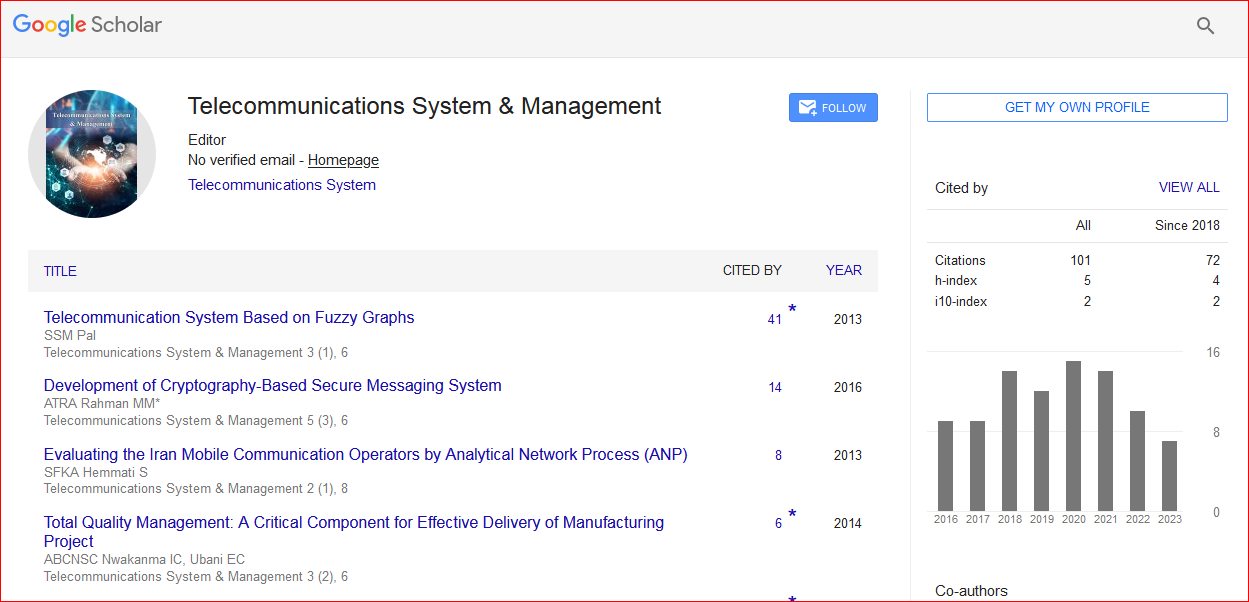
Telecommunications System & Management received 109 citations as per Google Scholar report