Opinion - (2025) Volume 15, Issue 4
Received: 01-Jul-2025, Manuscript No. jcde-25-177502;
Editor assigned: 03-Jul-2025, Pre QC No. P-177502;
Reviewed: 17-Jul-2025, QC No. Q-177502;
Revised: 22-Jul-2025, Manuscript No. R-177502;
Published:
29-Jul-2025
, DOI: 10.37421/2165-784X.2025.15.616
Citation: Silva, Leandro. ”Resilient Urban Water: Tech, Nature,
Governance.” J Civil Environ Eng 15 (2025):616.
Copyright: © 2025 Silva L. This is an open-access article distributed under the terms of the Creative Commons Attribution License, which permits unrestricted use, distribution
and reproduction in any medium, provided the original author and source are credited.
Urban water systems face increasing pressure from climate change, urbanization, and unforeseen disruptions, highlighting the critical need for resilience. Strategies focus on integrating diversified water sources, enhancing infrastructure flexibility, and adopting advanced monitoring technologies, moving beyond mere shock resistance to encompass adaptation, recovery, and transformation. This calls for a holistic approach, blending technical solutions with robust governance and community engagement. [1] Digital Twin technology provides real-time monitoring, predictive modeling, and optimized management for water networks, treatment plants, and drainage systems within urban water infrastructure. This technology significantly enhances operational efficiency, reduces maintenance costs, and improves decision-making, particularly for proactive incident response and planning future infrastructure upgrades. [2] Nature-based solutions (NBS) offer multifaceted benefits for urban water management, including flood mitigation, water quality enhancement, and biodiversity promotion. However, challenges like funding, land availability, and integration with existing grey infrastructure persist, necessitating tailored implementation strategies and stronger policy support. [3]
Adapting urban water systems to climate change is a pressing need, addressing challenges such as increased flood risks, water scarcity, and infrastructure vulnerability. Opportunities lie in integrated water resource management, green infrastructure, and demand-side management, emphasizing a combination of technological innovation, policy reform, and community engagement for resilient urban water futures. [4] The Internet of Things (IoT) plays a vital role in advancing smart water management. Various IoT technologies find application in water monitoring, leak detection, and demand management, despite facing challenges in data security and interoperability. IoT holds significant potential to enhance efficiency, reduce water losses, and improve the overall sustainability of urban water systems. [5] Research trends in the urban Water-Energy-Food (WEF) nexus highlight the interconnectedness of these resources in urban environments and the need for integrated governance. Managing trade-offs and synergies across sectors requires interdisciplinary approaches and policy coherence to optimize resource allocation and minimize environmental impacts, aiming for sustainable development goals. [6] Green infrastructure (GI) in urban stormwater management demonstrates effectiveness in reducing runoff, improving water quality, and creating ecological benefits. Challenges in planning, funding, and public acceptance exist, but integrating GI with conventional grey infrastructure is crucial for developing resilient and sustainable urban drainage systems. [7] Circular economy principles offer transformative strategies for urban water management, including water reuse, nutrient recovery, and energy generation from wastewater. Transitioning from a linear to a circular model enhances resource efficiency and reduces environmental pollution, fostering sustainable urban development despite demanding systemic changes and technological advancements. [8] Participatory governance in urban water management synthesizes approaches where engaging stakeholders, including local communities, leads to more equitable, effective, and sustainable water solutions. Benefits include increased public trust and better policy acceptance, though challenges like power imbalances and resource limitations in fostering genuine participation need addressing. [9] Finally, data-driven approaches are revolutionizing urban water management, applying machine learning, Artificial Intelligence, and big data analytics for tasks such as leak detection, demand forecasting, and water quality monitoring. These technologies significantly improve operational efficiency, reduce costs, and enhance the resilience and sustainability of urban water systems, requiring robust data infrastructure and skilled personnel. [10]Urban water systems are at a crossroads, needing to build resilience against climate change impacts, urbanization, and unforeseen disruptions. Strategies for this involve integrating diverse water sources, enhancing infrastructure flexibility, and adopting advanced monitoring technologies. The focus is not just on resisting shocks but on developing the capacity to adapt, recover, and transform. This requires a holistic approach, merging technical solutions with strong governance and community involvement [1]. The adaptation to climate change specifically addresses challenges like increased flood risks, water scarcity, and infrastructure vulnerability, promoting integrated water resource management, green infrastructure, and demand-side management. Success here depends on technological innovation, policy reform, and community engagement to ensure resilient urban water futures [4].
Technological advancements are central to modern urban water management. Digital Twin technology offers real-time monitoring, predictive modeling, and optimized management across water networks, treatment plants, and drainage systems. This significantly improves operational efficiency, cuts maintenance costs, and refines decision-making, especially for proactive incident responses and future infrastructure planning [2]. The Internet of Things (IoT) also drives smart water management through various technologies applied in water monitoring, leak detection, and demand management. While data security and interoperability pose challenges, IoT promises enhanced efficiency, reduced water losses, and overall system sustainability [5]. Furthermore, data-driven methods, including Machine Learning and Artificial Intelligence, are transforming leak detection, demand forecasting, and water quality monitoring. These approaches significantly improve operational efficiency, lower costs, and bolster the resilience and sustainability of urban water systems, though robust data infrastructure and skilled personnel are critical [10].
Nature-based solutions (NBS) present a powerful avenue for urban water management, offering benefits like flood mitigation, improved water quality, and biodiversity enhancement. Yet, obstacles such as funding, land availability, and seamless integration into existing grey infrastructure remain. Advocating for tailored implementation strategies and stronger policy backing is essential to maximize NBS potential [3]. In a similar vein, green infrastructure (GI) for urban stormwater management is highly effective in reducing runoff and enhancing water quality, while also yielding ecological benefits. Despite challenges in planning, funding, and public acceptance, integrating GI with conventional grey infrastructure is a key step towards resilient and sustainable urban drainage systems [7].
Governance and resource interconnectedness are also paramount. Participatory governance, by actively involving stakeholders like local communities and NGOs, fosters more equitable, effective, and sustainable water solutions. This boosts public trust and policy acceptance, though power imbalances and resource limitations in achieving genuine participation need careful handling [9]. Simultaneously, the urban Water-Energy-Food (WEF) nexus emphasizes the deep interconnectedness of these resources within urban settings. Integrated governance becomes crucial for sustainable development, necessitating interdisciplinary approaches and policy coherence to optimize resource allocation and minimize environmental impacts [6].
Finally, the application of circular economy principles is pivotal in urban water management, promoting water reuse, nutrient recovery, and energy generation from wastewater. This shift from a linear to a circular model enhances resource efficiency, reduces environmental pollution, and cultivates sustainable urban development, even as it calls for substantial systemic changes and technological progress [8].
This compilation of research reviews critically examines various strategies and technologies aimed at modernizing urban water management for enhanced resilience, sustainability, and efficiency. A central theme is the development of resilient urban water systems, advocating for diversified water sources, flexible infrastructure, and advanced monitoring, recognizing that resilience involves adapting and transforming rather than just resisting shocks. Adapting to climate change is another core focus, addressing challenges like increased flood risks and water scarcity through integrated water resource management, green infrastructure, and demand-side solutions. Technological advancements are highlighted as pivotal, with Digital Twin technology offering real-time monitoring and predictive modeling, while the Internet of Things (IoT) enhances smart water management through leak detection and demand control. Data-driven approaches, leveraging Machine Learning and Artificial Intelligence, are transforming operational efficiency for tasks like water quality monitoring and demand forecasting. Nature-based solutions (NBS) and green infrastructure (GI) are recognized for their multifaceted benefits in flood mitigation, water quality, and biodiversity, despite facing implementation hurdles. The reviews also emphasize the significance of integrated governance, encompassing participatory approaches to foster equitable water solutions and managing the complex urban Water-Energy-Food (WEF) nexus. The circular economy principles, promoting water reuse and nutrient recovery, are presented as key to reducing pollution and achieving sustainable urban development. Collectively, these studies underscore the necessity of a holistic, interdisciplinary approach, combining advanced technical solutions with strong governance and community engagement to ensure robust urban water futures.
1. Feng M, Liang C, Jiahong G. "Towards resilient urban water systems: A review of strategies and challenges".Water Res. 246 (2023):120677.
Indexed at, Google Scholar, Crossref
2. Xuan R, Bo L, Weian L. "Digital Twin Applications in Urban Water Infrastructure: A Review".J. Water Resour. Plan. Manage. 150 (2024):03123002.
Indexed at, Google Scholar, Crossref
3. Christine MR, Sophie R, Jasper OK. "Nature-based solutions for urban water management: A systematic review of benefits and challenges".J. Environ. Manage. 295 (2021):113063.
Indexed at, Google Scholar, Crossref
4. Mohammad AI, Jeganathan S, Touhid A. "Adapting urban water systems to climate change: A review of challenges and opportunities".J. Clean. Prod. 356 (2022):131872.
Indexed at, Google Scholar, Crossref
5. Ahmad KA, Shah IA, Syed MI. "Internet of Things for Smart Water Management: A Review of Technologies, Applications, and Challenges".Sustain. Cities Soc. 69 (2021):102830.
Indexed at, Google Scholar, Crossref
6. Chang W, Jin C, Yan L. "The Urban Water-Energy-Food Nexus: A Critical Review of Research Trends and Future Directions".Renew. Sust. Energ. Rev. 185 (2023):113645.
Indexed at, Google Scholar, Crossref
7. Sanjeev KJ, Shreya K, Kunal J. "Green infrastructure for urban stormwater management: A review of benefits, challenges, and future perspectives".Ecol. Eng. 196 (2023):107050.
Indexed at, Google Scholar, Crossref
8. Rengin A, Cigdem A, Neslihan A. "Circular economy principles for urban water management: A systematic review".Sci. Total Environ. 849 (2022):157929.
Indexed at, Google Scholar, Crossref
9. Muhammad M, Hameed K, Saqib A. "Participatory governance in urban water management: A review of approaches and outcomes".Util. Policy 71 (2021):101235.
Indexed at, Google Scholar, Crossref
10. Wenbin Z, Jia L, Shaojie W. "Data-driven approaches for urban water management: A comprehensive review".J. Hydrol. 610 (2022):127926.
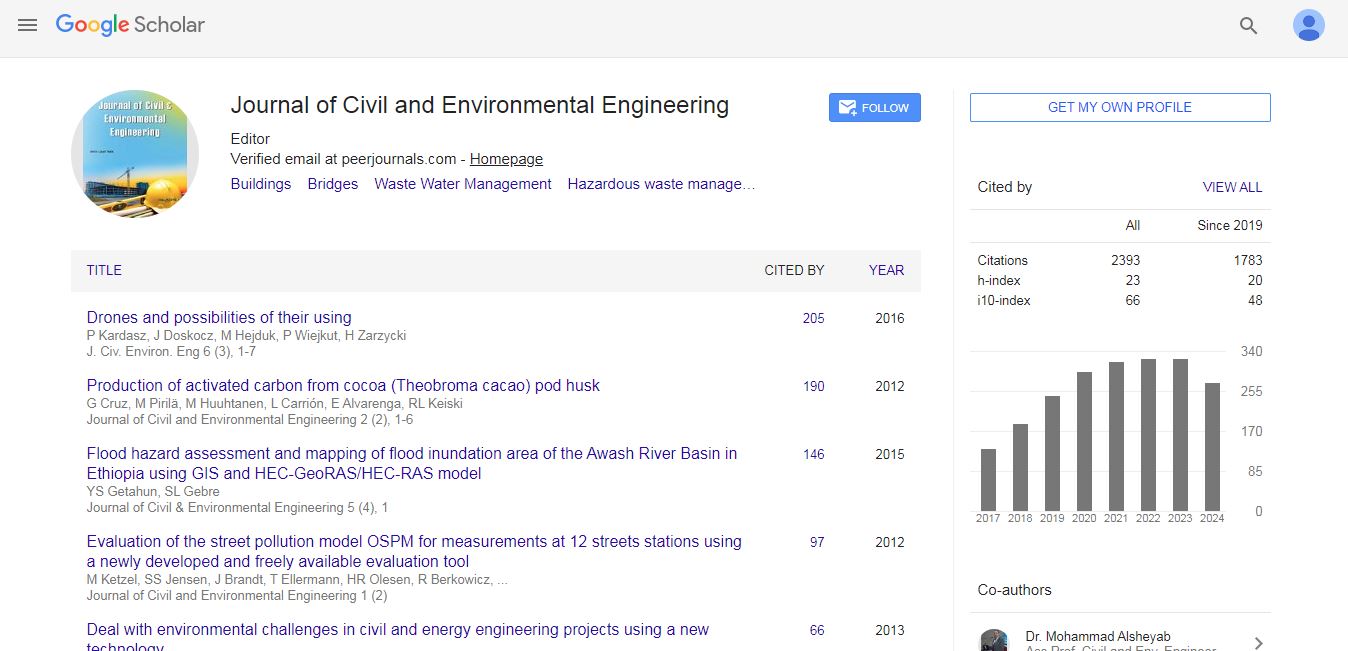
Journal of Civil and Environmental Engineering received 1798 citations as per Google Scholar report