Short Communication - (2025) Volume 16, Issue 4
Received: 31-Jul-2025, Manuscript No. gjto-25-176012;
Editor assigned: 04-Aug-2025, Pre QC No. P-176012;
Reviewed: 14-Aug-2025, QC No. QC-176012;
Revised: 21-Aug-2025, Manuscript No. R-176012;
Published:
28-Aug-2025
, DOI: 10.37421/2229-8711.2025.16.462
Citation: O’Shea, Damian. ”Resilience: Multifaceted Adaptation Across Systems and Selves.” Global J Technol Optim 16 (2025): 462.
Copyright: © 2025 O’Shea D. This is an open-access article distributed under the terms of the Creative Commons Attribution License, which permits unrestricted use, distribution and reproduction in any medium, provided the original author and source are credited.
This paper examines the inherent resilience of healthcare systems, highlighting how they adapt and maintain function despite expected and unexpected disruptions. It emphasizes that while systems are designed for safety, their true resilience emerges from the constant adjustments people make to manage variability and uncertainty. The insights here suggest that focusing on adaptive capacity and understanding how work is done 'in practice' is crucial for improving patient safety and system performance [1]. This meta-analytic review synthesizes existing research on organizational resilience, identifying key antecedents and outcomes. It provides a clearer understanding of what makes organizations resilient, emphasizing factors like strategic planning, flexible structures, learning capabilities, and leadership support. The work offers a robust empirical foundation for future research and practical applications in enhancing an organization's ability to cope with disruptions and thrive post-crisis [2].
This systematic review explores components for a resilience index for public health systems, crucial for effective responses to health crises. It identifies various dimensions of resilience, including preparedness, response capacity, and recovery mechanisms, and highlights the need for a comprehensive, measurable framework. What this really means is developing practical tools to assess and strengthen public health infrastructure before the next big challenge hits [3]. This article delves into the concept of social-ecological system resilience, exploring how interconnected human and natural systems cope with change and disturbance. It emphasizes adaptability, transformability, and the importance of feedback loops in maintaining system function. The key takeaway is recognizing the dynamic interplay between society and the environment when building lasting resilience [4].
This systematic review and meta-analysis investigate resilience and its influencing factors among nurses. It identifies psychological capital, social support, and coping strategies as critical determinants of resilience in this demanding profession. Understanding these factors is vital for developing interventions to support nurses' mental well-being and strengthen the overall healthcare workforce [5]. This study explores how resilience impacts mental health among university students, proposing a moderated mediation model. It finds that resilience directly contributes to better mental health and can buffer the effects of stress. The insights here highlight the importance of fostering resilience-building programs within educational institutions to support student well-being [6]. This scoping review examines community resilience among Indigenous populations, identifying how cultural strengths, traditional knowledge, and social capital contribute to their ability to cope with adversity. It underscores the unique aspects of resilience in these communities and the need for culturally appropriate support mechanisms. What this means is respecting and integrating traditional practices in building resilience [7].
This paper investigates what constitutes a resilient older adult, proposing a definition and discussing measurement strategies for resilience in this population, with or without medical and psychiatric conditions. It highlights the multidimensional nature of resilience, encompassing psychological, social, and physical factors. The work provides a foundation for clinical interventions and public health strategies aimed at promoting healthy aging [8]. This study examines the drivers of ecosystem resilience in a world facing rapid environmental change. It highlights the importance of biodiversity, functional redundancy, and spatial connectivity in maintaining ecosystem stability and function. Understanding these drivers is crucial for conservation efforts and managing ecosystems to withstand future disturbances [9]. This article reflects on the concept of resilience in health systems, drawing lessons from the COVID-19 pandemic. It emphasizes the need for systems to not only absorb shocks but also to adapt and transform in the face of unprecedented challenges. The core idea here is moving beyond mere stability to a more dynamic, learning-oriented approach for future health crises [10].
This paper examines the inherent resilience of healthcare systems, highlighting how they adapt and maintain function despite expected and unexpected disruptions. It emphasizes that while systems are designed for safety, their true resilience emerges from the constant adjustments people make to manage variability and uncertainty. The insights here suggest that focusing on adaptive capacity and understanding how work is done 'in practice' is crucial for improving patient safety and system performance [1].
This meta-analytic review synthesizes existing research on organizational resilience, identifying key antecedents and outcomes. It provides a clearer understanding of what makes organizations resilient, emphasizing factors like strategic planning, flexible structures, learning capabilities, and leadership support. The work offers a robust empirical foundation for future research and practical applications in enhancing an organization's ability to cope with disruptions and thrive post-crisis [2].
This systematic review explores components for a resilience index for public health systems, crucial for effective responses to health crises. It identifies various dimensions of resilience, including preparedness, response capacity, and recovery mechanisms, and highlights the need for a comprehensive, measurable framework. What this really means is developing practical tools to assess and strengthen public health infrastructure before the next big challenge hits [3].
This article delves into the concept of social-ecological system resilience, exploring how interconnected human and natural systems cope with change and disturbance. It emphasizes adaptability, transformability, and the importance of feedback loops in maintaining system function. The key takeaway is recognizing the dynamic interplay between society and the environment when building lasting resilience [4].
This systematic review and meta-analysis investigate resilience and its influencing factors among nurses. It identifies psychological capital, social support, and coping strategies as critical determinants of resilience in this demanding profession. Understanding these factors is vital for developing interventions to support nurses' mental well-being and strengthen the overall healthcare workforce [5].
This study explores how resilience impacts mental health among university students, proposing a moderated mediation model. It finds that resilience directly contributes to better mental health and can buffer the effects of stress. The insights here highlight the importance of fostering resilience-building programs within educational institutions to support student well-being [6].
This scoping review examines community resilience among Indigenous populations, identifying how cultural strengths, traditional knowledge, and social capital contribute to their ability to cope with adversity. It underscores the unique aspects of resilience in these communities and the need for culturally appropriate support mechanisms. What this means is respecting and integrating traditional practices in building resilience [7].
This paper investigates what constitutes a resilient older adult, proposing a definition and discussing measurement strategies for resilience in this population, with or without medical and psychiatric conditions. It highlights the multidimensional nature of resilience, encompassing psychological, social, and physical factors. The work provides a foundation for clinical interventions and public health strategies aimed at promoting healthy aging [8].
This study examines the drivers of ecosystem resilience in a world facing rapid environmental change. It highlights the importance of biodiversity, functional redundancy, and spatial connectivity in maintaining ecosystem stability and function. Understanding these drivers is crucial for conservation efforts and managing ecosystems to withstand future disturbances [9].
This article reflects on the concept of resilience in health systems, drawing lessons from the COVID-19 pandemic. It emphasizes the need for systems to not only absorb shocks but also to adapt and transform in the face of unprecedented challenges. The core idea here is moving beyond mere stability to a more dynamic, learning-oriented approach for future health crises [10].
This collection of papers broadly explores the concept of resilience across diverse systems and populations, highlighting its critical role in navigating disruptions and fostering well-being. It delves into the inherent resilience of healthcare systems, emphasizing adaptive capacity and practical adjustments made by people to ensure patient safety and system performance. Organizational resilience is examined, identifying strategic planning, flexible structures, learning capabilities, and strong leadership as key factors for thriving post-crisis. The discussion extends to public health systems, advocating for a comprehensive and measurable resilience index to enhance preparedness and effective responses to health crises. The dynamic interplay in social-ecological systems and the maintenance of ecosystem stability, driven by biodiversity, functional redundancy, and spatial connectivity, is also considered. Furthermore, the collection addresses individual and community resilience, focusing on nurses' mental well-being through psychological capital, social support, and coping strategies. It also explores resilience's impact on university students' mental health and highlights how Indigenous populations leverage cultural strengths, traditional knowledge, and social capital. Resilience in older adults is defined and measured across psychological, social, and physical dimensions to promote healthy aging. The lessons from the COVID-19 pandemic also underscore the necessity for health systems to not just absorb shocks but adapt and transform. Overall, the insights underscore that resilience is a multifaceted construct, crucial for systems and individuals to absorb shocks, adapt, and transform in the face of expected and unprecedented challenges, moving towards a more dynamic and learning-oriented approach.
None
None
Erik H, Anne BR, Robert LW. "The resilience of healthcare systems".BMJ Qual Saf 29 (2020):846-851.
Indexed at, Google Scholar, Crossref
Stefanie D, Stefan R, Aline K. "The resilience of organizations: A meta-analytic review of the literature".J Manag 46 (2020):1121-1144.
Indexed at, Google Scholar, Crossref
Khulood MA, Karem A, Thomas O. "Developing a resilience index for public health systems: A systematic review".Health Policy 124 (2020):742-751.
Indexed at, Google Scholar, Crossref
R. B, M. S, M. LS. "The resilience of social-ecological systems: Exploring the concept and its applications".Annu Rev Environ Resour 44 (2019):593-617.
Indexed at, Google Scholar, Crossref
Fard F, Mostafa F, Reyhaneh A. "Resilience and its determinants among nurses: A systematic review and meta-analysis".J Adv Nurs 77 (2021):20-30.
Indexed at, Google Scholar, Crossref
Tao H, Dong Z, Junchao W. "The effect of resilience on mental health among university students: A moderated mediation model".J Affect Disord 270 (2020):111-118.
Indexed at, Google Scholar, Crossref
Judith CK, D. E, B. J. "Community resilience and Indigenous populations: A scoping review".Health Promot Int 34 (2019):e1-e12.
Indexed at, Google Scholar, Crossref
Dilip VJ, Gauri S, Barton WP. "What makes a resilient older adult? Defining and measuring resilience in older adults with and without medical and psychiatric conditions".J Psychiatr Res 119 (2019):10-18.
Indexed at, Google Scholar, Crossref
Ian D, Helmut H, Jonathan MC. "Drivers of ecosystem resilience in a changing world".Nat Ecol Evol 5 (2021):574-581.
Indexed at, Google Scholar, Crossref
Helen R, Mario S, Karen L. "Resilience and health in a time of crisis: lessons from the COVID-19 pandemic".Health Policy 124 (2020):933-936.
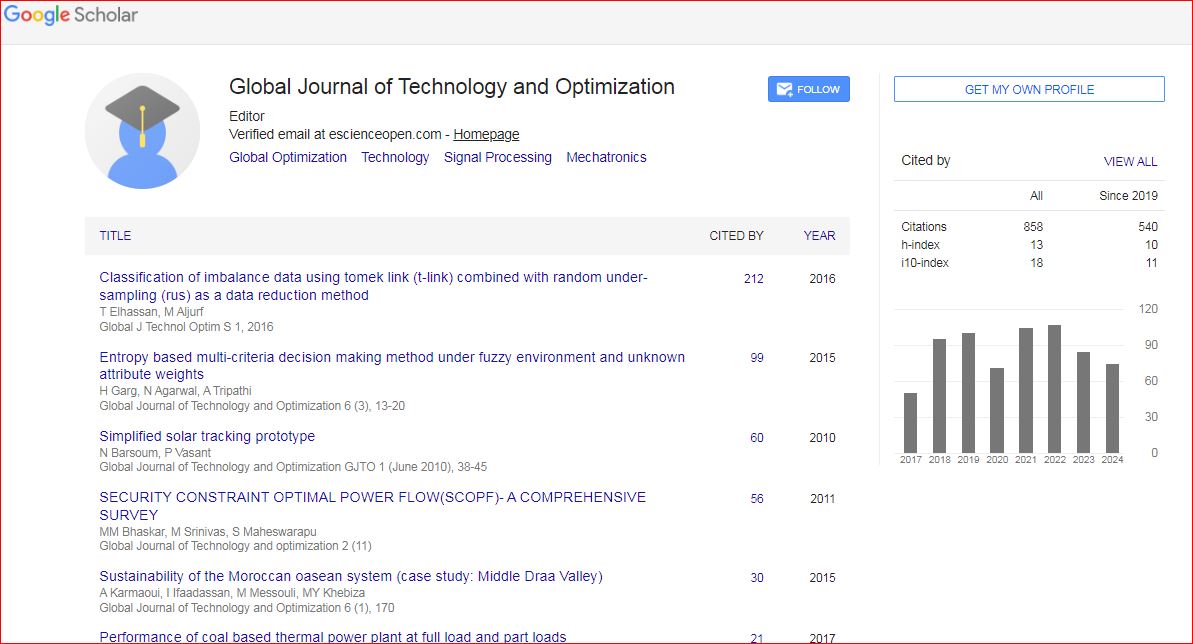
Global Journal of Technology and Optimization received 847 citations as per Google Scholar report