Opinion - (2025) Volume 8, Issue 3
Received: 01-Sep-2025, Manuscript No. pollution-25-176603;
Editor assigned: 03-Sep-2025, Pre QC No. P-176603;
Reviewed: 17-Sep-2025, QC No. Q-176603;
Revised: 22-Sep-2025, Manuscript No. R-176603;
Published:
29-Sep-2025
, DOI: 10.37421/2684-4958.2025.8.382
Citation: Rem, Michael. ”Renewable Energy Advancements Reshape Global Landscape.” Pollution 08 (2025):382.
Copyright: © 2025 Rem M. This is an open-access article distributed under the terms of the Creative Commons Attribution License, which permits unrestricted use, distribution
and reproduction in any medium, provided the original author and source are credited.
This comprehensive review explores the current state, challenges, and future opportunities of perovskite solar cells, highlighting their rapid advancement in efficiency and stability. It covers material innovation, device architectures, and strategies to overcome long-term degradation issues, positioning them as a promising next-generation photovoltaic technology. The review particularly highlights their rapid advancement in efficiency and stability, discussing comprehensive strategies for material innovation, sophisticated device architectures, and methods to mitigate long-term degradation. This positions perovskite solar cells as a particularly promising next-generation photovoltaic technology [1].
This review details the significant advancements in offshore wind turbine technology, from innovative foundation designs and larger turbine capacities to advanced control systems and grid integration solutions. It addresses technical challenges and environmental considerations, emphasizing the role of offshore wind in meeting global energy demands. These innovations include advanced foundation designs, significantly larger turbine capacities, sophisticated control systems, and effective grid integration solutions. The work addresses both technical hurdles and critical environmental considerations, underlining offshore wind's vital role in addressing global energy demands sustainably [2].
This review summarizes recent technological advancements in geothermal energy production and utilization, including enhanced geothermal systems (EGS), binary power plants, and direct-use applications. It discusses improved drilling techniques, reservoir engineering, and sustainable practices for expanding geothermal's contribution to renewable energy portfolios. This includes a focus on enhanced geothermal systems (EGS), binary power plants, and various direct-use applications. Key improvements involve advanced drilling techniques, innovative reservoir engineering, and the implementation of sustainable practices to ensure geothermal energy contributes significantly to renewable energy portfolios [3].
This article reviews the latest advancements in biomass energy conversion technologies, focusing on thermochemical (pyrolysis, gasification, combustion) and biochemical (anaerobic digestion, fermentation) processes. It highlights efficiency improvements, waste-to-energy solutions, and the production of advanced biofuels, emphasizing sustainable biomass utilization. This encompasses both thermochemical processes, like pyrolysis, gasification, and combustion, and biochemical methods, such as anaerobic digestion and fermentation. The article points to significant efficiency improvements, the development of advanced waste-to-energy solutions, and the production of advanced biofuels, all contributing to sustainable biomass utilization [4].
This review examines recent developments in small hydropower plants, covering innovations in turbine designs, control systems, and environmental mitigation strategies. It discusses the potential of small hydro for decentralized power generation in remote areas, balancing energy needs with ecological preservation. These advancements span innovations in turbine designs, intelligent control systems, and effective environmental mitigation strategies. The review underscores the considerable potential of small hydro for decentralized power generation, especially in remote areas, emphasizing the careful balance between energy needs and ecological preservation [5].
This critical review evaluates various energy storage systems crucial for integrating renewable energy sources into power grids. It discusses battery technologies (Li-ion, flow batteries), pumped hydro, compressed air, and thermal storage, assessing their performance, cost-effectiveness, and environmental implications for grid stability and reliability. The analysis covers various battery technologies, including Li-ion and flow batteries, alongside pumped hydro, compressed air, and thermal storage solutions. It provides an assessment of their performance, cost-effectiveness, and the environmental implications crucial for maintaining grid stability and reliability with high renewable penetration [6].
This review provides an overview of recent advancements in green hydrogen production through water electrolysis, focusing on alkaline, proton exchange membrane (PEM), and solid oxide electrolyzers. It examines catalyst development, system design improvements, and challenges related to efficiency, cost, and scalability for a sustainable hydrogen economy. This includes a deep dive into alkaline, proton exchange membrane (PEM), and solid oxide electrolyzers. The review explores critical areas like catalyst development, system design enhancements, and the existing challenges concerning efficiency, cost, and scalability, all vital for fostering a sustainable hydrogen economy [7].
This global review analyzes the impact of renewable energy policies on economic growth across various countries. It assesses the effectiveness of different policy instruments, such as feed-in tariffs, quotas, and tax incentives, in stimulating investment, job creation, and sustainable economic development while addressing challenges and offering recommendations. It evaluates the efficacy of diverse policy instruments, such as feed-in tariffs, quotas, and various tax incentives. The analysis focuses on how these policies stimulate investment, foster job creation, and drive sustainable economic development, while also identifying challenges and providing actionable recommendations for future policy frameworks [8].
This comprehensive review explores the challenges and solutions associated with high penetration of renewable energy sources into existing power grids. It covers issues like grid stability, intermittency management, forecasting, advanced control strategies, and the role of smart grid technologies in facilitating a robust and resilient energy system. It delves into issues like maintaining grid stability, managing intermittency, improving forecasting techniques, and implementing advanced control strategies. The review also highlights the pivotal role of smart grid technologies in creating a robust and resilient energy system capable of handling substantial renewable integration [9].
This review highlights recent advancements in marine renewable energy technologies, including wave, tidal, ocean thermal, and offshore wind energy. It covers device designs, energy conversion mechanisms, and environmental impacts, discussing the vast untapped potential of oceans for clean energy generation and the obstacles to widespread commercialization. These encompass wave, tidal, ocean thermal, and offshore wind energy systems. The review discusses specifics of device designs, energy conversion mechanisms, and potential environmental impacts, illuminating the vast untapped potential of oceans for clean energy generation and the persistent obstacles to widespread commercialization [10].
In the realm of renewable energy, perovskite solar cells represent a significant area of research. These cells demonstrate rapid advancement in efficiency and stability, driven by innovations in material science and device architecture. The focus is on overcoming long-term degradation issues to firmly establish them as a leading next-generation photovoltaic technology [1]. Concurrently, offshore wind turbine technology has seen substantial progress. This includes developing innovative foundation designs, increasing turbine capacities, implementing advanced control systems, and improving grid integration solutions. These efforts address technical challenges and environmental considerations, underscoring offshore wind's critical role in meeting global energy demands [2].
Technological advancements are also transforming geothermal energy production and utilization. This encompasses enhanced geothermal systems (EGS), binary power plants, and various direct-use applications. Key developments include improved drilling techniques, sophisticated reservoir engineering, and sustainable practices aimed at expanding geothermal's contribution to renewable energy portfolios [3]. Biomass energy conversion technologies are similarly evolving, with advancements in both thermochemical processes like pyrolysis, gasification, and combustion, and biochemical methods such as anaerobic digestion and fermentation. These innovations lead to significant efficiency improvements, effective waste-to-energy solutions, and the production of advanced biofuels, all promoting sustainable biomass utilization [4]. Furthermore, small hydropower plants are experiencing recent developments, focusing on innovative turbine designs, advanced control systems, and environmental mitigation strategies. Their potential for decentralized power generation in remote areas is noteworthy, balancing energy needs with ecological preservation [5].
Integrating renewable energy sources into existing power grids presents complex challenges, notably grid stability and intermittency management. Addressing these issues requires improved forecasting, advanced control strategies, and the widespread adoption of smart grid technologies to facilitate a robust and resilient energy system [9]. Crucial to this integration are effective energy storage systems. Various technologies, including Li-ion and flow batteries, pumped hydro, compressed air, and thermal storage, are being evaluated for their performance, cost-effectiveness, and environmental implications. These systems are vital for ensuring grid stability and reliability as renewable energy penetration increases [6].
The production of green hydrogen through water electrolysis is another area seeing rapid advancements. Reviews provide overviews of progress in alkaline, proton exchange membrane (PEM), and solid oxide electrolyzers. Research focuses on catalyst development, system design improvements, and overcoming challenges related to efficiency, cost, and scalability, all essential for a sustainable hydrogen economy [7]. Meanwhile, marine renewable energy technologies offer vast untapped potential. Developments include wave, tidal, ocean thermal, and offshore wind energy. This involves refining device designs, understanding energy conversion mechanisms, and assessing environmental impacts, though obstacles to widespread commercialization remain [10].
Beyond technological progress, the impact of renewable energy policies on economic growth is a significant area of global analysis. Studies assess the effectiveness of different policy instruments, such as feed-in tariffs, quotas, and tax incentives, in stimulating investment, job creation, and sustainable economic development. Such analyses identify challenges and provide recommendations for optimizing policy frameworks to maximize positive economic outcomes [8].
Recent advancements across various renewable energy technologies are reshaping the global energy landscape. Perovskite solar cells are rapidly advancing in efficiency and stability, with ongoing innovations in materials and device architectures to overcome degradation issues, positioning them as a leading next-generation photovoltaic technology. Significant progress is also evident in offshore wind turbine technology, encompassing innovative foundation designs, larger capacities, and advanced control systems, which address technical and environmental challenges while meeting global energy demands. Geothermal energy production and utilization are seeing notable advancements, including enhanced geothermal systems, binary power plants, and improved drilling techniques for sustainable expansion. Biomass energy conversion technologies are experiencing efficiency gains through thermochemical and biochemical processes, leading to advanced biofuels and effective waste-to-energy solutions. Similarly, small hydropower plants are developing innovative turbine designs and control systems, enhancing decentralized power generation in remote areas. Energy storage systems are crucial for integrating these diverse renewable sources into power grids. Reviews highlight battery technologies, pumped hydro, compressed air, and thermal storage, evaluating their performance, cost, and environmental implications to ensure grid stability and reliability. The production of green hydrogen through water electrolysis is also seeing significant advancements, with a focus on alkaline, PEM, and solid oxide electrolyzers, improving catalyst development and system designs. Integrating high penetration of renewables into existing power grids presents challenges, such as grid stability and intermittency, but solutions involve advanced control strategies and smart grid technologies. Finally, marine renewable energy, including wave, tidal, and ocean thermal, holds vast untapped potential, with continuous developments in device designs and conversion mechanisms.
None
None
Indexed at, Google Scholar, Crossref
Indexed at, Google Scholar, Crossref
Indexed at, Google Scholar, Crossref
Indexed at, Google Scholar, Crossref
Indexed at, Google Scholar, Crossref
Indexed at, Google Scholar, Crossref
Indexed at, Google Scholar, Crossref
Indexed at, Google Scholar, Crossref
Indexed at, Google Scholar, Crossref
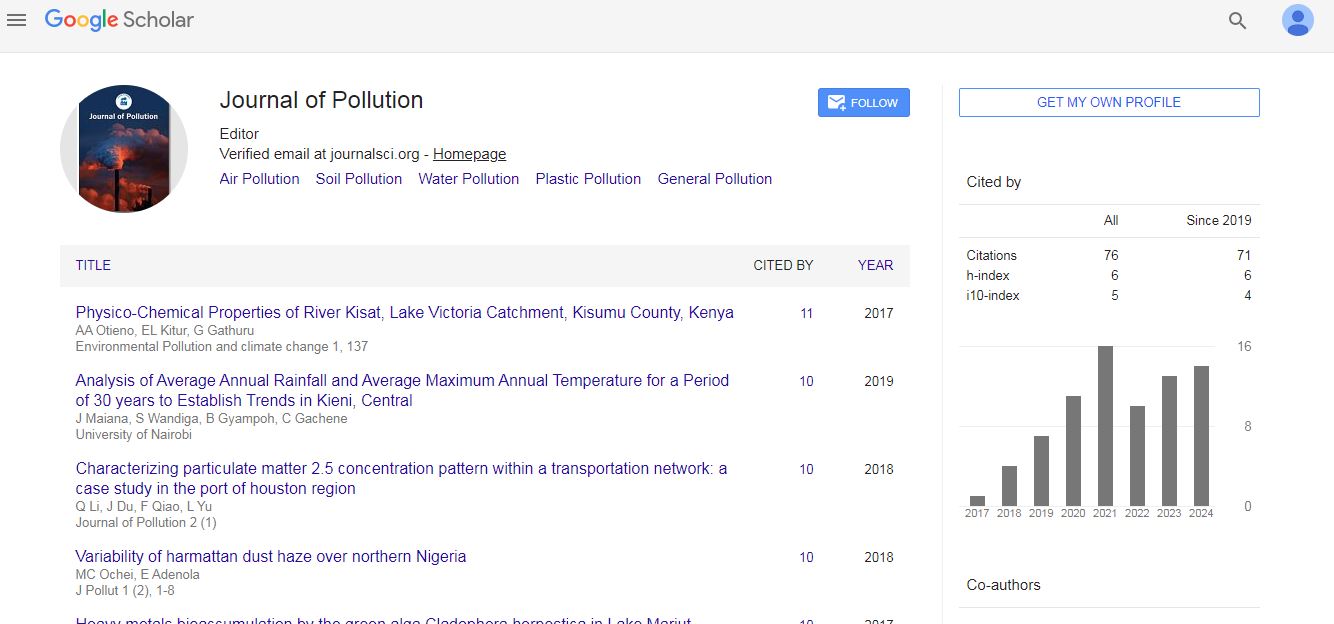
Journal of Pollution received 64 citations as per Google Scholar report