Brief Report - (2025) Volume 14, Issue 5
Received: 02-Sep-2025, Manuscript No. pbt-25-173773;
Editor assigned: 04-Dec-2025, Pre QC No. P-173773;
Reviewed: 18-Sep-2025, QC No. Q-173773;
Revised: 23-Sep-2025, Manuscript No. R-173773;
Published:
30-Sep-2025
, DOI: 10.37421/2167-7689.2025.14.502
Citation: Fitzgerald, Naomi. ”Regulatory Science: Navigating Innovation for Patient Safety.” Pharmaceut Reg Affairs 14 (2025):502.
Copyright: © 2025 Fitzgerald N. This is an open-access article distributed under the terms of the Creative Commons Attribution License, which permits unrestricted use,
distribution and reproduction in any medium, provided the original author and source are credited.
The field of regulatory science is dynamically evolving, playing a crucial part in modern drug development by emphasizing novel methodologies, data analytics, and Real-World Evidence (RWE). This streamlines the regulatory submission process from early research to post-market surveillance, accelerating approval of safe and effective therapeutics while maintaining high quality standards [1].
Regulators also grapple with the complexities of Artificial Intelligence (AI)-based medical devices, ensuring safety, efficacy, and ethical considerations throughout their lifecycle. Adaptable regulatory frameworks are needed to keep pace with rapid technological advancements, covering pre-market assessment to post-market surveillance, fostering innovation while protecting public health [2].
Meanwhile, expedited drug development programs in regions like the United States and the European Union aim to bring critically needed drugs to market faster. These pathways, including Fast Track and Breakthrough Therapy, introduce complexities requiring robust post-market studies and a careful balance between speed and ensuring long-term safety and efficacy [3].
A growing area of focus is the burgeoning role of Real-World Evidence (RWE) in regulatory decision-making. Real-World Evidence (RWE), derived from sources like electronic health records and patient registries, complements traditional clinical trial data, providing a comprehensive understanding of a product's safety and effectiveness in diverse patient populations. Methodological considerations, data quality, and an evolving regulatory landscape are crucial to fully leverage Real-World Evidence (RWE) for informed submissions [4].
The global regulatory environment for digital health technologies is also rapidly changing, with jurisdictions adapting frameworks for software as a medical device, Artificial Intelligence (AI)-driven tools, and telehealth platforms. Harmonization of standards, agile review processes, and a focus on data privacy and security are critical to ensure these innovations safely and effectively reach patients worldwide [5].
Regulatory harmonization for pharmaceutical products, specifically focusing on the Asia-Pacific region, presents both advances and persistent challenges. Diverse national regulations impact drug development and market access, highlighting efforts by international bodies and regional alliances to standardize submission requirements. Greater harmonization can reduce duplication, accelerate product availability, and improve public health outcomes through more efficient cross-border regulatory processes [6].
Beyond initial approval, Post-Market Surveillance (PMS) plays a critical function in refining regulatory decisions for medical devices. Continuous monitoring of device performance and safety after market entry provides invaluable real-world data, informing updates to regulatory submissions and product labeling. Various Post-Market Surveillance (PMS) methodologies are stressed for identifying long-term risks and improving device safety and efficacy, ensuring patient protection [7].
Orphan drug development presents specific global regulatory considerations. Therapeutics for rare diseases face unique challenges, including smaller patient populations and limited clinical data, necessitating specialized incentives. Regulatory frameworks in the US, EU, and Japan emphasize pathways designed to accelerate approval while maintaining rigorous safety and efficacy standards, aiming to bring life-saving treatments to patients with unmet medical needs [8].
Good Manufacturing Practices (GMP) are fundamentally important for maintaining the quality and safety of pharmaceutical products and biologics throughout their lifecycle. Adherence to Good Manufacturing Practices (GMP) guidelines is a cornerstone of regulatory submissions, ensuring consistency in manufacturing processes, control of contamination, and robust quality management systems. Global regulatory expectations for Good Manufacturing Practices (GMP) compliance directly impact regulatory approval and patient trust [9].
Finally, patient engagement is increasingly important in regulatory submissions and decision-making processes. Current strategies integrate patient perspectives, experiences, and preferences into product development and review. This collaborative approach leads to better-designed clinical trials and more patient-centric outcomes. Addressing challenges related to methodologies and meaningful inclusion, standardized frameworks are advocated to ensure robust and impactful patient involvement in regulatory pathways [10].
Regulatory science is fundamental to modern drug development, emphasizing novel methodologies, data analytics, and Real-World Evidence (RWE) to streamline regulatory submissions. This framework, spanning early research to post-market surveillance, accelerates approval of safe, effective therapeutics while maintaining high quality standards [1]. It helps navigate the complexities of product lifecycles and ensures patient protection.
Artificial Intelligence (AI)-based medical devices introduce unique regulatory hurdles concerning safety, efficacy, and ethical considerations. Adaptable regulatory frameworks are crucial to keep pace with rapid technological advancements, covering pre-market assessment to post-market surveillance. The goal remains fostering innovation while safeguarding public health [2]. Concurrently, expedited drug development programs in the United States and European Union, such as Fast Track and Breakthrough Therapy, aim to bring critically needed drugs to market faster. These pathways, however, require robust post-market studies and a careful balance between speed and ensuring long-term safety and efficacy [3].
The role of Real-World Evidence (RWE) in regulatory decision-making is rapidly expanding. Derived from sources like electronic health records and patient registries, Real-World Evidence (RWE) complements traditional clinical trial data, offering a more comprehensive understanding of a product's safety and effectiveness in diverse patient populations. Methodological considerations, data quality, and an evolving regulatory landscape are necessary to fully leverage Real-World Evidence (RWE) for informed submissions [4]. Similarly, the global regulatory environment for digital health technologies is rapidly changing, with jurisdictions adapting frameworks for software as a medical device, Artificial Intelligence (AI)-driven tools, and telehealth platforms. Harmonization of standards, agile review processes, and a focus on data privacy and security are essential to safely and effectively bring these innovations to patients worldwide [5].
Regulatory harmonization for pharmaceutical products, particularly in the Asia-Pacific region, faces ongoing challenges and progress. Diverse national regulations complicate drug development and market access. Efforts by international bodies aim to standardize submission requirements, which could reduce duplication, accelerate product availability, and improve public health outcomes through more efficient cross-border processes [6]. Following market entry, Post-Market Surveillance (PMS) is critical for refining regulatory decisions for medical devices. Continuous monitoring provides real-world data that informs updates to submissions and labeling. Various Post-Market Surveillance (PMS) methodologies are important for identifying long-term risks and improving device safety and efficacy, thereby ensuring patient protection [7].
Orphan drug development also has specific global regulatory considerations. Rare disease therapeutics face unique obstacles like small patient populations and limited data, necessitating specialized incentives. Regulatory frameworks in the US, EU, and Japan offer pathways to accelerate approval while upholding rigorous safety and efficacy standards, aiming to meet unmet medical needs [8]. Good Manufacturing Practices (GMP) are paramount for maintaining the quality and safety of pharmaceuticals and biologics. Adherence to Good Manufacturing Practices (GMP) guidelines is a cornerstone of regulatory submissions, ensuring consistency, contamination control, and robust quality management systems. Global Good Manufacturing Practices (GMP) compliance directly impacts regulatory approval and patient trust [9]. Finally, patient engagement is increasingly vital in regulatory submissions and decision-making. Integrating patient perspectives and preferences into product development and review can lead to better-designed clinical trials and patient-centric outcomes. Standardized frameworks are advocated to ensure impactful patient involvement in regulatory pathways [10].
The landscape of regulatory science is dynamically evolving, playing an indispensable role in ensuring the safety and efficacy of medical products. Modern drug development increasingly relies on novel methodologies, sophisticated data analytics, and Real-World Evidence (RWE) to streamline submissions and accelerate approvals. Challenges persist in regulating emerging technologies like Artificial Intelligence (AI)-based medical devices, where adaptable frameworks are crucial to balance innovation with public health protection. Expedited drug development programs, while speeding up access to critical therapies, necessitate robust post-market studies to confirm long-term safety. The expanding use of Real-World Evidence (RWE) from sources such as electronic health records provides a richer understanding of product performance in diverse patient populations, requiring careful methodological and data quality considerations. Global regulatory harmonization for both digital health technologies and pharmaceutical products, particularly in regions like Asia-Pacific, is a key focus to reduce duplication and improve market access. Furthermore, Post-Market Surveillance (PMS) remains vital for medical devices, offering continuous data for refining regulatory decisions and enhancing product safety. Specialized considerations apply to orphan drug development, which demands unique incentives and pathways to address rare diseases. Good Manufacturing Practices (GMP) are fundamental to product quality and safety, serving as a cornerstone for regulatory approvals and patient trust. Finally, integrating patient engagement into regulatory processes is gaining momentum, aiming to foster more patient-centric product development and decision-making. These interconnected areas highlight the multifaceted efforts required to navigate and advance regulatory science effectively.
None
None
1. Minli H, Ping Y, Shaoli H. "Regulatory science for drug development: an overview of key concepts and recent advances".Curr Pharm Des 28 (2022):2154-2164.
Indexed at, Google Scholar, Crossref
2. Zhen C, Yang L, Xiang W. "Artificial Intelligence-Based Medical Devices: A Comprehensive Overview of Regulatory Challenges and Solutions".Front Med 10 (2023):1121016.
Indexed at, Google Scholar, Crossref
3. Jun L, Jian C, Zhen W. "Expedited drug development programs in the United States and European Union: current trends and challenges".Expert Rev Clin Pharmacol 14 (2021):1195-1206.
Indexed at, Google Scholar, Crossref
4. Robert ES, Richard EG, Bob GL. "Real-World Evidence in Regulatory Decision Making: Challenges and Opportunities".Clin Pharmacol Ther 107 (2020):781-789.
Indexed at, Google Scholar, Crossref
5. Steven RS, Lorie W, Alan C. "The evolving landscape of digital health regulation: a global perspective".NPJ Digit Med 6 (2023):149.
Indexed at, Google Scholar, Crossref
6. Yu C, Shengjie L, Hong W. "Progress and Challenges in Regulatory Harmonization for Pharmaceutical Products: An Asia-Pacific Perspective".Front Pharmacol 13 (2022):902895.
Indexed at, Google Scholar, Crossref
7. John MS, Katherine EJ, Andrew LB. "The Role of Post-Market Surveillance in Optimizing Regulatory Decision-Making for Medical Devices".Med Devices (Auckl) 13 (2020):233-242.
Indexed at, Google Scholar, Crossref
8. Mary AJ, Seok PL, Do YK. "Regulatory Considerations for Orphan Drug Development: A Global Perspective".J Clin Pharmacol 62 (2022):1303-1311.
Indexed at, Google Scholar, Crossref
9. Rohit S, Alok K, Suresh P. "The Role of Good Manufacturing Practices (GMP) in Ensuring Quality and Safety of Pharmaceuticals and Biologics: A Regulatory Perspective".J Pharm Sci 110 (2021):3505-3515.
Indexed at, Google Scholar, Crossref
10. Lisa G, Peter W, Mark B. "Patient Engagement in Regulatory Submissions and Decision-Making: Current Practices and Future Directions".Ther Innov Regul Sci 57 (2023):14-23.
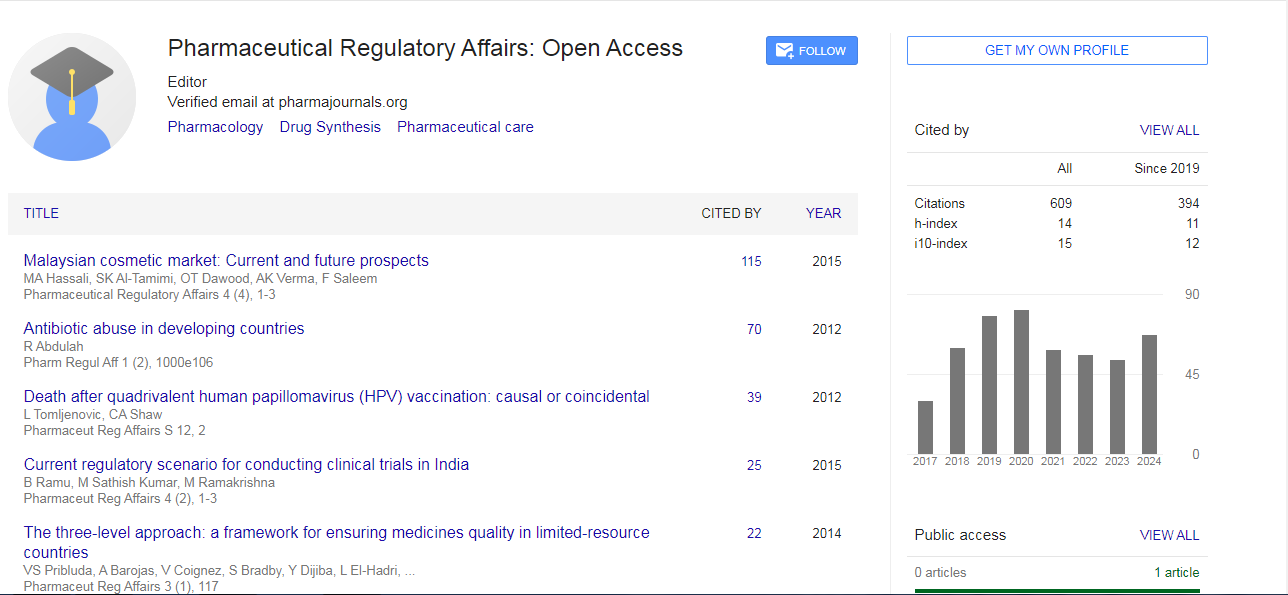
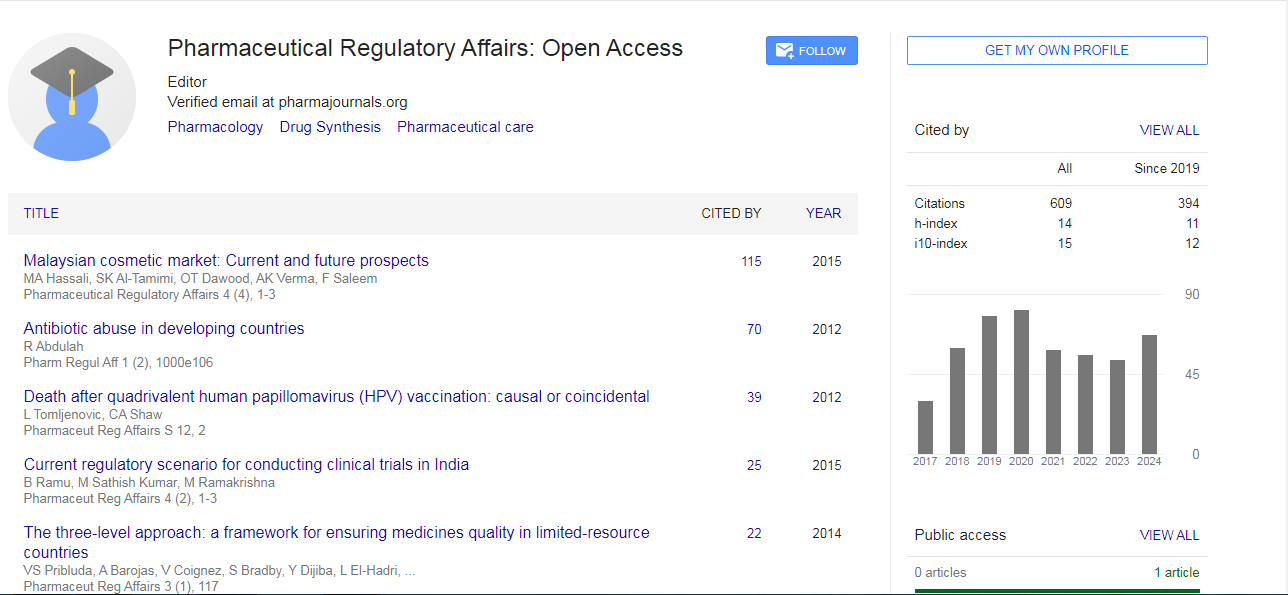
Pharmaceutical Regulatory Affairs: Open Access received 533 citations as per Google Scholar report