Opinion - (2025) Volume 10, Issue 1
Received: 01-Feb-2025, Manuscript No. arwm-25-165538;
Editor assigned: 03-Feb-2025, Pre QC No. P-165538;
Reviewed: 14-Feb-2025, QC No. Q-165538;
Revised: 19-Jan-2025, Manuscript No. R-165538;
Published:
26-Feb-2025
, DOI: 10.37421/2475-7675.2025.10.390
Citation: Kubo, Tanaka. “Recent Advances in Adsorption Materials for Clean Energy.’’ Adv Recycling Waste Manag 10 (2025): 390.
Copyright: © 2025 Kubo T. This is an open-access article distributed under the terms of the Creative Commons Attribution License, which permits unrestricted use, distribution and reproduction in any medium, provided the original author and source are credited.
In the global quest for sustainable development and environmental stewardship, clean energy technologies have assumed a pivotal role. Among these technologies, adsorption materials have emerged as critical components in various clean energy applications, including carbon capture, hydrogen storage, gas separation, and energy-efficient cooling systems. The advancement in the design, synthesis, and application of novel adsorption materials has significantly improved the performance and efficiency of these energy systems. Recent years have witnessed a surge in research focused on the development of high-performance adsorbents with enhanced capacity, selectivity, regeneration capability, and environmental stability, driven by both the urgent need to mitigate climate change and the rapid evolution of materials science.
One of the most extensively studied applications of adsorption materials is carbon dioxide capture from industrial emissions and the atmosphere. Traditional materials such as activated carbon, zeolites, and silica gels have been widely used due to their porous nature and relatively low cost. However, these materials often suffer from limited selectivity and poor regeneration performance under the humid and variable conditions typical of real-world flue gases. As a response, metal-organic frameworks (MOFs) have garnered significant attention for COâ?? capture. MOFs are crystalline materials composed of metal ions or clusters coordinated to organic ligands, forming highly porous structures with tunable pore sizes and surface functionalities. Their modular nature allows for the fine-tuning of adsorption properties, including selectivity for COâ?? over nitrogen or methane, high uptake capacity, and low energy requirements for regeneration. For instance, amine-functionalized MOFs have demonstrated exceptional COâ?? uptake under low partial pressures, which is crucial for capturing carbon directly from air or dilute sources [1].
Covalent Organic Frameworks (COFs), another class of crystalline porous materials, have also been investigated for clean energy applications. COFs possess high surface areas, structural regularity, and low densities, making them suitable for gas storage and separation. Unlike MOFs, COFs are built entirely from light elements such as carbon, hydrogen, nitrogen, and oxygen, resulting in materials that are typically more thermally and chemically stable. Recent developments in COF synthesis have enabled the incorporation of functional groups that enhance interactions with specific gases, thereby improving selectivity and uptake. Moreover, their organic nature allows for greater flexibility in tailoring electronic properties, potentially opening new avenues in photo catalysis and energy storage [2].
In hydrogen storage, adsorption-based methods offer a promising alternative to traditional storage techniques such as compression and liquefaction, which are energy-intensive and often pose safety risks. Materials such as MOFs, porous polymers, and carbon-based adsorbents have been extensively explored for their hydrogen storage capacities under various temperature and pressure conditions. The key to effective hydrogen storage lies in the balance between high surface area and favorable binding energy. While physisorption materials can store large volumes of hydrogen at cryogenic temperatures, recent efforts have focused on developing materials that can achieve substantial hydrogen uptake at near-ambient conditions. This includes doping porous carbon materials with heteroatoms such as nitrogen and boron to create stronger adsorption sites and enhance binding energies. Similarly, incorporating metal nanoparticles into MOFs or porous polymers has shown to improve hydrogen spillover effects, thereby increasing storage capacity [3,4].
The role of adsorption materials in gas separation is another critical area of development, especially for purifying methane from biogas, separating oxygen from air, or recovering valuable hydrocarbons from mixed gas streams. Zeolites have long been used in industrial-scale separations due to their well-defined microporosity and ion-exchange capabilities. However, newer materials such as ultramicroporous materials and hybrid materials have demonstrated superior selectivity and stability. One promising direction is the design of "molecular sieves" that can distinguish gas molecules based on size, shape, or polarity. This is particularly useful in separating gases with very similar physical properties, such as ethylene and ethane or nitrogen and oxygen [5]. Functionalized MOFs, for example, can be engineered to have gate-opening behavior or responsive adsorption characteristics, enabling dynamic separation processes that are more energy-efficient than traditional cryogenic distillation or chemical absorption methods.
In addition to gas storage and separation, adsorption materials are playing an increasingly important role in adsorption-based cooling and heating technologies, particularly for applications in building climate control and waste heat recovery. Adsorption chillers operate on the principle of adsorbing and desorbing a refrigerant (usually water or ammonia) onto a solid adsorbent under cyclic temperature changes. The performance of these systems is directly influenced by the adsorption capacity, thermal conductivity, and cycling stability of the adsorbent material. Silica gels and activated carbons have traditionally been used, but their low adsorption enthalpy and poor thermal conductivity limit system efficiency. Advances in composite adsorbents, such as silica impregnated with salts or hybrid materials combining metal oxides and polymers, have led to higher specific cooling powers and more compact designs. Furthermore, recent research has explored the use of MOFs and COFs in adsorption refrigeration, with promising results in terms of both energy efficiency and miniaturization potential.
A notable trend in the field is the increasing integration of computational materials science and machine learning with experimental efforts. High-throughput screening, density functional theory calculations, and molecular dynamics simulations have accelerated the discovery of new adsorbent materials by predicting their performance before synthesis. These computational tools can evaluate thousands of hypothetical materials for specific applications, identifying the most promising candidates based on properties such as surface area, pore volume, and esoteric heat of adsorption. Moreover, machine learning algorithms can uncover hidden structure-property relationships and guide the rational design of materials with tailored functionalities. This data-driven approach is expected to play a central role in the development of next-generation adsorbents, particularly as more experimental data become available for training and validation.
Google Scholar Cross Ref Indexed at
Google Scholar Cross Ref Indexed at
Google Scholar Cross Ref Indexed at
Google Scholar Cross Ref Indexed at
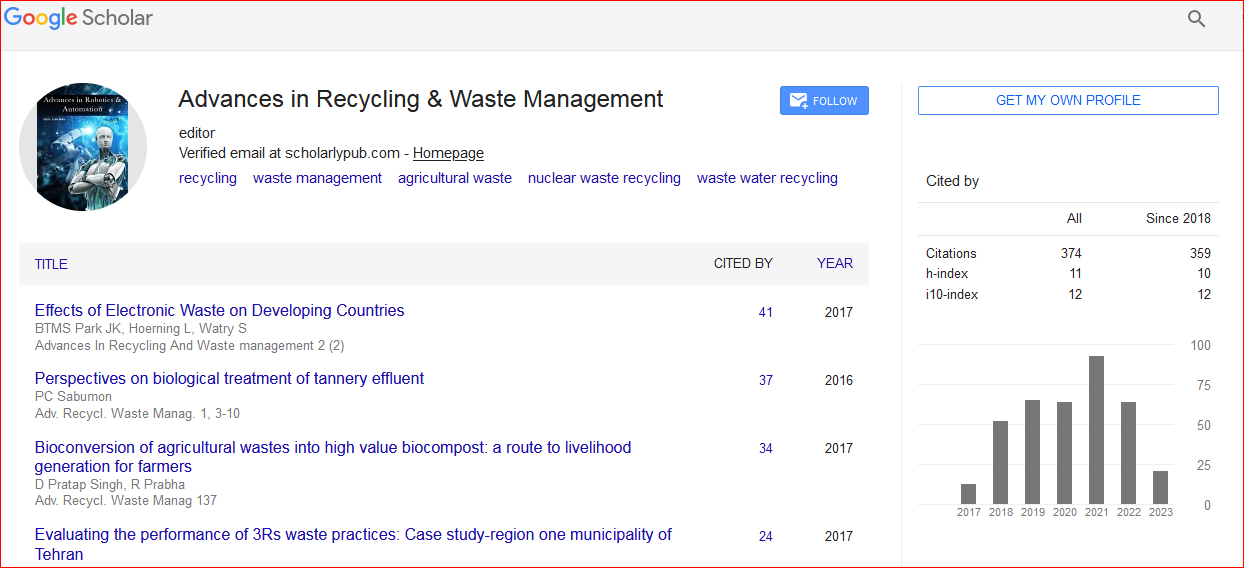
Advances in Recycling & Waste Management received 438 citations as per Google Scholar report