Brief Report - (2025) Volume 16, Issue 5
Received: 01-Sep-2025, Manuscript No. jhmi-26-178868;
Editor assigned: 03-Sep-2025, Pre QC No. P-178868;
Reviewed: 17-Sep-2025, QC No. Q-178868;
Revised: 22-Sep-2025, Manuscript No. R-178868;
Published:
29-Sep-2025
, DOI: 10.37421/2157-7420.2025.16.610
Citation: Okeke, Chinedu O.. ”Real-Time Analytics Revolutionizes Critical Care Outcomes.” J Health Med Informat 16 (2025):610.
Copyright: © 2025 Okeke O. Chinedu This is an open-access article distributed under the terms of the Creative Commons Attribution License, which permits unrestricted use, distribution and reproduction in any medium, provided the original author and source are credited.
Real-time analytics in critical care monitoring is fundamentally transforming patient management by providing immediate insights into vital signs and physiological data. This capability is crucial for the faster detection of deteriorating conditions, enabling proactive interventions and ultimately leading to improved patient outcomes. The integration of advanced data processing and visualization tools plays a pivotal role in establishing early warning systems and facilitating personalized treatment adjustments, thereby enhancing the efficiency and effectiveness of care in intensive settings [1].
The application of machine learning algorithms to real-time physiological data streams in critical care offers significant predictive capabilities for adverse events. These systems can forecast the likelihood of conditions such as sepsis or cardiac arrest, analyzing complex patterns in vital signs to alert clinicians to subtle changes that might otherwise be missed. This approach moves beyond simple threshold alarms to sophisticated risk stratification, potentially improving the timeliness of interventions and enhancing patient survival rates [2].
Implementing real-time analytics dashboards within intensive care units significantly enhances clinical situational awareness. These dashboards consolidate data from various monitoring devices, presenting it in an intuitive and actionable format. This visual clarity empowers healthcare teams to rapidly assess patient status, identify critical trends, and make more informed decisions, thereby reducing cognitive load and improving response times during high-stakes critical events [3].
The expanding scope of real-time analytics is being driven by the integration of wearable sensors and remote monitoring technologies. This innovation allows for continuous patient surveillance beyond the confines of the traditional ICU, enabling early detection of decompensation and facilitating timely interventions to prevent hospital readmissions. These systems are becoming increasingly vital for the effective management of chronic conditions and post-acute care [4].
However, the widespread implementation of real-time analytics in critical care faces several challenges. These include ensuring data quality, achieving interoperability between diverse medical devices, and maintaining robust cybersecurity measures. Addressing these issues is paramount to guarantee the reliability and security of patient data, which is an absolute necessity for making life-saving clinical decisions. Furthermore, ethical considerations and the potential for alert fatigue require careful and strategic management [5].
The deployment of artificial intelligence and advanced analytics in critical care environments holds substantial promise for identifying patients at high risk of developing serious complications. These predictive models, powered by real-time patient data, can flag individuals susceptible to conditions like acute kidney injury or respiratory failure, enabling proactive interventions that may reduce the severity of these complications and improve recovery trajectories [6].
Seamless real-time data integration from a multitude of sources, including electronic health records, laboratory systems, and bedside monitors, is foundational for comprehensive critical care analytics. Achieving true interoperability is the key to creating a unified and holistic patient view. This unified perspective is essential for supporting timely and informed clinical decisions, ultimately driving the healthcare environment towards greater connectivity and data-driven practices [7].
The development of sophisticated algorithms designed for the real-time detection of subtle physiological changes is critically important for enhancing patient safety in critical care settings. These advanced systems can identify the earliest signs of patient deterioration, such as variations in heart rate variability or respiratory patterns, thereby allowing for preemptive clinical intervention and potentially averting critical adverse events [8].
Personalized medicine in critical care settings is significantly advanced by the capabilities of real-time analytics. This technology allows for the dynamic adjustment of treatment strategies based on individual patient responses observed in real-time. By continuously analyzing a patient's unique physiological data, clinicians can optimize medication dosages, ventilator settings, and other therapeutic interventions, leading to improved patient outcomes and a reduction in adverse side effects [9].
Finally, the integration of real-time analytics with clinical decision support systems (CDSS) substantially enhances the capabilities of healthcare providers operating in critical care. By delivering evidence-based recommendations and timely alerts derived from continuous patient data analysis, CDSS can improve the accuracy and efficiency of diagnostic and therapeutic decisions, ultimately leading to enhanced patient care and a reduction in medical errors [10].
Real-time analytics in critical care monitoring is revolutionizing patient management by providing immediate insights into vital signs and physiological data. This capability is crucial for the faster detection of deteriorating conditions, enabling proactive interventions and ultimately leading to improved patient outcomes. The integration of advanced data processing and visualization tools plays a pivotal role in establishing early warning systems and facilitating personalized treatment adjustments, thereby enhancing the efficiency and effectiveness of care in intensive settings [1].
The application of machine learning algorithms to real-time physiological data streams in critical care offers significant predictive capabilities for adverse events. These systems can forecast the likelihood of conditions such as sepsis or cardiac arrest, analyzing complex patterns in vital signs to alert clinicians to subtle changes that might otherwise be missed. This approach moves beyond simple threshold alarms to sophisticated risk stratification, potentially improving the timeliness of interventions and enhancing patient survival rates [2].
Implementing real-time analytics dashboards within intensive care units significantly enhances clinical situational awareness. These dashboards consolidate data from various monitoring devices, presenting it in an intuitive and actionable format. This visual clarity empowers healthcare teams to rapidly assess patient status, identify critical trends, and make more informed decisions, thereby reducing cognitive load and improving response times during high-stakes critical events [3].
The expanding scope of real-time analytics is being driven by the integration of wearable sensors and remote monitoring technologies. This innovation allows for continuous patient surveillance beyond the confines of the traditional ICU, enabling early detection of decompensation and facilitating timely interventions to prevent hospital readmissions. These systems are becoming increasingly vital for the effective management of chronic conditions and post-acute care [4].
However, the widespread implementation of real-time analytics in critical care faces several challenges. These include ensuring data quality, achieving interoperability between diverse medical devices, and maintaining robust cybersecurity measures. Addressing these issues is paramount to guarantee the reliability and security of patient data, which is an absolute necessity for making life-saving clinical decisions. Furthermore, ethical considerations and the potential for alert fatigue require careful and strategic management [5].
The deployment of artificial intelligence and advanced analytics in critical care environments holds substantial promise for identifying patients at high risk of developing serious complications. These predictive models, powered by real-time patient data, can flag individuals susceptible to conditions like acute kidney injury or respiratory failure, enabling proactive interventions that may reduce the severity of these complications and improve recovery trajectories [6].
Seamless real-time data integration from a multitude of sources, including electronic health records, laboratory systems, and bedside monitors, is foundational for comprehensive critical care analytics. Achieving true interoperability is the key to creating a unified and holistic patient view. This unified perspective is essential for supporting timely and informed clinical decisions, ultimately driving the healthcare environment towards greater connectivity and data-driven practices [7].
The development of sophisticated algorithms designed for the real-time detection of subtle physiological changes is critically important for enhancing patient safety in critical care settings. These advanced systems can identify the earliest signs of patient deterioration, such as variations in heart rate variability or respiratory patterns, thereby allowing for preemptive clinical intervention and potentially averting critical adverse events [8].
Personalized medicine in critical care settings is significantly advanced by the capabilities of real-time analytics. This technology allows for the dynamic adjustment of treatment strategies based on individual patient responses observed in real-time. By continuously analyzing a patient's unique physiological data, clinicians can optimize medication dosages, ventilator settings, and other therapeutic interventions, leading to improved patient outcomes and a reduction in adverse side effects [9].
Finally, the integration of real-time analytics with clinical decision support systems (CDSS) substantially enhances the capabilities of healthcare providers operating in critical care. By delivering evidence-based recommendations and timely alerts derived from continuous patient data analysis, CDSS can improve the accuracy and efficiency of diagnostic and therapeutic decisions, ultimately leading to enhanced patient care and a reduction in medical errors [10].
Real-time analytics is revolutionizing critical care by enabling immediate insights into patient vital signs and physiological data, leading to faster detection of deterioration and improved outcomes. Machine learning algorithms applied to these data streams unlock predictive capabilities for adverse events, enhancing early intervention and patient survival. Integrated dashboards improve clinical situational awareness and decision-making, while wearable sensors extend continuous surveillance beyond the ICU. Challenges include data quality, interoperability, and cybersecurity. Artificial intelligence and advanced analytics help predict complications, and seamless data integration from diverse sources is crucial for a unified patient view. Sophisticated algorithms are vital for early detection of deterioration, and real-time analytics enables personalized treatment strategies. The integration with clinical decision support systems further enhances care by providing evidence-based recommendations and alerts.
None
None
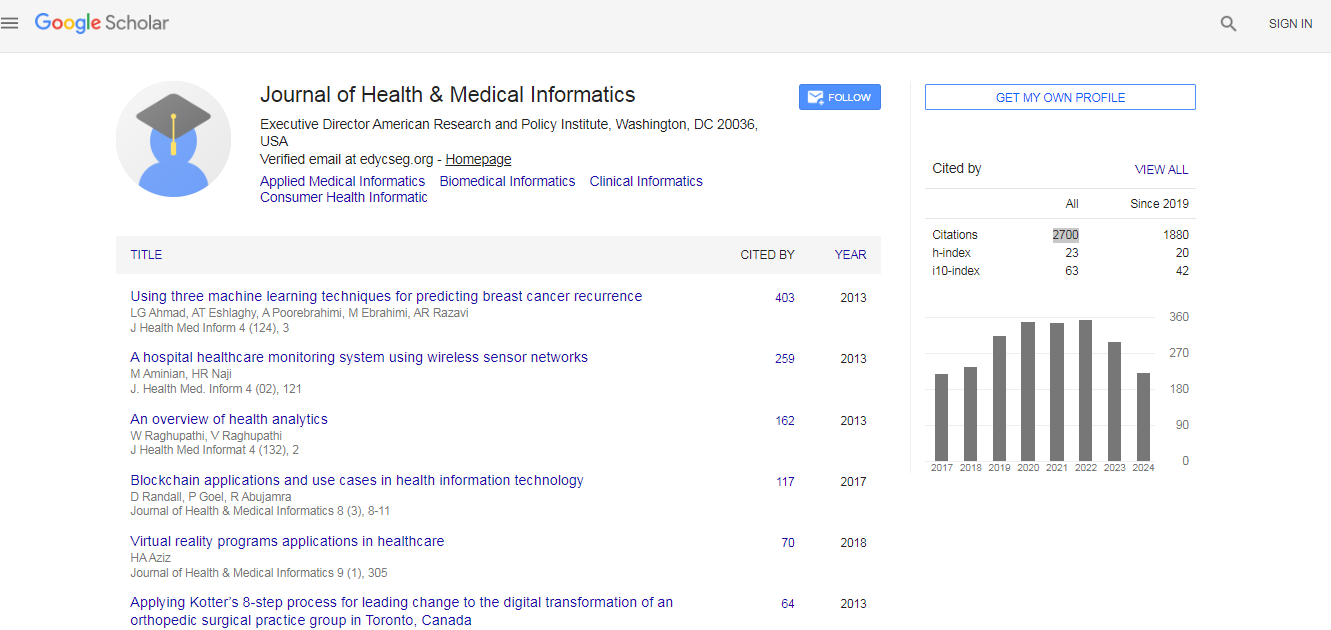
Journal of Health & Medical Informatics received 2700 citations as per Google Scholar report