Opinion - (2025) Volume 18, Issue 5
Received: 31-Aug-2025, Manuscript No. jcsb-25-176456;
Editor assigned: 02-Sep-2025, Pre QC No. P-176456;
Reviewed: 16-Sep-2025, QC No. Q-176456;
Revised: 23-Sep-2025, Manuscript No. R-176456;
Published:
30-Sep-2025
, DOI: 10.37421/0974-7230.2025.18.608
Citation: Ilic, Katarina. ”Quantum Algorithms: Transforming Biomedical Data Science.” J Comput Sci Syst Biol 18 (2025):608.
Copyright: © 2025 Ilic K. This is an open-access article distributed under the terms of the Creative Commons Attribution License, which permits unrestricted use, distribution and reproduction in any medium, provided the original author and source are credited.
The intersection of quantum mechanics and computational science is giving rise to a new paradigm: quantum computing, which promises to fundamentally alter how we approach complex scientific and engineering problems. This evolving field is particularly poised to make significant inroads into areas traditionally limited by classical computational capabilities, notably within biomedical research and healthcare. The inherent ability of quantum algorithms to process vast datasets and simulate intricate systems provides a unique advantage, moving beyond the limitations faced by conventional methods. In biomedical research generally, quantum algorithms are being explored to accelerate intricate simulations and data processing across diverse applications. This includes drug discovery, protein folding, medical imaging, and genomic analysis. Such capabilities offer fresh perspectives for understanding biological systems and developing groundbreaking therapeutic strategies [1].
Specifically, quantum machine learning algorithms are enhancing medical image processing. By leveraging quantum principles like superposition and entanglement, these methods can improve classical techniques for image segmentation, classification, and reconstruction. Quantum support vector machines and quantum neural networks show potential for significant speedups and improved accuracy when analyzing complex medical datasets, while also setting the stage for future research [2].
Molecular structure prediction, a cornerstone of drug discovery, benefits significantly from quantum computational methods. Techniques like variational quantum eigensolvers (VQE) and quantum phase estimation (QPE) are employed to accurately determine molecular ground state energies and geometries. These algorithms aim to surmount classical limitations in handling complex electronic structures, thereby speeding up the identification and optimization of new drug candidates [3].
For genomic sequence analysis, quantum algorithms are being developed to address crucial tasks such as sequence alignment, motif discovery, and phylogenetic tree reconstruction. These approaches exploit quantum phenomena to potentially offer speedups for computationally intensive problems. However, their practical implementation on current noisy intermediate-scale quantum (NISQ) devices remains a key challenge for future development [4].
The broader domain of biomedical data science also benefits from quantum paradigms designed to tackle computational bottlenecks in large-scale datasets. This encompasses complex pattern recognition and advanced statistical modeling. Quantum algorithms offer theoretical advantages for tasks like feature selection, dimensionality reduction, and classification, providing insights into their practical application despite hurdles to widespread adoption [5].
The protein folding problem, a formidable challenge in computational biology, is being addressed through novel quantum algorithms. Approaches like quantum annealing or variational quantum eigensolvers are used to explore protein conformational landscapes and predict stable 3D structures. By harnessing quantum parallelism and entanglement, these methods offer a promising path to overcome the exponential complexity faced by classical techniques, with profound implications for drug design and understanding protein-related diseases [6].
Quantum-based algorithms are also emerging for complex problems in neuroimaging. These can enhance the analysis of intricate neural network data, aid in identifying biomarkers for neurological disorders, and improve diagnostic accuracy. By managing the computational demands of high-dimensional brain imaging data, these algorithms offer a novel approach to understanding brain function and dysfunction, paving the way for advanced neurological research and personalized treatment [7].
In systems biology, quantum computing offers new ways to understand complex biological systems. Quantum algorithms are applied to simulate molecular interactions, analyze cellular networks, and delve into disease mechanisms at a fundamental level. These approaches aim to transcend classical computational limits, especially for large-scale simulations and optimization, suggesting a transformative impact on biological research and drug development [8].
The scope of quantum algorithms extends to materials science, where they are set to transform material design, discovery, and characterization. Quantum computational methods can predict material properties, simulate quantum many-body systems, and optimize material structures. Algorithms for electronic structure calculations and phase transitions illustrate how quantum approaches can overcome classical limitations in simulating complex quantum phenomena, accelerating the development of advanced materials [9].
Within the healthcare sector, quantum machine learning algorithms promise to enhance predictive analytics for disease diagnosis, personalize treatment plans, and optimize drug discovery processes. Quantum support vector machines and quantum neural networks demonstrate theoretical advantages in processing large, complex medical datasets. While practical clinical implementation faces challenges due to evolving quantum hardware, the potential for these advancements is substantial [10].
This collective body of research underscores a powerful shift towards quantum-enhanced capabilities across scientific and medical innovation.
Quantum algorithms represent a significant advancement in computational science, offering solutions to problems currently intractable for classical methods, particularly across various biomedical and scientific disciplines. These algorithms leverage fundamental quantum phenomena like superposition and entanglement to perform calculations with unprecedented efficiency, driving innovation in areas ranging from drug discovery to medical imaging and materials science. The core advantage lies in their ability to handle vast datasets and simulate highly complex systems, thereby accelerating scientific understanding and technological development.
One major application area is in the life sciences, where quantum algorithms are poised to transform how we approach biological problems. In biomedical research, quantum approaches are deployed to speed up complex simulations and data processing tasks, leading to new insights into biological systems and enabling the development of novel therapeutic strategies [1]. For instance, the challenging protein folding problem, critical for understanding protein function and disease, is being tackled with quantum annealing and variational quantum eigensolver techniques. These methods aim to predict stable 3D protein structures by exploring vast conformational landscapes, offering a promising alternative to computationally expensive classical methods [6]. Similarly, molecular structure prediction, a vital step in drug discovery, is enhanced by quantum computational methods such as VQE and QPE, which accurately determine ground state energies and geometries of molecules. This capability helps overcome classical limitations in handling complex electronic structures, thereby accelerating the identification and optimization of new drug candidates [3]. The emerging role of quantum computing in systems biology further highlights its potential to simulate molecular interactions, analyze cellular networks, and understand disease mechanisms at a fundamental level, addressing large-scale simulations and optimization problems beyond classical reach [8].
Quantum algorithms are also making substantial contributions to data-intensive fields like medical imaging and genomic analysis. Quantum machine learning algorithms, for example, provide a comprehensive overview of how quantum computing principles can enhance medical image processing tasks, including image segmentation, classification, and reconstruction. These algorithms, such as quantum support vector machines and quantum neural networks, promise significant speedups and improved accuracy in analyzing complex medical datasets [2]. In genomic sequence analysis, quantum algorithms are specifically designed for tasks like sequence alignment, motif discovery, and phylogenetic tree reconstruction. These methods exploit quantum phenomena to potentially offer speedups for computationally intensive processes crucial for understanding biological functions and disease mechanisms [4]. Moreover, for the broader field of biomedical data science, quantum computing paradigms address bottlenecks in processing large-scale datasets, from complex pattern recognition to advanced statistical modeling. They offer theoretical advantages for feature selection, dimensionality reduction, and classification, providing critical insights for practical implementation in research and clinical settings [5].
Beyond these areas, quantum algorithms are extending their reach into specialized domains like neuroimaging and even materials science. In neuroimaging, quantum-based algorithms are proposed to solve complex problems, enhancing the analysis of intricate neural network data, identifying biomarkers for neurological disorders, and improving diagnostic accuracy. These algorithms offer a novel perspective on understanding brain function and dysfunction by addressing the computational challenges of high-dimensional brain imaging data [7]. Interestingly, the principles also translate effectively to materials science, where quantum algorithms are explored for revolutionizing the design, discovery, and characterization of novel materials. They offer quantum computational approaches to predicting material properties, simulating quantum many-body systems, and optimizing material structures, surpassing classical limitations in simulating complex quantum phenomena [9].
Finally, the overarching healthcare sector stands to gain immensely from quantum machine learning algorithms, which can enhance predictive analytics for disease diagnosis, personalize treatment plans, and optimize drug discovery processes. Specific algorithms like quantum support vector machines and quantum neural networks demonstrate theoretical advantages in processing large, complex medical datasets, promising a future where these advancements translate into practical clinical tools [10]. The ongoing development of quantum hardware and the refinement of these algorithms continue to be pivotal for their widespread adoption and impact.
Quantum algorithms are rapidly transforming various scientific fields, particularly within biomedical research and data science. These advanced computational methods are being applied to accelerate complex simulations and data processing, moving beyond the limits of classical computing. For example, quantum algorithms are explored for drug discovery, where they help in molecular structure prediction and understanding protein folding, crucial steps for developing new therapies. In medical imaging and genomic analysis, quantum machine learning techniques promise significant speedups and improved accuracy. These methods can enhance tasks like image segmentation and classification for medical datasets, and offer new ways to approach genomic sequence alignment, motif discovery, and phylogenetic tree reconstruction. The field of biomedical data science also benefits, with quantum paradigms addressing bottlenecks in large-scale data processing, pattern recognition, and statistical modeling, offering advantages in feature selection and dimensionality reduction. Beyond specific applications, quantum computing is poised to impact systems biology by simulating molecular interactions and analyzing cellular networks at a fundamental level. The potential extends to neuroimaging, where quantum-based algorithms can improve the analysis of intricate neural network data and aid in identifying biomarkers for neurological disorders. While the technology is still evolving, with challenges in hardware and implementation on noisy intermediate-scale quantum devices, the theoretical advantages of quantum algorithms suggest a transformative future across healthcare, making personalized treatment and advanced research more accessible. Even materials science, a related field, shows how quantum algorithms can revolutionize material design and characterization by simulating quantum many-body systems and optimizing structures. The common thread is the exploitation of quantum phenomena to solve problems that are intractable for classical computers.
None
None
Sheng-Jung WH, Ming-Hsuan L, Tsz-Kit PM. "Quantum Algorithms in Biomedical Research".Int J Mol Sci 22 (2021):703.
Indexed at, Google Scholar, Crossref
D. P, G. RS, P. MDL. "Quantum Machine Learning Algorithms for Medical Image Processing: A Review".J Med Syst 46 (2022):86.
Indexed at, Google Scholar, Crossref
David AM, Alireza T, Frank GM. "Quantum algorithms for molecular structure prediction in the context of drug discovery".J Chem Phys 159 (2023):084102.
Indexed at, Google Scholar, Crossref
Benjamin TP, Nathan DW, K. BW. "A survey of quantum algorithms for genomic sequence analysis".BMC Bioinformatics 22 (2021):378.
Indexed at, Google Scholar, Crossref
Nian-Ze H, Yang-Hui L, Zhi-Yuan L. "Quantum Algorithms for Biomedical Data Science: Foundations, Applications, and Challenges".Front Phys (Lausanne) 10 (2022):955502.
Indexed at, Google Scholar, Crossref
K. CL, J. YL, H. SL. "Quantum algorithm for the protein folding problem on a quantum computer".Sci Rep 13 (2023):14197.
Indexed at, Google Scholar, Crossref
Francesco F, Raffaele IGF, Andrea D. "A quantum-based algorithm to solve complex neuroimaging problems: potential applications in clinical neuroscience".Eur J Neurosci 59 (2024):845-859.
Indexed at, Google Scholar, Crossref
Thomas BBS, Michael PS, David RS. "Quantum computing in systems biology".J Mol Model 29 (2023):167.
Indexed at, Google Scholar, Crossref
Sharaf AAA, Hamzah BMA, Musfira NK. "Quantum Algorithms for Materials Science Applications: A Review".Materials (Basel) 15 (2022):7730.
Indexed at, Google Scholar, Crossref
Ashish B, Rakesh S, Saurabh K. "Quantum Machine Learning Algorithms in Healthcare".Comput Math Methods Med 2022 (2022):3052802.
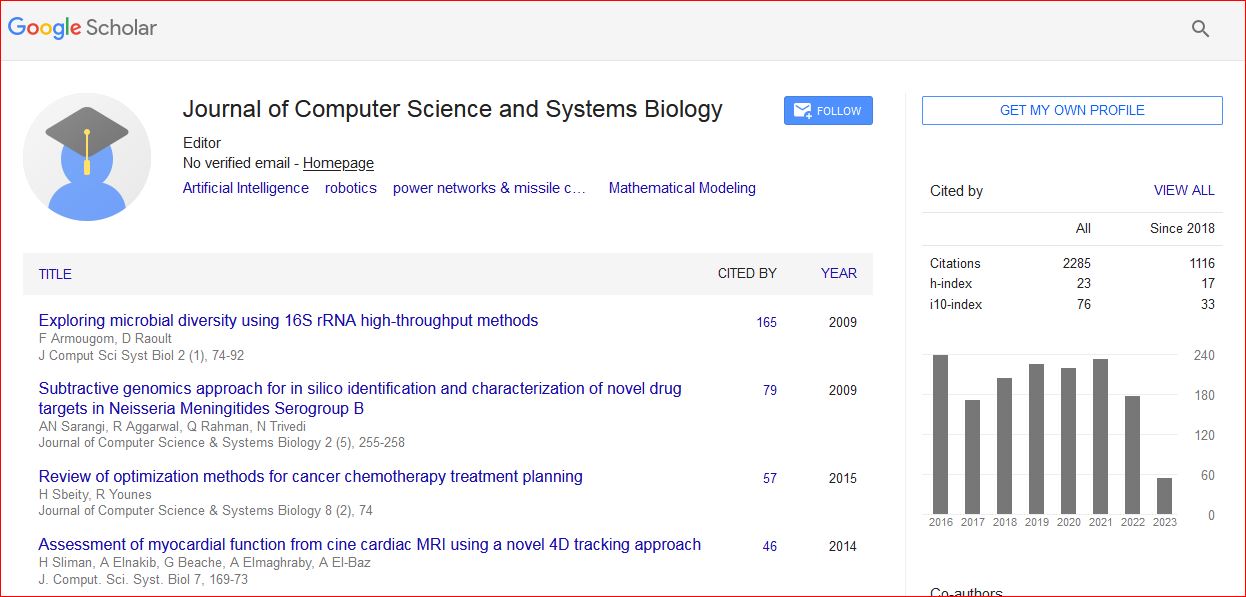
Journal of Computer Science & Systems Biology received 2279 citations as per Google Scholar report