Commentary - (2025) Volume 15, Issue 4
Received: 03-Aug-2025, Manuscript No. jprm-25-174455;
Editor assigned: 06-Aug-2025, Pre QC No. P-174455;
Reviewed: 19-Aug-2025, QC No. Q-174455;
Revised: 25-Aug-2025, Manuscript No. R-174455;
Published:
30-Aug-2025
, DOI: 10.37421/2161-105X.2025.15.747
Citation: Marin, Sofia. ”Pulmonary Rehabilitation: Broad Impact, Future Innovations.” J Pulm Respir Med 15 (2025):747.
Copyright: © 2025 Marin S. This is an open-access article distributed under the terms of the Creative Commons Attribution License, which permits unrestricted use, distribution and reproduction in any medium, provided the original author and source are credited.
Pulmonary rehabilitation (PR) serves as a critical, evidence-based intervention for individuals managing chronic respiratory diseases. Healthcare professionals are guided by comprehensive recommendations on implementing and delivering these programs effectively, which integrate key components like exercise training, education, and psychosocial support. The focus remains on individualized patient assessment and program tailoring, aiming to standardize care and improve patient outcomes[1].
For patients with Chronic Obstructive Pulmonary Disease (COPD), the established benefits of pulmonary rehabilitation are clear. It significantly improves exercise tolerance, reduces dyspnea, and enhances health-related quality of life. Emerging research in this field continues to explore personalized approaches and integrate digital health technologies, seeking to further optimize PR delivery and access[4].
The effectiveness of pulmonary rehabilitation extends to patients recovering from COVID-19. Systematic reviews underscore its significant benefits in restoring respiratory function, improving exercise capacity, and enhancing quality of life for post-COVID individuals. This highlights PRâ??s crucial role in long-COVID recovery pathways[2].
Pulmonary rehabilitation also significantly impacts the health-related quality of life for patients with Interstitial Lung Disease (ILD). It consistently demonstrates improvements in quality of life, dyspnea, and exercise capacity in this specific patient population. This solidifies PR as an important intervention for managing ILD symptoms and enhancing daily functioning[6].
Initiating pulmonary rehabilitation early after an acute exacerbation of COPD (AECOPD) offers substantial advantages. Studies show that early PR is both safe and highly effective in reducing hospital readmissions and improving functional outcomes. This approach is pivotal for accelerating recovery and preventing subsequent exacerbations[7].
Beyond traditional in-person models, telerehabilitation has emerged as an effective alternative for chronic respiratory diseases. Remotely delivered programs have proven comparable to conventional methods in improving exercise capacity and quality of life. This makes telerehabilitation a viable and accessible option, particularly when face-to-face care faces limitations[3].
Similarly, home-based pulmonary rehabilitation programs provide comparable benefits to center-based interventions. For individuals with chronic respiratory diseases, home-based PR effectively improves exercise capacity and quality of life, presenting a flexible and accessible option that broadens participation[5].
The future of pulmonary rehabilitation is increasingly digital. Various technological platforms, including mobile apps, wearables, and virtual reality, are being explored to enhance accessibility, engagement, and personalization of rehabilitation programs. Digital PR holds immense promise, especially for remote patient management[8].
Understanding the fundamental mechanisms by which exercise training in pulmonary rehabilitation leads to physiological and symptomatic improvements is crucial. Research focuses on optimal exercise prescription, training modalities, and strategies to maximize PR benefits through personalized approaches for patients with chronic respiratory diseases[9].
Gathering patient perspectives on pulmonary rehabilitation offers valuable insights for program refinement. Qualitative reviews highlight themes such as the perceived benefits of exercise and education, the critical role of peer support, and identified barriers to participation. These insights are essential for improving program design and fostering greater patient engagement[10].
Pulmonary rehabilitation (PR) represents a multifaceted approach to improving the lives of individuals with chronic respiratory diseases. Core guidelines underscore the necessity of evidence-based recommendations for its implementation, focusing on key components such as structured exercise training, comprehensive education, and essential psychosocial support. The design of these programs emphasizes individualized patient assessment and tailoring to meet specific needs, ultimately standardizing care and enhancing patient outcomes[1]. Fundamentally, exercise training within PR is crucial. It drives physiological and symptomatic improvements, making it essential to understand optimal exercise prescription, various training modalities, and strategies for maximizing benefits through highly personalized approaches[9].
The scope of PR's positive impact is broad, reaching patients with diverse respiratory conditions. For Chronic Obstructive Pulmonary Disease (COPD) patients, PR is a proven intervention that significantly enhances exercise tolerance, reduces dyspnea, and improves health-related quality of life. This area continues to evolve with research into personalized strategies and digital health integration[4]. Beyond established conditions, PR has proven indispensable for those recovering from COVID-19, where it helps restore respiratory function, boosts exercise capacity, and elevates quality of life, playing a vital role in long-COVID recovery pathways[2]. Patients with Interstitial Lung Disease (ILD) also experience substantial benefits, including improved quality of life, reduced dyspnea, and enhanced exercise capacity, solidifying PR's role in managing their symptoms[6]. Furthermore, timing matters significantly; initiating PR early after an acute exacerbation of COPD is a safe and effective strategy that reduces hospital readmissions and improves functional recovery, acting as a preventative measure for future exacerbations[7].
Innovation in PR delivery models is rapidly expanding access and flexibility. Telerehabilitation offers a compelling alternative for chronic respiratory diseases, demonstrating efficacy comparable to traditional in-person programs in improving exercise capacity and quality of life. This remote delivery is particularly valuable when face-to-face care presents logistical challenges[3]. Similarly, home-based pulmonary rehabilitation programs have shown comparable benefits to center-based care for individuals with chronic respiratory diseases, improving both exercise capacity and quality of life. This makes home-based PR a flexible and accessible choice for many patients[5]. The digital transformation of PR is also well underway. Incorporating mobile apps, wearables, and virtual reality, digital PR aims to enhance accessibility, patient engagement, and personalization, particularly for effective remote patient management[8].
Understanding the patient experience is paramount for optimizing pulmonary rehabilitation programs. Qualitative systematic reviews have explored the perspectives of patients, revealing key themes such as the profound perceived benefits of exercise and education, the critical importance of peer support networks, and various barriers that hinder participation. These valuable insights are fundamental for refining program design, fostering greater patient engagement, and ensuring PR programs are as effective and accessible as possible to all who need them[10].
Pulmonary rehabilitation (PR) offers significant benefits for individuals with chronic respiratory diseases, enhancing exercise capacity, reducing dyspnea, and improving overall quality of life. Guidelines emphasize evidence-based recommendations, individualized assessment, and tailored programs that incorporate exercise training, education, and psychosocial support to standardize care and optimize patient outcomes. PR is crucial not only for long-standing conditions like Chronic Obstructive Pulmonary Disease (COPD), where it improves exercise tolerance and health-related quality of life, but also for specific populations such as those recovering from COVID-19, where it helps restore respiratory function and aids in long-COVID recovery pathways. Research highlights the effectiveness of PR for Interstitial Lung Disease (ILD) patients, leading to better quality of life and functional capacity. Early initiation of PR after acute COPD exacerbations is shown to be safe and effective in reducing hospital readmissions and accelerating recovery. The field is evolving, with studies exploring alternative delivery methods. Telerehabilitation and home-based programs offer comparable benefits to traditional in-person settings, increasing accessibility, especially when face-to-face care is challenging. Digital PR, encompassing mobile apps, wearables, and virtual reality, represents a key future direction for enhancing engagement and personalization. Understanding the physiological mechanisms of exercise training in PR helps optimize prescription and modalities. Moreover, patient perspectives reveal the importance of exercise, education, and peer support, along with barriers to participation, which are vital for refining program design and fostering patient engagement. This body of work collectively underscores PR's broad impact and ongoing innovation.
None
None
1. Carole G, Richard C, Elizabeth CD. "Pulmonary Rehabilitation: An Official American Thoracic Society/European Respiratory Society Clinical Practice Guideline.".Am J Respir Crit Care Med 204 (2021):e64-e111.
Indexed at, Google Scholar, Crossref
2. Marco P, Paola G, Irene R. "The role of pulmonary rehabilitation in the COVID-19 pandemic: A systematic review.".Chron Respir Dis 19 (2022):14799731221081831.
Indexed at, Google Scholar, Crossref
3. Lorenzo G, Danilo DN, Pasquale L. "Telerehabilitation for chronic respiratory diseases: A systematic review and meta-analysis.".Respir Med 211 (2023):107212.
Indexed at, Google Scholar, Crossref
4. Milo AP, David M, Tobias S. "Pulmonary Rehabilitation for Patients with COPD: A Review of the Current Evidence and Future Directions.".Respiration 99 (2020):469-482.
Indexed at, Google Scholar, Crossref
5. Zhaolin L, Wei M, Tianjiao M. "Home-based pulmonary rehabilitation for chronic respiratory disease: A systematic review and meta-analysis.".Int J Chron Obstruct Pulmon Dis 18 (2023):2171-2183.
Indexed at, Google Scholar, Crossref
6. Lucy D, Christine JH, Andrew M. "Impact of Pulmonary Rehabilitation on Health-Related Quality of Life in Patients with Interstitial Lung Disease: A Systematic Review.".Respiration 100 (2021):1-13.
Indexed at, Google Scholar, Crossref
7. Anne TC, Christine C, Rowan O. "Early Pulmonary Rehabilitation in Patients with Acute Exacerbations of COPD: A Systematic Review and Meta-Analysis.".Chest 162 (2022):843-855.
Indexed at, Google Scholar, Crossref
8. Meng D, Yu W, Hongtao X. "Digital pulmonary rehabilitation: Current status and future directions.".J Thorac Dis 16 (2024):350-360.
Indexed at, Google Scholar, Crossref
9. Francois M, Marc D, Richard C. "Exercise Training in Pulmonary Rehabilitation: Mechanisms, Benefits, and Optimisation.".Am J Respir Crit Care Med 207 (2023):396-407.
Indexed at, Google Scholar, Crossref
10. Zoe JM, Christine JH, Anne EH. "Patient perspectives on pulmonary rehabilitation: A qualitative systematic review.".Chron Respir Dis 17 (2020):1479972320956973.
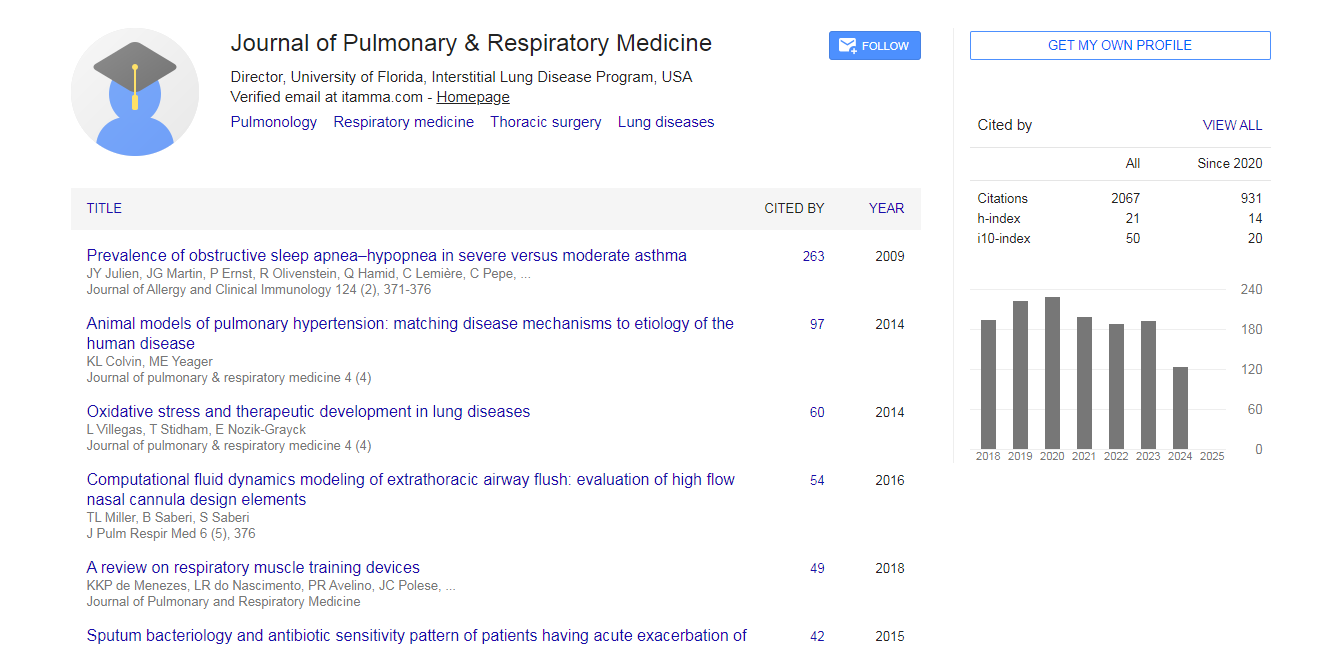
Pulmonary & Respiratory Medicine received 1690 citations as per Google Scholar report