Commentary - (2025) Volume 14, Issue 5
Received: 01-Oct-2025, Manuscript No. jhoa-26-187840;
Editor assigned: 03-Oct-2025, Pre QC No. P-187840;
Reviewed: 17-Oct-2025, QC No. Q-187840;
Revised: 22-Oct-2025, Manuscript No. R-187840;
Published:
29-Oct-2025
, DOI: 10.37421/2167-1095.2025.14.540
Citation: Alvarez, Ricardo. ”Public Health Strategies For Hypertension Prevention.” J Hypertens 14 (2025):540.
Copyright: © 2025 Alvarez R. This is an open-access article distributed under the terms of the Creative Commons Attribution License, which permits unrestricted use, distribution and reproduction in any medium, provided the original author and source are credited.
Public health strategies are fundamental to the prevention and control of hypertension, a significant global health concern. These strategies largely revolve around encouraging lifestyle modifications and implementing environmental changes to foster healthier populations. Key interventions include the promotion of diets rich in fruits and vegetables, advocating for regular physical activity, limiting sodium intake, and actively discouraging tobacco use. Community-based programs are vital for tailoring interventions to specific populations and their unique needs. Policy changes, such as implementing taxation on unhealthy foods and ensuring accessible healthcare services, are also crucial for creating supportive environments conducive to blood pressure management. Early detection through regular screenings and comprehensive patient education are empowering tools that enable individuals to adopt and sustain healthy habits throughout their lives. The role of community-based interventions in addressing disparities in hypertension is significant, as these programs can be adapted to suit the cultural factors and socioeconomic determinants of health prevalent in different communities. Focusing on accessible resources, fostering peer support, and delivering culturally sensitive health education can substantially improve adherence to lifestyle recommendations and prescribed medication regimens, ultimately leading to better blood pressure control, especially in underserved populations. Policy-level changes are also essential for achieving a broader impact on hypertension prevention, encompassing policies that promote healthier food environments through measures like reducing sodium in processed foods and increasing access to affordable healthy options. Furthermore, urban planning that encourages physical activity via safe walking paths and green spaces, coupled with stringent regulations on tobacco advertising, represents critical components of a holistic public health approach. Dietary interventions, particularly those concentrating on reducing sodium intake and increasing potassium consumption, form the bedrock of effective hypertension prevention strategies. Public health messaging should consistently highlight the advantages of diets like the DASH (Dietary Approaches to Stop Hypertension) and Mediterranean diets. Practical strategies for empowering individuals include educating them on how to read food labels to identify hidden sodium and encouraging home cooking with fresh, unprocessed ingredients. Promoting physical activity is a cornerstone of public health initiatives aimed at hypertension prevention. These strategies should encompass increasing both moderate-to-vigorous intensity aerobic exercise and muscle-strengthening activities. Public health campaigns and workplace wellness programs are effective in encouraging regular movement, and urban design that prioritizes pedestrian and cyclist safety further supports an active lifestyle for individuals across all age groups. Tobacco cessation programs are critically important for hypertension prevention, given that smoking substantially elevates blood pressure and overall cardiovascular risk. Public health efforts should encompass comprehensive cessation support, including counseling, pharmacotherapy, and the implementation of smoke-free policies. Targeting vulnerable populations with tailored cessation interventions can yield a significant impact on reducing the prevalence of hypertension. The application of technology in public health for hypertension prevention is increasingly important. Digital health tools, mobile applications for monitoring blood pressure and lifestyle habits, and telehealth services can enhance patient engagement and provide ongoing support. These technologies also facilitate the collection of valuable data for public health surveillance and the evaluation of interventions, leading to more targeted and effective strategies. Public health education and awareness campaigns are indispensable for informing the public about the risks associated with hypertension and the available preventive measures. Clear and consistent messaging disseminated across various media platforms can empower individuals to make healthier lifestyle choices. Emphasizing regular blood pressure monitoring, understanding individual risk factors, and encouraging the seeking of professional medical advice are crucial for early detection and effective management of hypertension. Workplace interventions offer a significant avenue for contributing to hypertension prevention efforts. Encouraging the availability of healthy food options in cafeterias, providing opportunities for physical activity during work breaks, and offering support for smoking cessation can collectively foster a healthier work environment. Such initiatives not only benefit the health of employees but can also lead to a reduction in healthcare costs for employers. Addressing the social determinants of health is paramount for developing and implementing effective hypertension prevention strategies. Factors such as socioeconomic status, educational attainment, access to healthcare, and living conditions profoundly influence an individual's susceptibility to hypertension and their capacity to manage their blood pressure. Public health strategies must proactively integrate these considerations to achieve equitable health outcomes and mitigate the substantial burden of hypertension across diverse populations.
Public health strategies form the bedrock of hypertension prevention and control, focusing on multifaceted approaches that extend beyond individual behavior to encompass societal and environmental influences. These strategies emphasize lifestyle modifications, including the adoption of healthy dietary patterns rich in fruits and vegetables, regular engagement in physical activity, judicious limitation of sodium intake, and concerted efforts to discourage tobacco use. Community-based interventions are particularly valuable for their ability to tailor strategies to the specific needs and contexts of diverse populations. These programs often consider cultural nuances and socioeconomic determinants of health, aiming to create accessible resources, foster peer support networks, and deliver culturally sensitive health education. Such approaches are instrumental in improving adherence to lifestyle recommendations and medication regimens, ultimately leading to better blood pressure control, especially within underserved communities. Policy changes are equally critical for creating a broader, systemic impact on hypertension prevention. This includes the implementation of policies that promote healthy food environments, such as regulations to reduce sodium in processed foods and initiatives to increase access to affordable, nutritious options. Furthermore, urban planning that encourages physical activity through the creation of safe walking paths and accessible green spaces, alongside robust regulations on tobacco advertising, are vital components of a comprehensive public health framework. Dietary interventions represent a cornerstone of hypertension prevention and management strategies. Emphasis is placed on reducing sodium intake and increasing potassium consumption. Public health messaging should consistently promote the benefits of evidence-based dietary patterns, such as the DASH (Dietary Approaches to Stop Hypertension) and Mediterranean diets. Practical strategies for empowering individuals include educating them on how to interpret food labels to identify hidden sources of sodium and encouraging the preparation of meals at home using fresh ingredients. The promotion of physical activity is another essential pillar of public health efforts aimed at preventing hypertension. Strategies should focus on increasing engagement in both moderate-to-vigorous intensity aerobic exercise and muscle-strengthening activities. Public health campaigns and workplace wellness programs serve as effective platforms for encouraging regular physical activity, while urban design that prioritizes pedestrian and cyclist safety further supports the adoption of an active lifestyle across all age demographics. Tobacco cessation programs are of paramount importance in the context of hypertension prevention, as smoking is a significant risk factor that markedly elevates blood pressure and increases overall cardiovascular risk. Public health initiatives in this area should provide comprehensive cessation support, encompassing counseling, pharmacotherapy, and the establishment of smoke-free environments. Targeted interventions designed for vulnerable populations can yield substantial improvements in reducing the prevalence of hypertension. The integration of technology into public health strategies for hypertension prevention is an evolving and increasingly significant trend. Digital health tools, mobile applications designed for tracking blood pressure and lifestyle behaviors, and telehealth services can significantly enhance patient engagement and provide continuous support. These technological advancements also facilitate the systematic collection of data, which is invaluable for public health surveillance and the evaluation of intervention effectiveness, thereby enabling the development of more precise and impactful strategies. Public health education and awareness campaigns play an indispensable role in informing the public about the risks associated with hypertension and the array of preventive measures available. The delivery of clear, consistent, and accessible messaging across diverse media platforms empowers individuals to make informed and healthier lifestyle choices. A key focus is placed on encouraging regular blood pressure monitoring, fostering an understanding of various risk factors, and promoting the timely seeking of professional medical advice, all of which are crucial for early detection and effective management. Workplace interventions offer a practical and impactful avenue for contributing to hypertension prevention efforts. These interventions can include initiatives such as encouraging the availability of healthy food options in workplace cafeterias, creating opportunities for physical activity during work breaks, and providing support for smoking cessation. Such measures contribute to the creation of a healthier work environment, yielding benefits not only for employee well-being but also potentially reducing healthcare costs for employers. A critical aspect of effective hypertension prevention involves a thorough understanding and active addressing of the social determinants of health. Factors such as socioeconomic status, educational attainment, access to quality healthcare services, and the conditions in which people live and work profoundly influence an individual's risk profile for hypertension and their capacity to manage their blood pressure effectively. Public health strategies must therefore be designed to systematically integrate these considerations to achieve equitable health outcomes and to substantially reduce the overall burden of hypertension across diverse and often vulnerable populations.
Public health strategies are critical for hypertension prevention and control, focusing on lifestyle changes like healthy diets, physical activity, reduced sodium intake, and tobacco cessation. Community-based programs and policy changes, such as food taxation and improved urban planning, create supportive environments. Early detection through screenings and patient education empower individuals. Dietary approaches like DASH and Mediterranean diets, along with reducing sodium and increasing potassium, are emphasized. Promoting physical activity through campaigns and safe urban design is key. Tobacco cessation programs are vital, particularly for vulnerable groups. Digital health tools and telehealth enhance patient engagement and data collection. Public health education campaigns inform the public about risks and preventive measures. Workplace interventions encourage healthy habits and can reduce employer healthcare costs. Addressing social determinants of health is essential for equitable outcomes and reducing the hypertension burden across diverse populations.
None
None
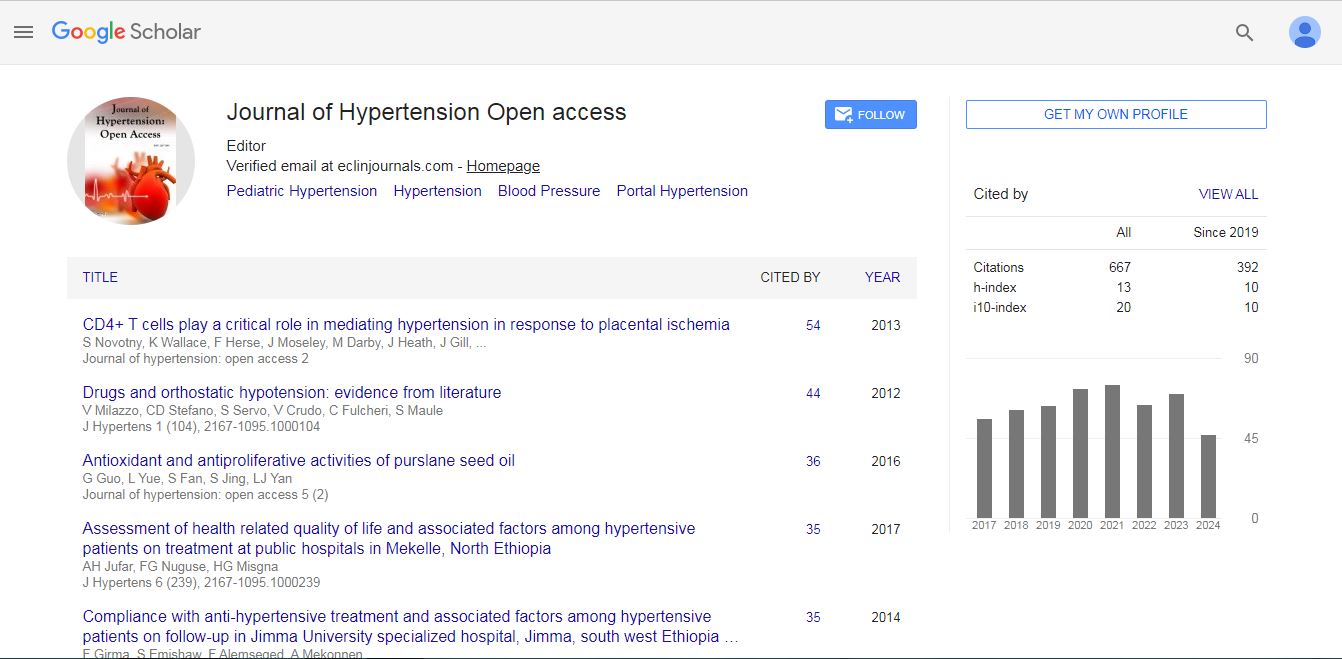
Journal of Hypertension: Open Access received 614 citations as per Google Scholar report