Commentary - (2025) Volume 14, Issue 2
Received: 01-Mar-2025, Manuscript No. jtm-25-172829;
Editor assigned: 03-Mar-2025, Pre QC No. p-172829;
Reviewed: 17-Mar-2025, QC No. R-172829;
Revised: 24-Mar-2025, Manuscript No. R-172829;
Published:
31-Mar-2025
, DOI: 10.37421/2167-1222.2025.14.668
Citation: Müller, David. ”PTSD: Mechanisms, Treatments, Populations, Personalized Care.” J Trauma Treat 14 (2025):668.
Copyright: © 2025 Müller D. This is an open-access article distributed under the terms of the Creative Commons Attribution License, which permits unrestricted use, distribution and reproduction in any medium, provided the original author and source are credited.
Understanding Post-Traumatic Stress Disorder (PTSD) involves a multifaceted approach, encompassing psychological treatments, biological underpinnings, and societal influences. A significant area of focus is psychotherapy for military personnel, particularly given the specific traumas they face. This review deeply explores the effectiveness of evidence-based psychological interventions, such as exposure therapy and cognitive processing therapy, tailored for military-related PTSD. It meticulously highlights the unique challenges inherent to military populations and proposes viable pathways to enhance both treatment access and overall outcomes for these individuals. [1] In parallel, the scientific community is making considerable strides in uncovering the biological markers associated with PTSD. This involves examining the current state and future directions of neuroimaging biomarkers. The research explores how observable changes in brain structure and function can offer crucial insights into accurate diagnosis, effectively predict individual responses to various treatments, and potentially identify individuals who are at a higher risk of developing PTSD. This work is pivotal, as it consistently pushes towards the development of more personalized and precise medicine approaches, allowing for interventions that are finely tuned to individual biological profiles. [2] It is equally critical to recognize that PTSD does not manifest uniformly across all age groups. A distinct body of work concentrates on the unique presentation and specific diagnostic considerations of PTSD in children and adolescents. This area of study strongly emphasizes the paramount importance of utilizing age-appropriate assessment tools and designing interventions that are developmentally suitable. It acknowledges that the way trauma impacts and manifests in developing individuals is markedly different from its presentation in adults, necessitating specialized approaches that cater to the cognitive and emotional stages of younger populations. [3] Modern technology offers innovative avenues for mental health care, with digital interventions for PTSD gaining increasing prominence. A systematic review and meta-analysis have thoroughly evaluated the effectiveness of various online and app-based programs designed to address PTSD symptoms. The findings from this comprehensive analysis indicate that numerous digital tools hold significant promise for substantially increasing accessibility to care. This is particularly beneficial for individuals who encounter considerable barriers to engaging with traditional, in-person therapy, thereby broadening the reach of essential mental health services. [4] Pharmacological treatments constitute another cornerstone of PTSD management, often used in conjunction with psychotherapy to alleviate debilitating symptoms. This article provides a crucial overview of current pharmacological treatments for PTSD, delving into the demonstrated efficacy of FDA-approved medications. Beyond existing treatments, it actively explores emerging drug targets, hinting at a dynamic future for medication development. The review also underscores the inherent complexities of medication management, stressing the need for careful consideration and often a multimodal approach to optimize therapeutic outcomes for patients. [5] Moreover, the intricate relationship between PTSD and co-occurring conditions, such as substance use disorders (SUD), necessitates specialized attention. This review highlights the critical need for integrated treatment approaches designed for individuals suffering from both conditions. It meticulously outlines therapeutic strategies that are crafted to simultaneously target both PTSD and SUD, recognizing their profound and often bidirectional influence on each other. The emphasis is on developing holistic recovery plans that address the intertwined nature of these challenges, leading to more sustainable healing. [6] Further understanding the biological underpinnings of PTSD involves exploring genetic predispositions. Recent advancements in this field have shed light on the genetic risk factors for PTSD. This research thoroughly discusses how specific genetic predispositions interact dynamically with environmental trauma exposure to significantly influence an individual's susceptibility to developing PTSD or, conversely, their capacity for resilience. These insights are groundbreaking, as they open new doors for the development of personalized prevention strategies and highly targeted intervention approaches. [7] Beyond clinical interventions, external factors like social support play an indispensable role in mitigating the impact of trauma. This paper rigorously examines the crucial role of social support in promoting resilience to traumatic events and actively mitigating the development of PTSD. It comprehensively explores how various forms of social connection and robust community engagement can effectively function as vital protective factors. This offers invaluable perspectives for both proactive prevention efforts and facilitating comprehensive recovery processes for those affected by trauma. [8] Looking ahead, the field of pharmacotherapy for PTSD continues to innovate, moving beyond established treatments. Emerging pharmacotherapies and novel targets for PTSD treatment are actively discussed in current literature. This involves highlighting experimental drugs and innovative mechanisms that extend beyond traditional antidepressants, aiming for more effective and symptom-specific interventions. These developments strongly suggest a dynamic and promising future for medication development, focusing on precision and improved patient outcomes. [9] Finally, effective PTSD care must acknowledge and integrate cultural contexts. This paper addresses the critical importance of incorporating cultural considerations into both the assessment and treatment of PTSD. It meticulously explores how diverse cultural backgrounds, deeply held beliefs, and prevalent societal stigma profoundly influence an individual's perception of trauma, the expression of their symptoms, and their overall engagement with mental health services. This advocacy for culturally sensitive care is paramount, ensuring that interventions are respectful, relevant, and ultimately more effective for a diverse patient population. [10]
Post-Traumatic Stress Disorder (PTSD) presents a complex set of challenges requiring multifaceted diagnostic and therapeutic approaches. Contemporary research consistently highlights the efficacy of various psychotherapeutic interventions, proving especially vital for specific populations such as military personnel. These evidence-based treatments, which critically include exposure therapy and cognitive processing therapy, are fundamental for not only improving individual outcomes but also for enhancing overall access to mental health care within this particular demographic [1]. Moving beyond conventional therapy settings, digital interventions are rapidly emerging as a promising and scalable solution. These accessible online and app-based programs offer substantial potential to overcome numerous barriers to traditional care, reaching individuals who might otherwise remain underserved [4]. Simultaneously, pharmacological treatments, encompassing both FDA-approved medications and innovative novel drug targets, play a crucial role in alleviating the debilitating symptoms of PTSD. These pharmaceutical options are frequently utilized in conjunction with psychotherapy, signaling a dynamic and evolving future for medication development aimed at greater precision and efficacy [5, 9].
A deeper understanding of the biological underpinnings of PTSD forms another significant area of intensive investigation. Advanced neuroimaging biomarkers are being rigorously explored for their transformative potential to refine diagnostic accuracy, predict individual responses to diverse treatment modalities, and crucially, identify individuals who may be at a higher inherent risk of developing PTSD. This work is instrumental in steering the field towards increasingly personalized medicine approaches [2]. Complementing these biological insights, comprehensive research into genetic risk factors for PTSD provides valuable revelations, detailing how specific genetic predispositions dynamically interact with environmental trauma exposure. This interaction profoundly influences an individual's susceptibility to developing the disorder or, conversely, their intrinsic capacity for resilience. Such genetic insights are groundbreaking, as they promise to open new avenues for personalized prevention strategies and highly targeted intervention techniques [7]. Furthermore, it is profoundly critical to acknowledge the unique and often distinct presentation of PTSD in children and adolescents. Trauma manifests and impacts developing individuals in ways that are markedly different from adults, thereby necessitating the development and application of age-appropriate assessment tools and carefully tailored interventions to ensure effective and sensitive support for younger populations [3].
The reality is that PTSD rarely exists in isolation; it frequently co-occurs with other significant conditions, most notably substance use disorders (SUD). Effectively addressing this intricate comorbidity urgently requires integrated treatment approaches designed to simultaneously target both PTSD and SUD. This strategy acknowledges their profound and often bidirectional influence on each other and underscores the critical necessity of developing holistic recovery plans that address the intertwined nature of these challenges for more sustainable and comprehensive healing [6]. Beyond the realm of clinical treatments, external psychosocial factors, such as robust social support, play an indispensable and often underestimated role in fostering resilience to traumatic events and significantly mitigating the development of PTSD. Various forms of meaningful social connection and active community engagement are recognized as powerful protective factors, offering invaluable perspectives for both proactive prevention efforts and facilitating comprehensive recovery processes for individuals affected by trauma throughout their lives [8].
Crucially, effective and ethical PTSD care must be inherently culturally informed and deeply sensitive to diverse patient backgrounds. Cultural contexts, deeply held beliefs, and the pervasive societal impact of stigma significantly shape how individuals interpret and perceive trauma, how they express their symptoms, and critically, their willingness and ability to engage with available mental health services. Incorporating these vital cultural considerations into both the assessment and treatment frameworks is absolutely paramount. This ensures the provision of respectful, relevant, and ultimately far more effective care for the incredibly diverse patient populations living with PTSD, fostering better engagement and therapeutic outcomes [10]. This collective body of research underscores a continuous, multifaceted effort to unravel the complexities of PTSD, from innovative treatments and biological discoveries to addressing specific population needs and broad societal influences. The ongoing integration of digital health solutions, advanced pharmacological strategies, and a nuanced understanding of co-occurring disorders, alongside the indispensable roles of social and cultural factors, collectively pave the way towards a future characterized by more accessible, personalized, and profoundly effective PTSD care for all individuals impacted by the lasting effects of trauma.
This collection of articles offers a comprehensive overview of Post-Traumatic Stress Disorder (PTSD), exploring its varied facets from specific populations to novel treatments and underlying mechanisms. It highlights the effectiveness of psychotherapy, including exposure and cognitive processing therapies, particularly for military personnel facing unique challenges. Research also delves into the promising role of neuroimaging biomarkers for diagnosis, treatment prediction, and identifying at-risk individuals, paving the way for personalized medicine. The discussion extends to the distinct presentation of PTSD in children and adolescents, emphasizing the need for age-appropriate assessment and interventions. The landscape of PTSD treatment is expanding, with digital interventions showing potential to enhance accessibility, especially for those with barriers to traditional care. Pharmacological approaches are also evolving, with current medications and emerging drug targets aiming for more effective and symptom-specific relief, often complementing psychotherapy. A critical aspect addressed is the integrated treatment required for co-occurring PTSD and substance use disorders, acknowledging their bidirectional influence. Furthermore, the review touches upon the genetic risk factors, demonstrating how genetic predispositions interact with trauma to affect susceptibility and resilience. Finally, the importance of social support as a protective factor against trauma and in promoting recovery is underscored, alongside the necessity of culturally sensitive care in assessment and treatment, recognizing diverse trauma perception and symptom expression.
None
None
Indexed at, Google Scholar, Crossref
Indexed at, Google Scholar, Crossref
Indexed at, Google Scholar, Crossref
Indexed at, Google Scholar, Crossref
Indexed at, Google Scholar, Crossref
Indexed at, Google Scholar, Crossref
Indexed at, Google Scholar, Crossref
Indexed at, Google Scholar, Crossref
Indexed at, Google Scholar, Crossref
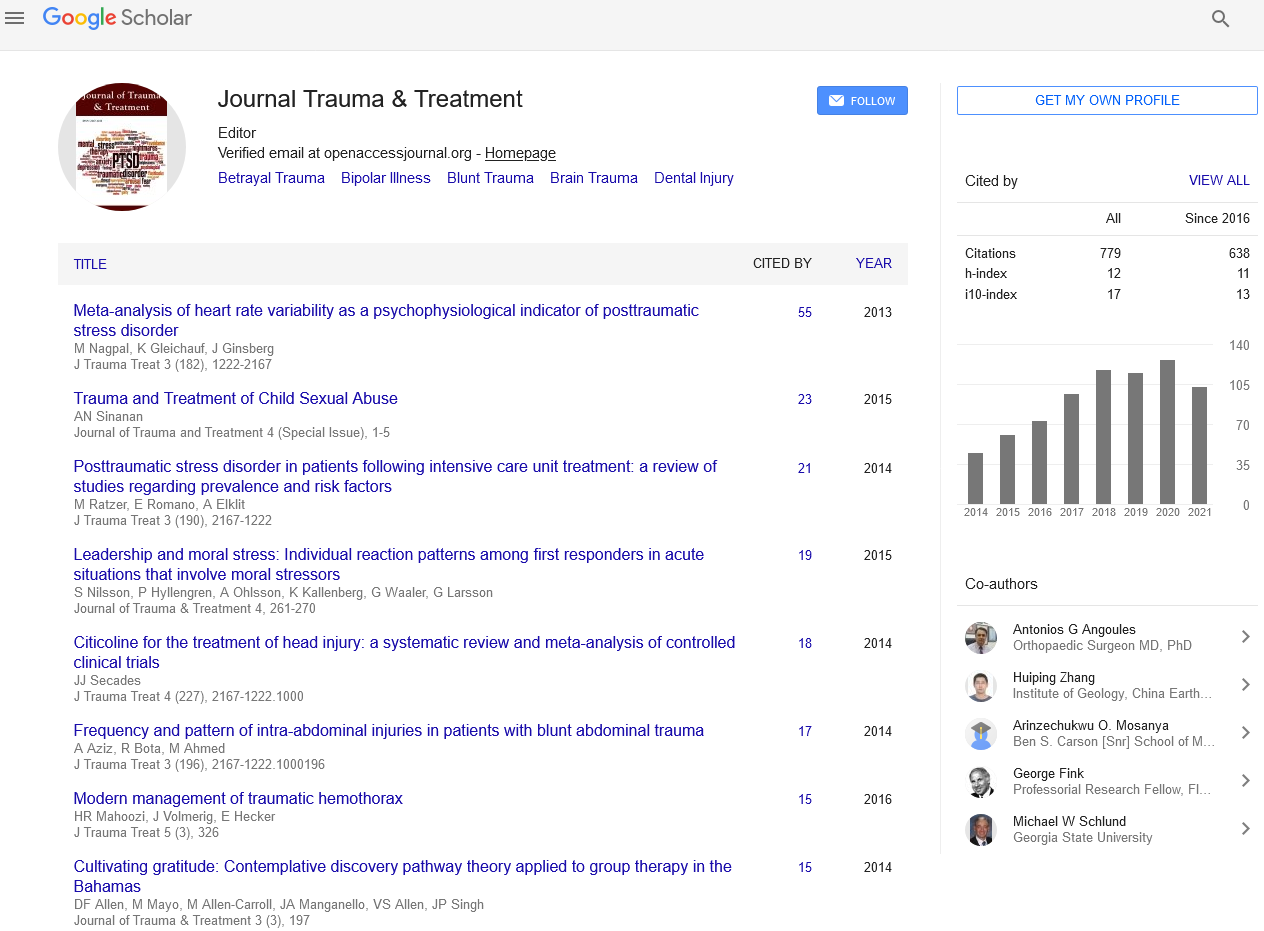
Journal of Trauma & Treatment received 1048 citations as per Google Scholar report