Brief Report - (2025) Volume 14, Issue 3
Received: 01-Jun-2025, Manuscript No. jbfa-25-174141;
Editor assigned: 03-Jun-2025, Pre QC No. P-174141;
Reviewed: 17-Jun-2025, QC No. Q-174141;
Revised: 23-Jun-2025, Manuscript No. R-174141;
Published:
30-Jun-2025
, DOI: 10.37421/2167-0234.2025.14.530
Citation: Jensen, Clara. ”Psychology, Biases, Investment Decisions, and Literacy.” J Bus Fin Aff 14 (2025):530.
Copyright: © 2025 Jensen C. This is an open-access article distributed under the terms of the Creative Commons Attribution License, which permits unrestricted use, distribution and reproduction in any medium, provided the original author and source are credited.
The realm of investment decision-making, traditionally viewed through the lens of rational economic theory, is increasingly understood to be profoundly influenced by psychological factors and behavioral biases. A substantial body of research consistently challenges the notion of fully rational economic agents, revealing that investors often exhibit cognitive and emotional biases that lead to deviations from optimal financial choices. This emerging field of behavioral finance provides critical insights into the human element of financial markets, exploring how psychological heuristics and cognitive errors shape individual and collective investment behavior. For example, research conducted in Pakistan delves into how financial knowledge moderates the influence of specific behavioral biases, such as overconfidence, herd mentality, and anchoring, on investment decisions [1].
This study indicates that while these biases significantly shape investor choices, an increase in financial knowledge can substantially reduce their detrimental effects, thereby fostering more rational financial behavior. Similarly, an investigation into the Vietnamese stock market explores the impact of various behavioral biases, including overconfidence, anchoring, and herding, on individual investment decisions [2].
The findings from this region underscore the considerable influence these psychological factors exert on investor behavior, frequently resulting in suboptimal financial choices. A broader perspective on the field comes from systematic literature reviews. One such review synthesizes existing research on behavioral finance and investment decisions, pinpointing key biases like loss aversion, mental accounting, and herding [3].
These biases are shown to cause investor choices to diverge from rational economic theory, offering a comprehensive overview of the field's evolution and its primary themes. Another study from Saudi Arabia examines how both financial literacy and various behavioral biases affect investment decisions [4].
It highlights that while financial literacy is crucial for shaping investor behavior, psychological biases, such as overconfidence and heuristic-driven decisions, significantly impact investment choices, often leading to outcomes that depart from pure rationality. Expanding on the foundational concepts, a systematic review critically examines investor rationality within the behavioral finance framework, drawing upon extensive empirical evidence [5].
This review emphasizes that investors commonly display cognitive and emotional biases, thereby challenging the conventional assumptions of perfectly rational economic agents and stressing the widespread impact of psychological factors on financial markets. Further regional studies highlight specific biases. Research on the Pakistani stock market, for instance, investigates the impact of mental accounting on individual investors' decisions [6].
This study reveals that investors tend to categorize and evaluate their money differently based on its source and intended use, leading to suboptimal investment choices and deviations from rational economic behavior. Another systematic literature review further synthesizes research on the role of behavioral biases in investment decision-making within financial markets [7].
It meticulously identifies and discusses a wide array of psychological heuristics and cognitive errors that influence investor behavior, emphasizing their pervasive effect on market efficiency and individual portfolio performance. The implications of behavioral finance extend beyond individual investment choices to corporate finance as well. A review in this area provides a synthesis of behavioral finance and its applications in corporate finance, bridging the gap between individual decision-making biases and their effects on corporate policies and outcomes [8].
This work explores how psychological factors influence managerial decisions concerning capital structure, investment, and mergers and acquisitions, offering a more realistic understanding of corporate financial behavior. Moreover, the influence of individual differences like personality traits on investment outcomes is also explored. A study focusing on Indian investors investigates the complex relationship between personality traits, behavioral biases, and investment performance [9].
It demonstrates how distinct personality characteristics correlate with specific cognitive biases, which, in turn, significantly influence investment decisions and ultimately affect portfolio returns, thereby illuminating the psychological underpinnings of financial outcomes. Lastly, the phenomenon of herding behavior is a significant aspect of collective investor irrationality. Research from the Egyptian stock market empirically examines herding behavior among investors, showing how individuals often follow the actions of a larger group rather than relying on their own analysis [10].
This collective irrationality can significantly impact market dynamics and investor returns, particularly in emerging markets, reinforcing the critical need to understand the psychological dimensions of financial markets globally.
The diverse collection of studies presented here offers a multifaceted exploration into the field of behavioral finance, illuminating how psychological factors systematically influence investment decisions across various global markets. A central theme underpinning much of this research is the recognition that investors frequently depart from the rational behavior assumed by traditional economic theories, instead exhibiting a range of cognitive and emotional biases that profoundly shape their financial choices.
One prominent area of investigation concerns the direct impact of specific behavioral biases on investment decisions. For instance, studies from both Pakistan and Vietnam shed light on how biases such as overconfidence, herd mentality, and anchoring significantly affect individual investors [1, 2]. These studies conclude that such psychological inclinations often lead to suboptimal investment outcomes, challenging the notion that investment decisions are solely driven by objective financial analysis. The pervasive nature of these biases is further reinforced by research in Saudi Arabia, which identifies overconfidence and heuristic-driven decisions as crucial psychological factors influencing investor choices and leading to deviations from purely rational results [4]. Additionally, the phenomenon of herding behavior, where investors mimic the actions of a larger group rather than their own analysis, has been empirically observed in emerging markets like the Egyptian stock market [10]. This collective irrationality significantly impacts market dynamics and investor returns, highlighting the need for a deeper understanding of social influences on financial behavior.
Beyond the direct impact of biases, research also explores moderating factors that can influence their effects. A key finding from the Pakistani market, for example, demonstrates that financial knowledge plays a crucial moderating role [1]. While behavioral biases strongly influence investor choices, greater financial knowledge substantially reduces their adverse effects, suggesting that education can empower more rational financial behavior. Similarly, the study from Saudi Arabia underscores the critical role of financial literacy in shaping investor behavior, even while acknowledging the significant influence of psychological biases [4]. These findings collectively advocate for financial education as a tool to mitigate the negative consequences of inherent human biases in investment.
Another significant area of focus involves specific cognitive biases like mental accounting. Research focusing on the Pakistani stock market reveals that individual investors tend to categorize and evaluate their money differently based on its source and intended use [6]. This mental accounting process often leads to suboptimal investment choices, indicating a fundamental deviation from rational economic behavior where money should be fungible regardless of its origin. This bias, along with others like loss aversion, is consistently identified in systematic literature reviews as a key factor steering investor choices away from theoretical rationality [3].
Systematic literature reviews further synthesize and consolidate the understanding of behavioral finance. These comprehensive reviews provide a broad overview of the field, identifying key behavioral biases that steer investor choices away from rational economic theory [3, 7]. They critically examine the concept of investor rationality, challenging traditional assumptions by highlighting the consistent exhibition of cognitive and emotional biases among investors [5]. These reviews are instrumental in mapping the evolution of behavioral finance, discussing a wide range of psychological heuristics and cognitive errors that influence investor behavior, and emphasizing their pervasive impact on market efficiency and individual portfolio performance [7]. The scope of behavioral finance also extends to corporate decisions, bridging individual biases with their effects on corporate policies and outcomes, such as capital structure, investment, and mergers and acquisitions [8]. This perspective offers a more realistic view of corporate financial behavior by incorporating psychological factors.
Finally, the role of individual personality traits in predisposing investors to certain biases and affecting investment performance is a crucial area of study. Evidence from India shows an intricate relationship between distinct personality characteristics and specific cognitive biases [9]. These biases, in turn, significantly influence investment decisions and ultimately affect portfolio returns, providing deeper insights into the psychological underpinnings of financial outcomes. This body of work collectively reinforces that understanding and addressing behavioral biases, potentially through enhanced financial education, is paramount for both individual investors seeking optimal returns and for policymakers aiming to improve overall market efficiency.
This compilation of studies delves into the complex interplay between human psychology and financial markets, particularly focusing on how behavioral biases shape investment decisions. Across diverse geographical contexts, including Pakistan, Vietnam, Saudi Arabia, India, and Egypt, research consistently demonstrates that investors frequently deviate from purely rational economic behavior due to cognitive and emotional influences. Key biases identified include overconfidence, herding, anchoring, loss aversion, mental accounting, and heuristic-driven decisions. These biases often lead to suboptimal investment choices and impact individual portfolio performance and market dynamics. One significant recurring theme is the moderating role of financial knowledge and literacy. Studies suggest that greater financial understanding can substantially reduce the adverse effects of these biases, empowering investors to make more rational choices. While behavioral biases are shown to significantly influence investor choices, the capacity for education to mitigate these effects offers a pathway toward improved financial outcomes. Furthermore, the systematic literature reviews provide a comprehensive overview of the field, synthesizing existing research on behavioral finance and its applications, from individual investment decisions to corporate finance policies. This collective body of work underscores the pervasive influence of psychological factors on both micro and macro financial behaviors, challenging traditional economic models that assume full rationality.
None
None
Indexed at, Google Scholar, Crossref
Indexed at, Google Scholar, Crossref
Indexed at, Google Scholar, Crossref
Indexed at, Google Scholar, Crossref
Indexed at, Google Scholar, Crossref
Indexed at, Google Scholar, Crossref
Indexed at, Google Scholar, Crossref
Indexed at, Google Scholar, Crossref
Indexed at, Google Scholar, Crossref
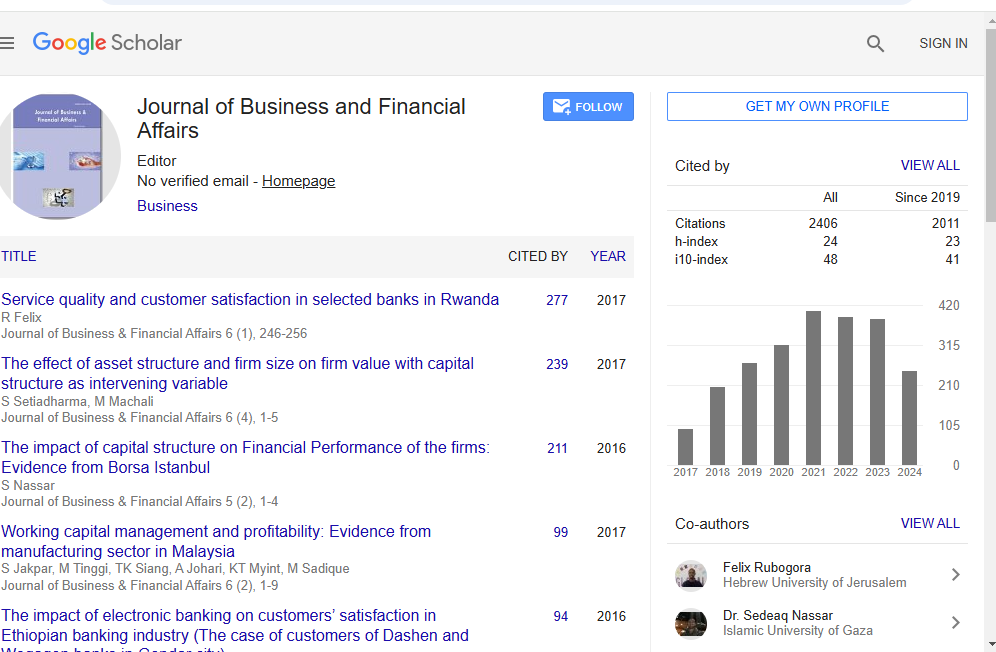
Journal of Business & Financial Affairs received 1726 citations as per Google Scholar report