Commentary - (2025) Volume 16, Issue 2
Received: 01-Apr-2025, Manuscript No. jmbd-26-179367;
Editor assigned: 03-Apr-2025, Pre QC No. P-179367;
Reviewed: 14-Apr-2025, QC No. Q-179367;
Revised: 22-Apr-2025, Manuscript No. R-179367;
Published:
29-Apr-2025
, DOI: 10.37421/2155-9929.2025.16.692
Citation: Rossi, Sofia. ”Proteomic Biomarkers: Revolutionizing Disease Insight and Treatment.” J Mol Biomark Diagn 16 (2025): 692.
Copyright: © 2025 Rossi S. This is an open-access article distributed under the terms of the Creative Commons Attribution License, which permits unrestricted use, distribution and reproduction in any medium, provided the original author and source are credited.
Proteomic biomarkers are at the forefront of revolutionizing disease diagnosis and prognosis, offering profound insights into the intricate molecular signatures that define health and illness [1].
This dynamic field meticulously identifies proteins whose presence, absence, or altered levels exhibit a significant correlation with specific physiological states or pathological conditions. The "Journal of Molecular Biomarkers & Diagnosis" serves as a premier platform for groundbreaking research, showcasing the transformative potential of these protein profiles in enabling early disease detection, predicting treatment responses, and advancing personalized medicine strategies [1].
By delving into these molecular underpinnings, we are progressively moving beyond the limitations of traditional diagnostic methods towards a more nuanced, precise, and individualized approach to patient care. Mass spectrometry-based proteomics stands as a cornerstone technology for the discovery and validation of these crucial proteomic biomarkers [2].
Sophisticated techniques, including shotgun proteomics and targeted proteomics, empower researchers to identify even low-abundance proteins within complex biological samples, thereby facilitating the discovery of novel signatures associated with a wide array of conditions such as cancer, neurodegenerative diseases, and cardiovascular disorders [2].
The paramount importance of the accuracy and sensitivity of these methodologies cannot be overstated, as they are indispensable for the successful translation of proteomic findings into clinically actionable diagnostic tools. Furthermore, the application of proteomic biomarkers extends significantly into the critical domain of monitoring treatment efficacy and predicting therapeutic outcomes [3].
By conducting detailed analyses of protein profiles at various stages – before, during, and after therapeutic interventions – clinicians gain the ability to assess a patient's real-time response to treatment [3].
This personalized, data-driven approach is instrumental in optimizing treatment regimens, avoiding the administration of ineffective therapies, and proactively identifying potential mechanisms of therapeutic resistance, representing a vital stride towards the realization of true precision medicine. While the human genome project has provided us with the fundamental genetic blueprint, it is the proteome that ultimately dictates cellular function and phenotype, offering a dynamic and immediate reflection of cellular processes [4].
Proteomic biomarkers capture this dynamic view, reflecting the immediate molecular impact of disease at the cellular level [4].
Their unparalleled ability to discern post-translational modifications and intricate protein-protein interactions provides a depth of detail unattainable through genomic analysis alone, solidifying their indispensable role in comprehending the complexities of human diseases. Despite the immense progress, significant challenges persist in the seamless clinical translation of proteomic biomarkers [5].
These hurdles include the critical need for standardization of methodologies, robust validation across diverse patient cohorts, and the development of cost-effective, high-throughput assay technologies [5].
However, continuous advancements in analytical instrumentation and bioinformatics are steadily dismantling these obstacles, thereby paving a clear path for the routine clinical implementation of sophisticated proteomic diagnostic tools. The development of highly sensitive and specific proteomic assays is paramount for achieving the ambitious goal of detecting diseases at their earliest, most treatable stages [6].
This often involves the identification and utilization of panels of biomarkers, rather than relying on single markers, which demonstrably enhances diagnostic accuracy and provides a more comprehensive understanding of the disease state [6].
In this pursuit, liquid biopsies, which analyze biomarkers in bodily fluids such as blood or urine, are emerging as particularly promising avenues for non-invasive disease detection and monitoring. Integrating proteomic data with other powerful omics technologies, including genomics and metabolomics, offers a holistic systems biology approach essential for unraveling the complexities of disease [7].
This multi-omics integration allows for the revelation of intricate molecular pathways and interactions that remain obscured when analyzing individual data types in isolation [7].
Such a comprehensive, interconnected view is indispensable for elucidating the multifaceted mechanisms that underlie a vast array of human diseases. Post-translational modifications (PTMs) significantly amplify the functional diversity of the proteome, playing pivotal roles in the pathogenesis of numerous diseases [8].
The precise identification and quantification of these modifications, facilitated by cutting-edge mass spectrometry techniques, are vital for discovering novel PTM-based biomarkers [8].
Modifications such as phosphorylation and glycosylation act as highly sensitive indicators of cellular stress, signaling events, and disease progression, providing critical molecular insights. Artificial intelligence (AI) and machine learning (ML) are increasingly being harnessed to analyze vast and complex proteomic datasets [9].
These powerful computational tools excel at identifying subtle patterns and correlations that may elude conventional analytical methods, leading to the discovery of novel biomarker signatures and the development of more accurate predictive models for disease [9].
The inherent capacity of AI to learn from extensive data accelerates the translation of fundamental proteomic research into tangible clinical applications. Finally, the identification of protein-protein interaction (PPI) networks associated with specific diseases represents a particularly promising frontier in proteomic biomarker research [10].
Understanding these complex molecular interactions is key to revealing critical pathways involved in disease initiation and progression, thereby offering novel targets for therapeutic intervention and refining diagnostic strategies [10].
Aberrations or disruptions within these intricate networks can serve as potent indicators of pathological states, providing valuable diagnostic and prognostic information.
Proteomic biomarkers are revolutionizing disease diagnosis and prognosis by offering deep insights into molecular signatures [1]. The "Journal of Molecular Biomarkers & Diagnosis" highlights research on how protein profiles can be used for early detection, treatment response prediction, and personalized medicine [1]. This field moves beyond traditional diagnostics towards a more precise approach to patient care [1]. Mass spectrometry-based proteomics is a cornerstone for discovering and validating proteomic biomarkers [2]. Techniques like shotgun and targeted proteomics allow for the identification of low-abundance proteins, aiding in the discovery of novel signatures for conditions like cancer and neurodegenerative diseases [2]. The accuracy and sensitivity of these methods are crucial for translating proteomic findings into clinically relevant diagnostic tools [2]. The application of proteomic biomarkers extends to monitoring treatment response and predicting therapeutic outcomes [3].
Analyzing protein profiles before, during, and after treatment allows clinicians to assess patient response in real-time, optimizing regimens and avoiding ineffective therapies [3]. This is a critical step in advancing precision medicine. The proteome, unlike the static genome, provides a dynamic view of cellular function and phenotype, reflecting the immediate impact of disease at the molecular level [4]. The ability to capture post-translational modifications and protein-protein interactions offers a level of detail unattainable through genomics alone, making proteomic biomarkers indispensable for understanding complex diseases [4]. Challenges in the clinical translation of proteomic biomarkers include standardization, validation across cohorts, and the development of cost-effective, high-throughput assays [5]. However, ongoing advancements in analytical technologies and bioinformatics are steadily addressing these hurdles, paving the way for routine clinical implementation of proteomic diagnostics [5]. Developing highly sensitive and specific proteomic assays is crucial for early disease detection [6]. Utilizing panels of biomarkers rather than single markers can improve diagnostic accuracy and provide a more comprehensive disease picture [6]. Liquid biopsies, analyzing bodily fluids, are particularly promising for non-invasive disease detection [6]. Integrating proteomic data with other omics technologies like genomics and metabolomics provides a systems biology approach to disease understanding [7]. This multi-omics integration can reveal complex molecular pathways and interactions not apparent from individual data types, offering a holistic view essential for uncovering intricate disease mechanisms [7]. Post-translational modifications (PTMs) significantly expand proteome diversity and play critical roles in disease pathogenesis [8].
Accurate identification and quantification of PTMs using advanced mass spectrometry are vital for discovering PTM-based biomarkers [8]. Modifications like phosphorylation and glycosylation act as sensitive indicators of cellular stress and disease progression [8]. Artificial intelligence (AI) and machine learning (ML) are increasingly applied to proteomic data analysis [9]. These tools identify complex patterns and correlations, leading to the discovery of novel biomarker signatures and improved predictive models for disease [9]. AI's ability to learn from vast data accelerates the translation of proteomic research into clinical applications [9]. Identifying protein-protein interaction (PPI) networks associated with disease is a promising area for proteomic biomarker research [10]. Understanding these interactions reveals critical pathways involved in disease initiation and progression, offering new targets for therapy and diagnostics [10]. Disruptions in these networks serve as powerful indicators of pathological states [10].
Proteomic biomarkers are revolutionizing disease diagnosis and prognosis by providing deep insights into molecular signatures. Techniques like mass spectrometry are crucial for identifying these biomarkers, which aid in early detection, treatment response prediction, and personalized medicine. The proteome offers a dynamic view of cellular function, capturing details beyond genomics, including post-translational modifications and protein-protein interactions. While challenges in standardization and clinical translation exist, ongoing technological advancements are paving the way for wider implementation. The integration of proteomic data with other omics technologies and the application of AI are further accelerating progress in discovering novel biomarker signatures and understanding complex disease mechanisms. Protein-protein interaction networks and liquid biopsies represent promising areas for future diagnostic and therapeutic strategies.
None
None
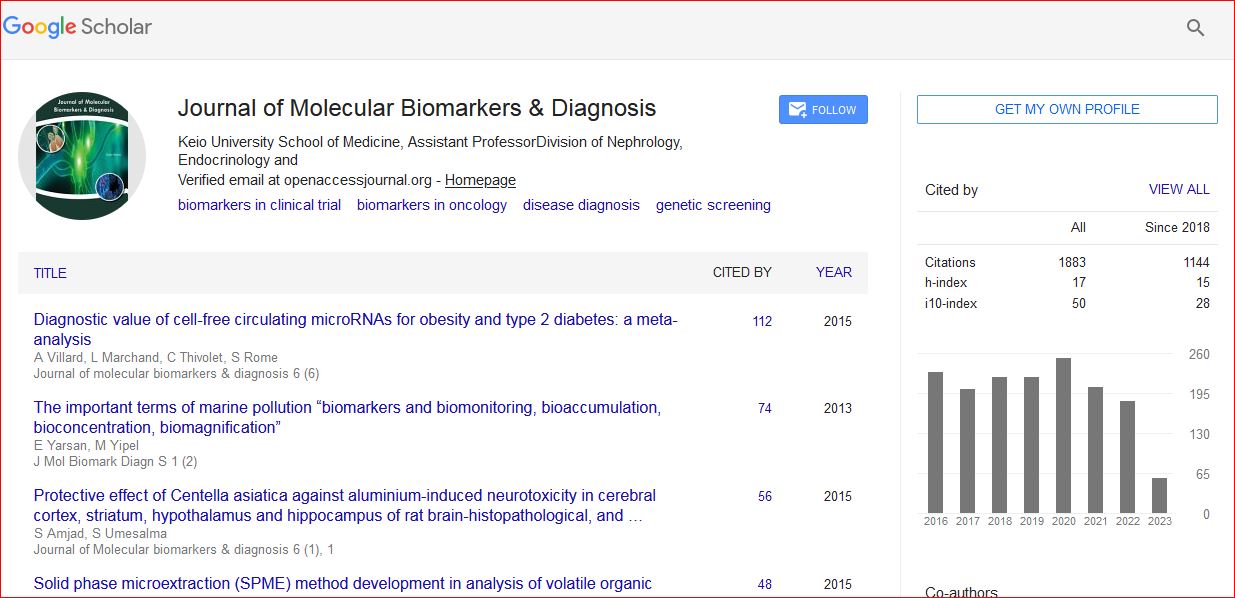
Journal of Molecular Biomarkers & Diagnosis received 2054 citations as per Google Scholar report