Perspective - (2025) Volume 15, Issue 6
Received: 01-Dec-2025, Manuscript No. mccr-25-178207;
Editor assigned: 03-Dec-2025, Pre QC No. P-178207;
Reviewed: 17-Dec-2025, QC No. Q-178207;
Revised: 22-Dec-2025, Manuscript No. R-178207;
Published:
29-Dec-2025
, DOI: 10.37421/2161-0444.2025.15.815
Citation: Henriksen, Lars. ”Prodrug Design: Enhancing Drug Bioavailability and Efficacy.” Med Chem 15 (2025):815.
Copyright: © 2025 Henriksen L. This is an open-access article distributed under the terms of the Creative Commons Attribution License, which permits unrestricted use, distribution and reproduction in any medium, provided the original author and source are credited.
Prodrug design represents a sophisticated and highly effective strategy in modern pharmaceutical science, fundamentally aimed at improving the pharmacokinetic and pharmacodynamic profiles of drug molecules. This approach involves the chemical modification of an active drug into an inactive or less active derivative, known as a prodrug, which is then converted back to the active drug in vivo through enzymatic or chemical hydrolysis. The primary objective of prodrug design is to overcome various limitations associated with parent drugs, thereby enhancing their therapeutic efficacy and patient compliance. For instance, prodrugs can be engineered to improve a drug's bioavailability by addressing issues such as poor solubility, low permeability across biological membranes, rapid metabolic degradation, or undesirable toxicity. These modifications can lead to a more efficient delivery of the drug to its intended site of action, ultimately optimizing therapeutic outcomes. One of the most significant impacts of prodrug design is its ability to enhance drug bioavailability, particularly for compounds that exhibit poor aqueous solubility. Many promising drug candidates are hindered in their clinical application due to their inability to dissolve adequately in biological fluids, which directly impacts their absorption and systemic availability. Prodrug strategies, such as esterification or amide formation, can dramatically increase the solubility of such drugs, facilitating their absorption from the gastrointestinal tract. This improved absorption translates into a higher concentration of the active drug reaching systemic circulation, leading to more predictable and effective therapeutic responses. Beyond solubility, prodrugs are instrumental in tackling challenges related to drug metabolism. Certain drugs are rapidly metabolized by enzymes in the liver or gut before they can reach their target sites or exert their therapeutic effects. By masking labile functional groups of the parent drug, prodrugs can evade premature enzymatic degradation. This protection extends the drug's half-life and ensures that a larger fraction of the administered dose becomes available for therapeutic action, thereby increasing its overall bioavailability and efficacy. Such approaches are crucial for developing drugs with improved pharmacokinetic profiles. Targeted delivery is another critical aspect addressed by prodrug design. Prodrugs can be specifically designed to release their active payload only at the disease site, minimizing exposure of healthy tissues to the drug. This targeted approach not only enhances the therapeutic efficacy by ensuring a higher local concentration of the drug where it is needed most but also significantly reduces the risk of systemic side effects. This level of precision in drug delivery can dramatically improve the therapeutic index and patient quality of life. Intestinal absorption is a key determinant of oral bioavailability, and prodrugs play a pivotal role in optimizing this process. By modifying a drug's lipophilicity or by incorporating it into systems that utilize transporter-mediated uptake mechanisms, prodrugs can circumvent efflux transporters that often limit drug absorption. This enhanced passage across the intestinal epithelium leads to a greater amount of the drug entering the portal circulation, thereby increasing its systemic availability. The pharmacokinetic profile of a drug, including its half-life and distribution, can be precisely modulated through prodrug design. By employing linkers that are cleaved at specific rates, prodrugs can achieve controlled release of the active drug. This controlled release can prolong the therapeutic duration of the drug, maintaining effective drug levels in the body for extended periods. Such strategies are vital for improving the overall bioavailability and convenience of drug administration. Advancements in prodrug technology have led to the development of stimuli-responsive prodrugs, which represent a sophisticated method for targeted drug delivery and enhanced bioavailability. These prodrugs are engineered to release the active drug in response to specific physiological cues, such as changes in pH, the presence of certain enzymes, or redox conditions unique to the disease microenvironment. This triggers the localized release of the drug, improving therapeutic outcomes while minimizing systemic exposure. Overcoming biological barriers, such as the blood-brain barrier (BBB), is a significant challenge in the development of drugs for central nervous system (CNS) disorders. Prodrug strategies offer a promising solution by temporarily modifying the drug's physicochemical properties to enhance its permeability across the BBB. This leads to increased drug concentrations in the brain, thereby improving efficacy for neurological conditions and directly impacting CNS bioavailability. The selection of appropriate linkers is fundamental to prodrug design, as these chemical moieties dictate the release rate and targeting efficiency of the prodrug. The use of various linker chemistries, including esters, amides, carbonates, and phosphates, allows for the design of prodrugs that are cleaved by specific enzymes or under particular physiological conditions. This fine-tuning of linker properties is essential for controlling the bioavailability of the released active drug and achieving desired therapeutic effects. In conclusion, prodrug design has emerged as a transformative approach in drug development, enabling the successful advancement of drug candidates that would otherwise be deemed undruggable. By enhancing critical parameters such as solubility, permeability, and metabolic stability, prodrugs significantly improve oral bioavailability and broaden the therapeutic window, making them indispensable tools for translating promising molecular entities into effective and safe therapies.
Prodrug design is a powerful strategy to enhance drug bioavailability by modifying the parent drug's physicochemical properties. This approach addresses limitations like poor solubility, low permeability, rapid metabolism, and undesirable toxicity. Prodrugs are inactive derivatives that, upon administration, undergo biotransformation to release the active drug at the target site or systemically. The impact on bioavailability is multifaceted, often leading to improved absorption, prolonged half-life, and targeted delivery, ultimately optimizing therapeutic efficacy [1].
The design of prodrugs for poorly soluble drugs is a critical area of research, with significant implications for oral bioavailability. Strategies such as esterification, amide formation, and the use of specific linkers can dramatically improve aqueous solubility and, consequently, absorption. This improvement directly translates to a higher fraction of the drug reaching systemic circulation [2].
Prodrug approaches can also mitigate issues related to drug metabolism. By masking labile functional groups of a parent drug, prodrugs can evade rapid enzymatic degradation in the liver or gut, leading to increased plasma concentrations and prolonged duration of action. This effectively enhances the drug's bioavailability by protecting it from premature clearance [3].
Targeted prodrug delivery systems are designed to release the active drug specifically at the disease site, minimizing systemic exposure and side effects. This localization strategy can significantly improve the therapeutic index and perceived bioavailability by ensuring a higher local concentration of the drug where it is needed most, while reducing off-target effects [4].
The impact of prodrug design on intestinal absorption is profound. By enhancing lipophilicity or employing transporter-mediated uptake mechanisms, prodrugs can bypass efflux transporters and improve paracellular or transcellular transport across the intestinal epithelium. This leads to a greater amount of drug entering the portal circulation [5].
Prodrug design can also influence the pharmacokinetic profile of a drug, particularly its half-life and distribution. Ester and ether linkages, for instance, can be cleaved at varying rates, allowing for controlled release of the active drug and potentially extending its therapeutic duration, thereby improving overall bioavailability by maintaining effective drug levels for longer [6].
The development of stimuli-responsive prodrugs represents a sophisticated approach to enhancing bioavailability. These prodrugs release the active agent in response to specific biological triggers (e.g., pH, enzymes, redox potential) present at the disease site, ensuring localized drug delivery and improved therapeutic outcomes with reduced systemic exposure [7].
Prodrug strategies are vital for overcoming the blood-brain barrier (BBB) limitations. By temporarily modifying a drug's properties, prodrugs can enhance its permeability across the BBB, leading to increased brain concentrations and improved efficacy for neurological disorders. This directly impacts the bioavailability of drugs within the central nervous system [8].
The choice of linker in prodrug design is crucial for controlling the release rate and targeting efficiency. Different linker chemistries, such as ester, amide, carbonate, or phosphate linkages, can be designed to be cleaved by specific enzymes or under particular physiological conditions, thus modulating the bioavailability of the released active drug [9].
Prodrug approaches have significantly advanced the development of challenging drug candidates, particularly those with poor physicochemical properties. By chemically modifying these molecules into prodrugs, their solubility, permeability, and metabolic stability can be improved, leading to enhanced oral bioavailability and a broader therapeutic window. This impact is essential for translating promising drug molecules into effective therapies [10].
Prodrug design is a key pharmaceutical strategy that enhances drug bioavailability by modifying parent drug properties to overcome limitations like poor solubility, low permeability, and rapid metabolism. These inactive derivatives are converted to active drugs in vivo, improving absorption, prolonging half-life, and enabling targeted delivery. Strategies like esterification and amide formation boost solubility for oral administration, while masking labile groups protects against premature degradation, increasing plasma concentrations. Targeted prodrugs release drugs at disease sites, minimizing side effects and maximizing therapeutic efficacy. Prodrugs also facilitate intestinal absorption and can be designed for controlled release, extending drug action. Stimuli-responsive prodrugs and those designed to cross the blood-brain barrier further demonstrate the versatility of this approach. The choice of linker is critical for controlling drug release and targeting, ultimately improving the overall therapeutic potential of drug candidates.
None
None
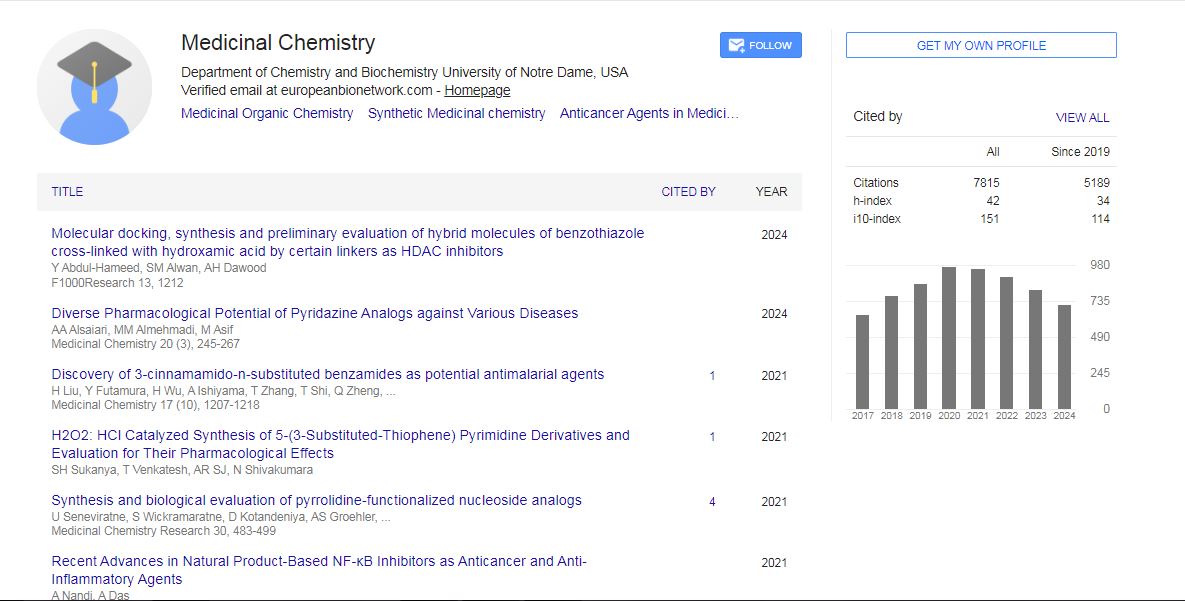
Medicinal Chemistry received 6627 citations as per Google Scholar report