Commentary - (2025) Volume 10, Issue 6
Received: 01-Dec-2025, Manuscript No. jdcm-26-182227;
Editor assigned: 03-Dec-2025, Pre QC No. P-182227;
Reviewed: 17-Dec-2025, QC No. Q-182227;
Revised: 22-Dec-2025, Manuscript No. R-182227;
Published:
29-Dec-2025
, DOI: 10.37421/2475-3211.2025.10.345
Citation: Al-Qahtani, Abdulrahman S.. ”Pregnancy Diabetes Management: Critical For Fetal Outcomes.” J Diabetic Complications Med 10 (2025):345.
Copyright: © 2025 Al-Qahtani S. Abdulrahman This is an open-access article distributed under the terms of the Creative Commons Attribution License, which permits unrestricted use, distribution and reproduction in any medium, provided the original author and source are credited.
Gestational diabetes mellitus (GDM) and pre-existing diabetes in pregnant individuals represent significant health concerns, necessitating careful management to ensure optimal maternal and fetal outcomes. The presence of hyperglycemia during pregnancy can lead to a spectrum of adverse events, including macrosomia, neonatal hypoglycemia, and the development of preeclampsia. Addressing these risks requires a comprehensive and multidisciplinary strategy involving endocrinologists, obstetricians, and dietitians to effectively screen, diagnose, and treat these conditions [1].
Congenital anomalies are a particularly alarming complication associated with diabetes in pregnancy. The risk of these birth defects can be substantially mitigated by maintaining tight glycemic control from the preconception period through the critical first trimester of gestation. Advances in prenatal screening and diagnostic capabilities, coupled with improvements in the mother's metabolic health, play a pivotal role in minimizing the occurrence of such anomalies [2].
Preeclampsia, a severe hypertensive disorder, exhibits a higher prevalence among women with diabetes. Understanding the intricate pathophysiological connections between diabetes and preeclampsia is crucial. These links often involve shared inflammatory pathways and the phenomenon of endothelial dysfunction, underscoring the need for early detection and proactive management [3].
Macrosomia, characterized by excessive fetal growth, is a frequently encountered complication in pregnancies where diabetes is poorly controlled. This condition elevates the risk of birth trauma and increases the likelihood of cesarean delivery. Current guidelines for glycemic targets and nutritional recommendations are instrumental in preventing the development of macrosomia [4].
Neonatal hypoglycemia is a serious concern for infants born to mothers with diabetes. The underlying mechanisms responsible for this condition are complex, and established management protocols are essential. These protocols typically include early initiation of feeding and diligent glucose monitoring to stabilize the infant's blood sugar levels [5].
The utility of continuous glucose monitoring (CGM) in optimizing glycemic control during pregnancy for individuals with diabetes is gaining increasing recognition. Examining the benefits and challenges associated with CGM implementation provides valuable insights into its impact on maternal and neonatal outcomes, as well as identifying future research directions [6].
International guidelines for the diagnosis and management of gestational diabetes mellitus are continually updated to reflect the latest evidence. These guidelines encompass screening strategies, diagnostic criteria, and therapeutic interventions, with a strong emphasis on lifestyle modifications and the judicious use of pharmacologic treatments when necessary [7].
The long-term health trajectory of offspring exposed to maternal diabetes in utero is a critical area of ongoing research. Emerging evidence suggests a link between prenatal exposure to hyperglycemia and an increased risk of childhood obesity and the subsequent development of metabolic syndrome in later life [8].
Cardiovascular complications, including preeclampsia and hypertension, are known to be exacerbated in pregnancies complicated by diabetes. Investigating the shared risk factors and developing tailored management strategies are paramount for safeguarding cardiovascular health in this high-risk obstetric population [9].
A patient-centered approach is fundamental to the effective management of diabetes in pregnancy. This approach integrates comprehensive education on diet, exercise, and self-monitoring of blood glucose, fostering shared decision-making and providing essential psychological support to women navigating the complexities of diabetic pregnancies [10].
The management of diabetes during pregnancy, encompassing both gestational diabetes mellitus (GDM) and pre-existing diabetes, demands rigorous attention due to the inherent risks to maternal and fetal well-being. Effective control of maternal hyperglycemia is paramount in averting complications such as macrosomia, neonatal hypoglycemia, and preeclampsia. This necessitates a collaborative effort among endocrinologists, obstetricians, and dietitians, focusing on current strategies for screening, diagnosis, and therapeutic interventions [1].
A significant concern in diabetic pregnancies is the occurrence of congenital anomalies. The risk of these serious birth defects can be markedly reduced through meticulous glycemic control maintained from the preconception phase through the crucial first trimester. Modern advancements in prenatal screening and diagnostic techniques, combined with improved maternal metabolic status, are vital in mitigating this specific complication [2].
Preeclampsia, a serious hypertensive disorder of pregnancy, is observed with greater frequency in women with diabetes. Elucidating the pathophysiological pathways that connect diabetes and preeclampsia, particularly the shared inflammatory mechanisms and endothelial dysfunction, is essential for advancing early detection and proactive management [3].
Macrosomia, defined as an abnormally large fetus, is a common sequela of inadequately controlled diabetes during pregnancy. This condition heightens the risks of birth trauma and necessitates a greater likelihood of cesarean delivery. Adherence to current guidelines concerning glycemic targets and nutritional interventions is crucial for preventing macrosomia [4].
Infants born to mothers with diabetes are at an increased risk of neonatal hypoglycemia. Understanding the mechanisms that lead to this condition and implementing appropriate management protocols, including early feeding and consistent glucose monitoring, are critical for infant health [5].
The role of continuous glucose monitoring (CGM) in enhancing glycemic control during pregnancy for women with diabetes is increasingly appreciated. A thorough examination of the benefits and challenges associated with CGM use, its influence on maternal and neonatal outcomes, and its future potential is warranted [6].
International guidelines for diagnosing and managing gestational diabetes mellitus are periodically updated to incorporate the latest scientific findings. These revisions cover screening methods, diagnostic criteria, and therapeutic approaches, emphasizing lifestyle changes and, when indicated, pharmacological interventions [7].
The long-term health consequences for children born to mothers with diabetes are an active area of investigation. Current research suggests that prenatal exposure to hyperglycemia may be associated with a higher incidence of childhood obesity and the development of metabolic syndrome later in life [8].
Cardiovascular complications, such as preeclampsia and hypertension, are known to be more severe in pregnancies affected by diabetes. A detailed understanding of the shared risk factors and the implementation of effective management strategies are crucial for addressing cardiovascular health in this vulnerable population [9].
A patient-centered philosophy is fundamental to the care of pregnant individuals with diabetes. This approach prioritizes patient education on diet, exercise, and self-monitoring, alongside shared decision-making and psychological support, to navigate the unique challenges of diabetic pregnancies [10].
Managing diabetes in pregnancy, including gestational diabetes mellitus (GDM) and pre-existing diabetes, is critical to prevent adverse outcomes such as macrosomia, neonatal hypoglycemia, and preeclampsia. Tight glycemic control from preconception through the first trimester significantly reduces the risk of congenital anomalies. Preeclampsia is more prevalent in women with diabetes, linked by shared inflammatory pathways and endothelial dysfunction. Macrosomia can be prevented with optimal glycemic control and nutritional strategies. Neonatal hypoglycemia requires prompt management including early feeding and glucose monitoring. Continuous glucose monitoring (CGM) offers benefits for glycemic control. Updated international guidelines provide frameworks for diagnosis and management, emphasizing lifestyle modifications and pharmacotherapy. Prenatal exposure to maternal hyperglycemia may increase long-term risks of childhood obesity and metabolic syndrome in offspring. Cardiovascular complications are amplified in diabetic pregnancies, necessitating attention to shared risk factors and management. Patient-centered care, focusing on education, self-monitoring, shared decision-making, and psychological support, is essential for successful management.
None
None
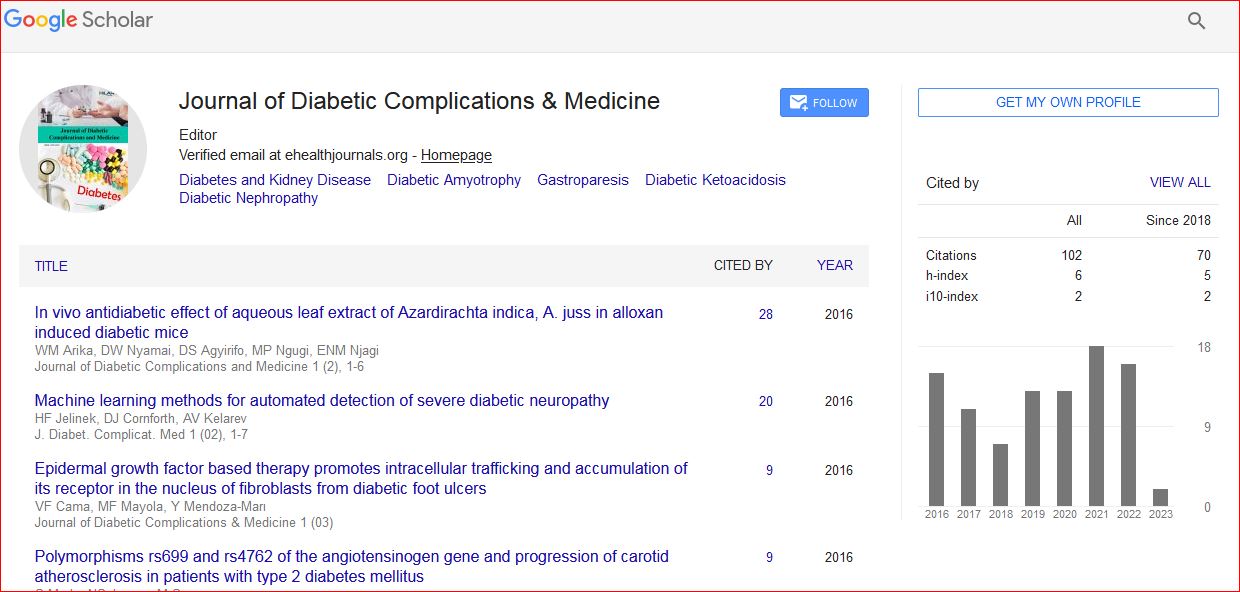
Journal of Diabetic Complications & Medicine received 102 citations as per Google Scholar report