Commentary - (2025) Volume 16, Issue 6
Received: 01-Nov-2025, Manuscript No. jhmi-26-178885;
Editor assigned: 03-Nov-2025, Pre QC No. P-178885;
Reviewed: 17-Nov-2025, QC No. Q-178885;
Revised: 24-Nov-2025, Manuscript No. R-178885;
Published:
29-Nov-2025
, DOI: 10.37421/2157-7420.2025.16.617
Citation: Lopes, Mariana F.. ”Predictive Analytics: Optimizing Healthcare Operations For Better Outcomes.” J Health Med Informat 16 (2025):617.
Copyright: © 2025 Lopes F. Mariana This is an open-access article distributed under the terms of the Creative Commons Attribution License, which permits unrestricted use, distribution and reproduction in any medium, provided the original author and source are credited.
The integration of predictive analytics within healthcare systems has emerged as a transformative approach to optimizing resource allocation, enhancing operational efficiency, and ultimately improving patient care. This methodology leverages advanced statistical techniques and machine learning algorithms to forecast future trends and demands, enabling healthcare providers to make more informed and proactive decisions. Predictive analytics offers a powerful lens through which to examine complex healthcare operations, moving beyond reactive measures to a more strategic, data-driven paradigm. One critical area benefiting from predictive analytics is the optimization of healthcare resource allocation, encompassing patient flow, staff scheduling, and equipment utilization. By understanding patterns and predicting future needs, health systems can significantly enhance their efficiency, reduce operational costs, and elevate the quality of patient outcomes through sophisticated forecasting and decision-making processes [1].
Machine learning models are increasingly being applied to predict vital metrics such as hospital bed occupancy and patient admissions. The insights derived from these models empower healthcare facilities to manage bed availability proactively, thereby minimizing patient wait times and streamlining the overall efficiency of patient throughput, which is fundamental to effective resource management [2].
Furthermore, predictive analytics plays a pivotal role in optimizing staffing levels within high-pressure environments like emergency departments (EDs). By accurately forecasting patient arrival patterns and their associated acuity, hospitals can ensure that adequate staffing is consistently maintained, leading to accelerated patient care and more judicious resource utilization during periods of peak demand [3].
The application of predictive analytics extends to the meticulous management of medical equipment inventory and its maintenance. Through precise forecasting of equipment usage patterns and potential failure rates, healthcare institutions can facilitate timely procurement and servicing, effectively preventing critical shortages and minimizing operational downtime [4].
Surgical scheduling and operating room utilization are also prime candidates for optimization through predictive modeling. By analyzing historical data pertaining to surgery durations, scheduling complexities, and cancellation rates, healthcare facilities can significantly boost the efficiency of their surgical suites, leading to reduced costs and expanded patient access to essential procedures [5].
In the realm of supply chain management, predictive analytics offers substantial benefits for optimizing the flow of essential medical supplies and pharmaceuticals. Forecasting demand accurately for these critical items helps prevent stockouts, minimizes waste, and ensures that resources are allocated efficiently throughout the healthcare network [6].
Predictive modeling is also proving invaluable in forecasting patient readmission rates, which in turn allows for the optimized allocation of post-discharge resources. By identifying patients at a higher risk of readmission, healthcare providers can implement targeted interventions and strategically deploy resources to mitigate this common challenge and improve patient recovery pathways [7].
The deployment of mobile health units and community-based services can be significantly enhanced through predictive analytics. This approach ensures that healthcare resources are systematically directed towards areas exhibiting the greatest need, thereby improving overall healthcare access and promoting greater equity in service delivery [8].
Finally, predictive analytics is instrumental in comprehensive workforce planning within the healthcare sector. By forecasting staffing requirements based on projected patient volume, acuity levels, and operational demands, organizations can ensure an adequate supply of personnel while simultaneously optimizing labor costs and resource allocation [9].
The core of modern healthcare management lies in the effective allocation of resources, a complex challenge addressed by the burgeoning field of predictive analytics. This approach allows healthcare institutions to transition from reactive problem-solving to proactive strategic planning, utilizing data to anticipate needs and optimize operations across various domains. Specifically, predictive analytics offers a sophisticated framework for enhancing healthcare resource allocation. This includes optimizing patient flow through hospitals, ensuring appropriate staff scheduling to meet demand, and maximizing the utilization of critical medical equipment. The ultimate goal is to achieve greater operational efficiency, realize cost reductions, and improve the overall quality of patient outcomes through intelligent, data-driven forecasting and decision-making processes within health systems [1].
Machine learning models are proving to be powerful tools for predicting key operational metrics, such as hospital bed occupancy rates and future patient admissions. The predictive insights generated enable healthcare facilities to manage bed availability proactively, significantly reducing patient wait times and enhancing the efficiency of patient throughput, which is paramount for effective resource management [2].
Within the demanding environment of emergency departments (EDs), predictive analytics is instrumental in optimizing staffing levels. By accurately forecasting patient arrival patterns and their associated acuity, EDs can ensure that staffing is consistently aligned with anticipated demand. This proactive approach leads to faster patient care and more effective utilization of resources, especially during high-demand periods [3].
The strategic management of medical equipment is another area ripe for optimization through predictive analytics. This involves forecasting usage patterns and predicting potential equipment failure rates. Such foresight allows for timely procurement of necessary equipment and scheduling of maintenance, thereby preventing shortages and minimizing costly operational downtime [4].
Surgical scheduling and the utilization of operating rooms present significant opportunities for efficiency gains through predictive modeling. By analyzing historical data on surgery durations, scheduling complexities, and cancellation trends, healthcare facilities can enhance the efficiency of their surgical suites. This optimization leads to reduced operational costs and improved patient access to surgical services [5].
In the critical domain of healthcare supply chains, predictive analytics plays a vital role in optimizing the management of pharmaceuticals and medical supplies. Accurate demand forecasting helps prevent stockouts of essential items and reduces waste, ensuring that resources are allocated efficiently and that the supply chain remains robust and responsive [6].
Predictive modeling is also being leveraged to forecast patient readmission rates, enabling a more optimized allocation of post-discharge resources. By identifying patients with a higher likelihood of readmission, healthcare providers can implement targeted interventions and allocate resources effectively to support patient recovery and prevent unnecessary hospital revisits [7].
The deployment of mobile health units and community-based services can be significantly improved through predictive analytics. This approach allows for the strategic direction of resources to areas demonstrating the greatest need, thereby enhancing healthcare access and promoting greater equity in service delivery across diverse populations [8].
Finally, predictive analytics is a cornerstone for effective workforce planning within healthcare organizations. By forecasting future staffing needs based on projected patient volume, acuity, and operational demands, healthcare providers can ensure they have the right personnel in place, optimize labor costs, and manage their workforce resources effectively [9].
Predictive analytics is revolutionizing healthcare by enabling data-driven optimization of various operational aspects. Key applications include enhancing resource allocation for patient flow, staff scheduling, and equipment utilization, leading to improved efficiency and patient outcomes. Machine learning models are vital for predicting hospital bed occupancy and patient admissions, allowing for proactive management and reduced wait times. Emergency departments benefit from optimized staffing through arrival pattern forecasting. Medical equipment inventory and maintenance are improved by predicting usage and failure rates. Surgical scheduling and operating room utilization are enhanced through historical data analysis. Healthcare supply chains are optimized by forecasting demand for pharmaceuticals and medical supplies, preventing stockouts and waste. Predictive modeling of patient readmissions enables targeted interventions and better post-discharge resource allocation. Mobile health unit deployment is optimized by directing resources to areas of greatest need, improving access and equity. Workforce planning is also significantly improved by forecasting staffing requirements, ensuring adequate personnel and optimizing labor costs.
None
None
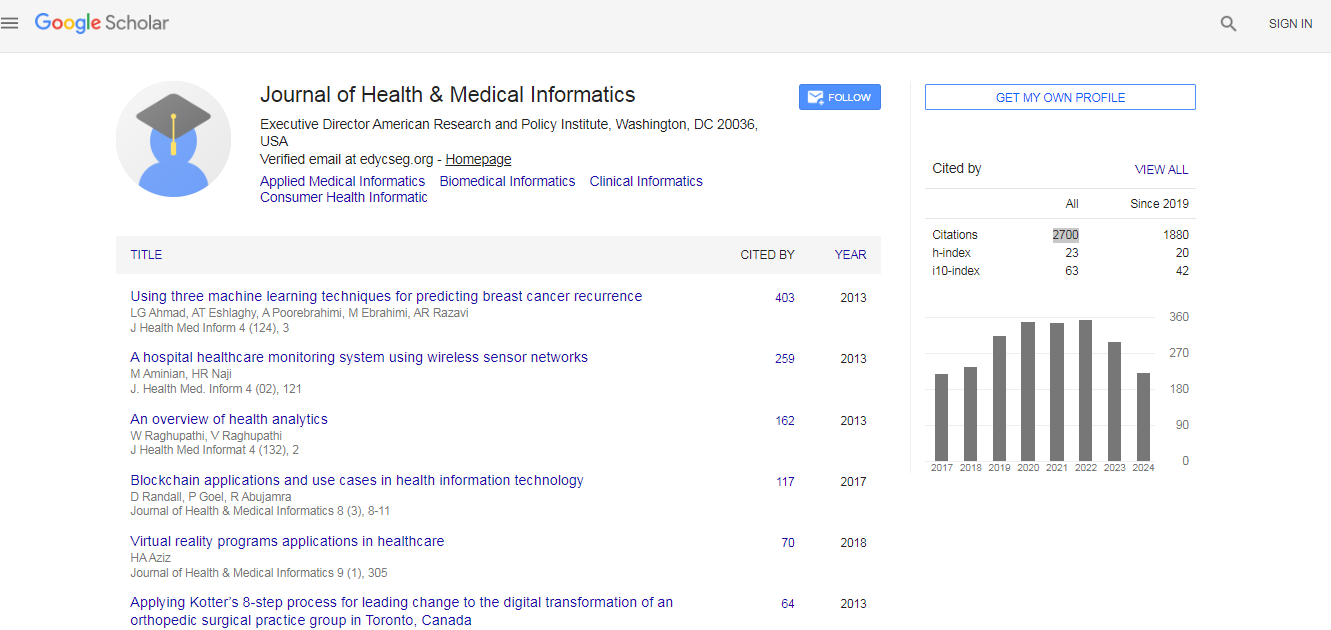
Journal of Health & Medical Informatics received 2700 citations as per Google Scholar report