Commentary - (2025) Volume 16, Issue 3
Received: 02-Jun-2025, Manuscript No. jmbd-26-179388;
Editor assigned: 04-Jun-2025, Pre QC No. P-179388;
Reviewed: 15-Jun-2025, QC No. Q-179388;
Revised: 23-Jun-2025, Manuscript No. R-179388;
Published:
30-Jun-2025
, DOI: 10.37421/2155-9929.2025.16.703
Citation: Smith, Oliver. ”Precision Oncology: Revolutionizing Cancer Treatment Through Biomarkers.” J Mol Biomark Diagn 16 (2025):703.
Copyright: © 2025 Smith O. This is an open-access article distributed under the terms of the Creative Commons Attribution License, which permits unrestricted use, distribution and reproduction in any medium, provided the original author and source are credited.
Precision oncology is fundamentally transforming the landscape of cancer treatment by leveraging molecular biomarkers to guide the selection of targeted therapies, thereby enhancing patient outcomes and minimizing adverse effects on healthy tissues. This advanced approach mandates a profound comprehension of the genomic alterations within tumors, as well as the precise identification of mutations that can be therapeutically targeted [1].
The accurate identification and rigorous validation of specific molecular biomarkers are of paramount importance for the successful implementation of targeted therapies across a broad spectrum of cancer types. In this context, next-generation sequencing (NGS) has emerged as an indispensable tool, playing a critical role in the discovery of these essential biomarkers [2].
Liquid biopsies, which analyze circulating tumor DNA (ctDNA) found in bodily fluids such as blood, offer a significantly less invasive methodology for continuously monitoring a patient's response to treatment. Furthermore, they provide a means to detect the emergence of resistance mechanisms in real-time, thereby complementing traditional tissue-based diagnostic methods [3].
The development of highly specific targeted therapies, including inhibitors designed to block the activity of particular oncogenic drivers such as EGFR, ALK, and BRAF, has led to a remarkable improvement in survival rates for patients whose cancers harbor these specific genetic alterations [4].
Tumor heterogeneity, characterized by the genetic diversity within a single tumor, and the development of acquired resistance to therapies represent substantial hurdles that must be overcome in the field of precision oncology. A thorough understanding of these complex phenomena is indispensable for devising effective strategies to counteract treatment failure and extend the duration of patient benefit [5].
The integration of artificial intelligence (AI) and machine learning (ML) methodologies is increasingly being explored as a means to enhance the process of biomarker discovery, refine treatment selection, and improve the prediction of therapeutic response within the domain of precision oncology [6].
Pharmacogenomics, which scientifically investigates how an individual's genetic makeup influences their response to pharmaceutical agents, constitutes an integral component of modern precision medicine. This field enables the optimization of drug choices and precise adjustments to dosage regimens [7].
The ethical considerations and regulatory frameworks that govern the application of molecular biomarkers and targeted therapies in clinical settings are inherently complex. Careful attention and thoughtful deliberation are required to safeguard patient privacy and ensure equitable access to these advanced treatment modalities [8].
The ongoing discovery of novel biomarkers through sophisticated proteomic and transcriptomic analyses continues to broaden the array of actionable molecular targets available for the development of innovative cancer therapies [9].
The effective integration of precision oncology principles into the routine practice of clinical care necessitates the establishment of robust infrastructure for molecular profiling. Moreover, it requires fostering close and effective collaboration among oncologists, pathologists, and geneticists to ensure comprehensive patient management [10].
Precision oncology represents a paradigm shift in cancer treatment, moving away from a one-size-fits-all approach towards personalized interventions guided by molecular insights. This revolution is driven by the utilization of molecular biomarkers to tailor therapies, leading to improved clinical outcomes and a significant reduction in off-target toxicities. Achieving this level of personalization requires an in-depth understanding of tumor genomics and the ability to identify actionable mutations [1].
The cornerstone of successful targeted therapy lies in the meticulous identification and rigorous validation of specific molecular biomarkers. These biomarkers serve as critical indicators for treatment selection, and their discovery is heavily reliant on advanced technologies such as next-generation sequencing (NGS), which plays a pivotal role in uncovering these crucial molecular signatures [2].
Liquid biopsies have emerged as a groundbreaking advancement, offering a less invasive alternative to traditional tissue biopsies. By analyzing circulating tumor DNA (ctDNA), these biopsies allow for real-time monitoring of treatment response and the early detection of resistance mechanisms, thereby providing valuable dynamic information that complements static tissue diagnoses [3].
The therapeutic armamentarium of precision oncology includes a growing list of targeted therapies, such as inhibitors directed against specific oncogenic drivers like EGFR, ALK, and BRAF. The strategic application of these agents has demonstrably improved survival rates and quality of life for patients with cancers harboring corresponding genetic alterations [4].
Despite the remarkable progress, significant challenges persist, notably tumor heterogeneity and the inevitable development of acquired resistance. Addressing these complexities is crucial for developing resilient treatment strategies that can overcome therapeutic failure and sustain patient benefit over extended periods [5].
To further enhance the precision and efficacy of cancer care, the integration of cutting-edge technologies like artificial intelligence (AI) and machine learning (ML) is being actively investigated. These tools hold immense potential for improving biomarker discovery, optimizing treatment selection, and more accurately predicting therapeutic response [6].
Pharmacogenomics, the study of how genetic variations influence drug metabolism and efficacy, is an essential component of precision medicine. By understanding an individual's genetic profile, clinicians can optimize drug selection and dosage, thereby maximizing therapeutic benefit while minimizing adverse drug reactions [7].
The widespread adoption of precision oncology raises important ethical and regulatory questions. Ensuring patient privacy, data security, and equitable access to these advanced diagnostics and therapies requires careful consideration and proactive policy development [8].
The continuous evolution of precision oncology is fueled by ongoing research into novel biomarkers. Advanced proteomic and transcriptomic analyses are instrumental in expanding the repertoire of actionable targets that can be exploited for therapeutic intervention [9].
The successful translation of precision oncology from research settings to standard clinical practice is contingent upon several factors, including the establishment of comprehensive molecular profiling infrastructure and the cultivation of strong collaborative relationships among oncologists, pathologists, and geneticists [10].
Precision oncology revolutionizes cancer treatment by using molecular biomarkers to guide targeted therapies, improving outcomes and reducing side effects. This approach requires deep understanding of tumor genomics and identification of actionable mutations, often facilitated by next-generation sequencing. Liquid biopsies offer a less invasive method for monitoring treatment and detecting resistance. Targeted therapies like EGFR, ALK, and BRAF inhibitors have significantly improved survival. Challenges include tumor heterogeneity and acquired resistance, necessitating ongoing research. Artificial intelligence and machine learning are being explored to enhance biomarker discovery and treatment selection. Pharmacogenomics optimizes drug selection and dosage based on genetic profiles. Ethical and regulatory considerations are crucial for patient privacy and equitable access. Novel biomarkers are continually being identified through proteomic and transcriptomic analyses. Implementing precision oncology requires robust infrastructure and interdisciplinary collaboration.
None
None
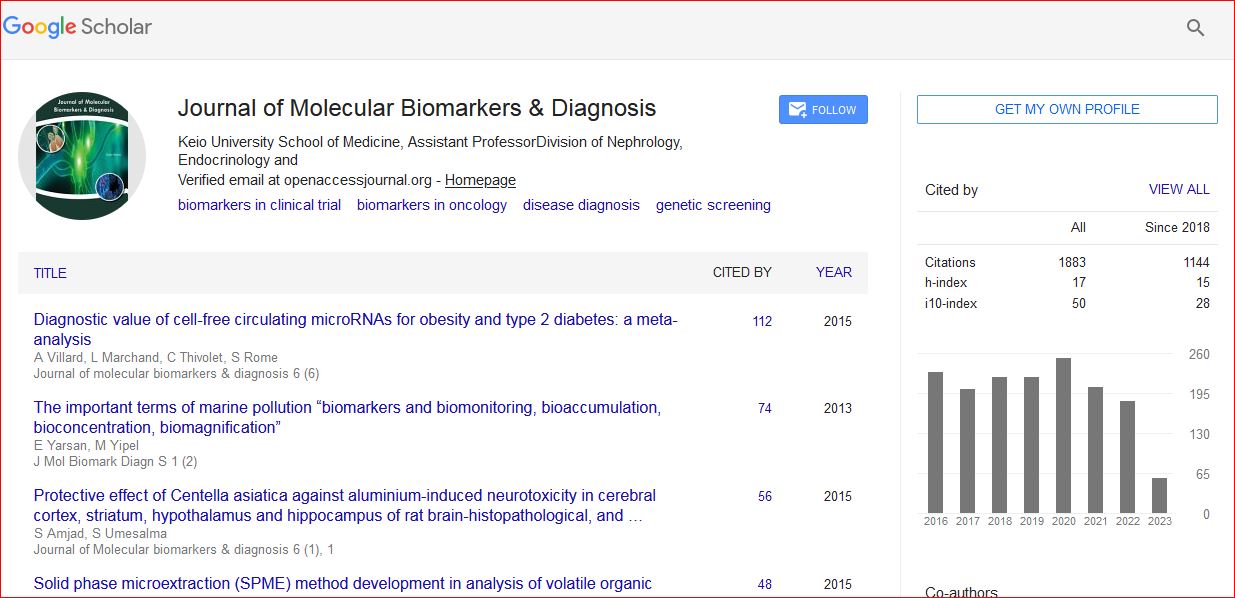
Journal of Molecular Biomarkers & Diagnosis received 2054 citations as per Google Scholar report