Opinion - (2025) Volume 11, Issue 2
Received: 02-May-2025, Manuscript No. jotr-25-175571;
Editor assigned: 05-May-2025, Pre QC No. P-175571;
Reviewed: 19-May-2025, QC No. Q-175571;
Revised: 23-May-2025, Manuscript No. R-175571;
Published:
30-May-2025
, DOI: 10.37421/2476-2261. 2025.11.303
Citation: Santos, Emilia. ”Precision Oncology: Realities, Roadblocks, Revolution.” J Oncol Transl Res 11 (2025):303.
Copyright: © 2025 Santos E. This is an open-access article distributed under the terms of the Creative Commons Attribution License, which permits unrestricted use, distribution and reproduction in any medium, provided the original author and source are credited.
Precision oncology has transitioned from a theoretical concept to a tangible reality, driven by significant advancements in genomic profiling and the development of targeted therapies. This approach tackles the challenges of implementation, particularly concerning equitable access and the necessity for robust bioinformatics infrastructure to effectively interpret complex molecular data for patient-specific treatment decisions [1].
However, precision oncology faces distinct hurdles, especially in low-resource settings, marked by limited access to advanced genomic sequencing, prohibitive drug costs, and a lack of specialized infrastructure. Addressing these issues requires exploring solutions such as international collaborations, developing cost-effective technologies, and implementing tailored strategies to ensure broader accessibility to these advanced treatments [2].
Further developments in precision oncology involve its application in aggressive diseases like small cell lung cancer (SCLC), where it moves beyond traditional chemotherapy. Ongoing research focuses on identifying emerging molecular targets, potential biomarkers, and novel therapeutic strategies to significantly improve patient outcomes through personalized approaches [3].
The application of precision oncology principles to rare cancers also presents its own set of unique challenges and valuable opportunities. Given the small patient populations, conducting large-scale clinical trials is difficult, emphasizing the need for innovative trial designs, international collaborations, and comprehensive molecular profiling to accelerate the development of targeted therapies [4].
Exploring the synergistic potential of combining precision oncology approaches, which target specific molecular alterations, with immunotherapy, which utilizes the body's own immune system, represents a powerful avenue. Molecular profiling proves crucial in identifying patients most likely to benefit from immunotherapy, although challenges persist in optimizing treatment sequencing and managing complex toxicities [5].
Liquid biopsy is emerging as a transformative tool within precision oncology, offering non-invasive monitoring of tumor progression, early detection of minimal residual disease, and the identification of resistance mechanisms. Through the analysis of circulating tumor DNA (ctDNA), this method refines treatment selection and disease surveillance, ultimately leading to more dynamic and personalized patient care [6].
The integration of Artificial Intelligence (AI) in precision oncology promises to revolutionize the field by analyzing vast omics data, identifying novel biomarkers, and accurately predicting treatment responses. AI is expected to significantly enhance clinical decision-making, optimize the drug discovery process, and enable the development of truly personalized therapeutic strategies, surpassing current computational limits [7].
Precision oncology also navigates significant ethical and regulatory complexities, ranging from ensuring informed patient consent for genomic data sharing to addressing equitable access to often expensive targeted therapies. Establishing clear guidelines for incidental findings, maintaining data privacy, and striking a balance between innovative development and responsible implementation in clinical practice are critical concerns [8].
Moreover, the economic impact of precision oncology warrants careful consideration, involving the analysis of costs associated with molecular testing, targeted therapies, and overall healthcare utilization. The substantial financial burden on healthcare systems and individual patients highlights the urgent need for robust cost-effectiveness analyses and value-based pricing models to ensure the long-term sustainability and equitable access of these advanced treatments [9].
Finally, the advancement of precision oncology is further propelled by multi-omics approaches, which integrate genomic, transcriptomic, proteomic, and metabolomic data. By offering a more comprehensive molecular understanding of tumors, multi-omics can pinpoint more precise biomarkers, anticipate drug resistance, and tailor therapeutic strategies beyond the scope of single-omics analyses [10].
Precision oncology has advanced from theoretical promise to practical reality, driven by genomic profiling and targeted therapies addressing specific molecular alterations [1]. This approach integrates multi-omics dataâ??genomic, transcriptomic, proteomic, and metabolomic informationâ??to create a comprehensive tumor landscape. This integration is vital for identifying precise biomarkers, predicting drug resistance, and devising personalized therapeutic strategies beyond single-omics analysis capabilities [10]. The goal is to arrive at patient-specific treatment decisions, tailoring therapies to each individualâ??s unique cancer profile.
Despite its potential, precision oncology faces significant implementation challenges. Equitable access is a major hurdle, especially in low-resource settings with limited genomic sequencing, high drug costs, and underdeveloped infrastructure [2]. For rare cancers, conducting large-scale clinical trials is difficult due to small patient populations, demanding innovative trial designs and international collaborations for therapy development [4]. The economic burden of molecular testing and targeted therapies also strains healthcare systems and patients. Sustainability requires meticulous cost-effectiveness analyses and the exploration of value-based pricing models [9].
New technologies continuously reshape precision oncologyâ??s diagnostic and monitoring capabilities. Liquid biopsy offers a non-invasive method to monitor tumor progression, detect minimal residual disease, and identify resistance mechanisms via circulating tumor DNA (ctDNA) analysis. This refines treatment selection, providing dynamic, personalized care [6]. Artificial Intelligence (AI) is another pivotal advancement, holding potential to analyze vast omics data. AI can identify novel biomarkers, predict treatment responses, and enhance decision-making, optimizing drug discovery and personalizing strategies beyond current computational limits [7].
The field also progresses through innovative therapeutic strategies and specific applications. In aggressive diseases like small cell lung cancer (SCLC), precision oncology focuses on identifying emerging molecular targets and biomarkers beyond traditional chemotherapy, improving patient outcomes through personalized approaches [3]. Furthermore, combining precision oncology with immunotherapy shows promise. This strategy uses molecular profiling to identify patients likely to respond to immunotherapy, though optimizing treatment sequencing and managing complex toxicities remain active research areas [5].
As precision oncology integrates into clinical practice, it brings a complex array of ethical and regulatory considerations. Issues range from ensuring patient consent for genomic data sharing to addressing equitable access to expensive targeted therapies. There is an urgent need for clear guidelines on incidental findings, robust data privacy measures, and balancing innovation with responsible implementation in clinical practice [8]. Addressing these factors is paramount for the long-term success and ethical integration of personalized medicine into healthcare systems.
Precision oncology has become a practical reality, propelled by advancements in genomic profiling and targeted therapies. Implementing these strategies, however, faces significant challenges, notably ensuring equitable access and establishing a robust bioinformatics infrastructure to interpret complex molecular data for patient-specific decisions. In low-resource settings, unique hurdles arise from limited sequencing, high drug costs, and a lack of specialized infrastructure, emphasizing the need for international collaborations and cost-effective solutions. The approach is also evolving for aggressive diseases like small cell lung cancer, focusing on new molecular targets, and for rare cancers, where innovative trial designs are crucial for developing targeted therapies. Combining precision oncology with immunotherapy shows great promise, using molecular profiling to predict patient response, though managing treatment sequencing and toxicities remains complex. Liquid biopsy is transforming monitoring by enabling non-invasive detection of tumor progression and resistance mechanisms. Artificial Intelligence (AI) integration is set to revolutionize data analysis, biomarker identification, and treatment prediction, moving beyond current computational limits. The field also grapples with ethical and regulatory complexities, including patient consent, data privacy, and equitable access to expensive treatments. Furthermore, the economic burden necessitates careful cost-effectiveness analyses and value-based pricing. Multi-omics approaches are enhancing precision oncology by integrating diverse molecular data for more comprehensive tumor insights and refined personalized strategies.
None
None
Ashish KR, Srinivas P, Gobardhan M. "Precision Oncology: A Journey from Hope to Promise.".J Oncol Pract 16 (2020):213-221.
Indexed at, Google Scholar, Crossref
Jonathan JA, Alfred AA, Vincent B. "Challenges and opportunities for precision oncology in low-resource settings.".Nat Med 29 (2023):20-27.
Indexed at, Google Scholar, Crossref
Yi D, Peng C, Yi Y. "Precision oncology for small cell lung cancer: New avenues for targeted therapy.".Front Oncol 13 (2023):1114532.
Indexed at, Google Scholar, Crossref
Emese Z, Stephanie L, Charles G. "Precision oncology in rare cancers: a critical review and future perspectives.".J Natl Cancer Inst 113 (2021):703-714.
Indexed at, Google Scholar, Crossref
Christophe M, Jean-Charles S, Alexander E. "Combining precision oncology and immunotherapy: Opportunities and challenges.".J Immunother Cancer 9 (2021):e002360.
Indexed at, Google Scholar, Crossref
Jeanne T, Isaac K, Ying W. "Liquid biopsy in precision oncology: a new era.".Genome Med 13 (2021):167.
Indexed at, Google Scholar, Crossref
Sumit O, Amit J, Kalyani G. "Precision oncology and the promise of artificial intelligence.".Int J Cancer 150 (2022):745-758.
Indexed at, Google Scholar, Crossref
Effy V, Wim D, Fadi M. "Ethical and regulatory challenges of precision oncology: From the bench to the bedside.".J Med Ethics 46 (2020):228-234.
Indexed at, Google Scholar, Crossref
Krystal H, Seung CK, Yong Y. "The economic burden of precision oncology: a systematic review.".Pharmacoeconomics 38 (2020):71-87.
Indexed at, Google Scholar, Crossref
Rahul K, Gaurav G, Anurag A. "Beyond the genome: the promise of multi-omics in precision oncology.".NPJ Precis Oncol 7 (2023):11.
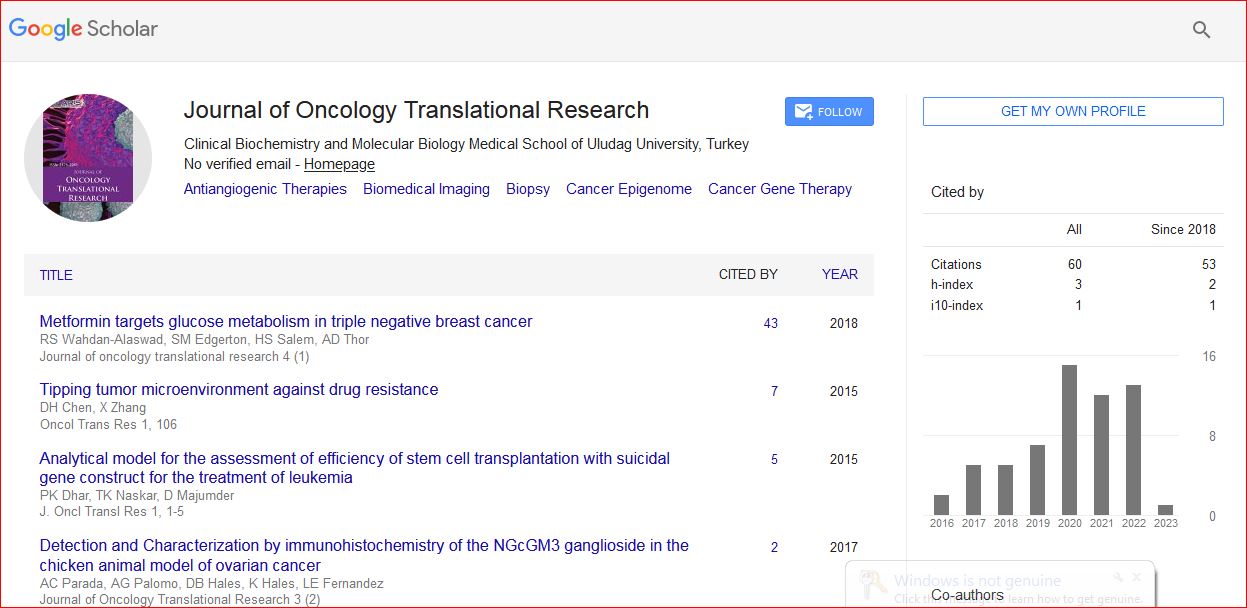
Journal of Oncology Translational Research received 93 citations as per Google Scholar report