Perspective - (2025) Volume 14, Issue 4
Received: 01-Aug-2025, Manuscript No. idse-26-182838;
Editor assigned: 04-Aug-2025, Pre QC No. P-182838;
Reviewed: 18-Aug-2025, QC No. Q-182838;
Revised: 22-Aug-2025, Manuscript No. R-182838;
Published:
29-Aug-2025
, DOI: 10.37421/2168-9768.2025.14.504
Citation: Ivanenko, Olga. ”Precision Irrigation and Drainage for
Sustainable Agriculture.” Irrigat Drainage Sys Eng 14 (2025):504.
Copyright: © 2025 Ivanenko O. This is an open-access article distributed under the terms of the Creative Commons Attribution License, which permits unrestricted use,
distribution and reproduction in any medium, provided the original author and source are credited.
The optimization of irrigation scheduling and the design of effective drainage systems are paramount for achieving sustainable agricultural practices and ensuring global food security. Advanced engineering techniques are continuously being developed to enhance water use efficiency and mitigate the adverse effects of waterlogging and salinity in agricultural lands. This evolving field integrates cutting-edge technologies and methodologies to manage water resources more effectively, thereby improving crop yields and preserving soil health for future generations. The synergy between precise irrigation and robust drainage is increasingly recognized as a cornerstone of modern agricultural water management, addressing the complex challenges posed by diverse environmental conditions and increasing water demands.
Remote sensing and Geographic Information Systems (GIS) have emerged as powerful tools for precision irrigation scheduling, particularly in arid and semi-arid regions where water scarcity is a significant concern. These technologies enable spatially explicit monitoring of crop water requirements and soil moisture status, leading to substantial water savings and improved crop performance compared to conventional methods. The integration of satellite imagery with ground-based sensor data provides a comprehensive understanding of field conditions, allowing for tailored irrigation strategies. Furthermore, effective drainage design is intrinsically linked to these precision approaches, playing a critical role in managing excess water and preventing the detrimental effects of secondary salinization, thereby ensuring long-term land productivity and agricultural viability. The hydraulic performance of various subsurface drainage configurations is a critical area of research, especially under diverse soil conditions. Investigations into the impact of pipe spacing, depth, and material are essential for optimizing the efficiency of water removal and preventing waterlogging. The findings from such studies are crucial for designing cost-effective and sustainable drainage systems that can adapt to specific environmental needs. Moreover, when integrated with sophisticated irrigation scheduling techniques, these drainage designs can create a synergistic effect, minimizing water stress for crops while simultaneously maintaining optimal soil aeration, which is vital for root development and overall plant health. Developing dynamic irrigation scheduling models that incorporate plant physiological responses and soil water balance is a frontier in agricultural water management. These models leverage real-time weather data, crop coefficients, and soil moisture sensor readings to generate precise irrigation recommendations. The role of drainage is also integral to these models, as it helps manage shallow groundwater tables and prevents root zone saturation. By optimizing both irrigation and drainage, these approaches significantly improve water productivity and reduce the environmental footprint of agricultural operations, contributing to more resilient farming systems. The impact of different mulching materials and irrigation techniques on water use efficiency and soil moisture conservation in vegetable crops is a vital aspect of sustainable agriculture. Assessing how varying irrigation schedules, in conjunction with surface mulching, influence crop growth and yield provides valuable insights for optimizing water application. The importance of adequate drainage in preventing waterlogging, particularly under heavy rainfall or excessive irrigation, cannot be overstated. This highlights the critical interplay between water management strategies, where both irrigation and drainage must be carefully coordinated to ensure optimal soil conditions for crop production and minimize water-related risks. Engineering principles for designing efficient surface and subsurface drainage systems are fundamental for agricultural lands prone to waterlogging and salinity. These principles guide the calculation of drainage rates, the determination of appropriate pipe sizes, and the optimization of system layouts. Integrating these drainage designs with irrigation scheduling allows for the establishment of optimal soil water conditions for crop production, promoting a holistic approach to land and water management. Such integrated strategies are essential for maximizing agricultural output while minimizing negative environmental consequences. Deficit irrigation strategies, when coupled with efficient drainage systems, offer a promising avenue for improving water productivity in drought-prone areas. By carefully adjusting the timing and amount of irrigation, and ensuring adequate drainage to prevent waterlogging, this approach impacts crop physiology and yield positively. The quantitative data generated on water savings and potential yield reductions provides valuable insights for optimizing irrigation schedules in water-scarce environments, making agriculture more resilient to climatic variability and water limitations. The application of artificial intelligence (AI) and machine learning (ML) in optimizing irrigation scheduling represents a significant advancement in agricultural technology. These models learn from historical data, weather forecasts, and sensor inputs to accurately predict crop water needs and recommend precise irrigation timings. The complementary importance of drainage design in preventing the negative impacts of over-irrigation or heavy rainfall is also emphasized, ensuring that AI-driven irrigation practices contribute to sustainable agricultural operations and resource conservation. Climate change poses substantial challenges to existing irrigation demands and drainage requirements in agricultural catchments. Analyzing projected changes in precipitation patterns and temperature is crucial for adapting water management strategies. The research advocating for adaptive irrigation scheduling and resilient drainage designs is essential for coping with increased variability in water availability and the heightened occurrence of extreme weather events. This foresight is critical for ensuring the long-term sustainability and resilience of agricultural systems in a changing climate. An integrated approach to water management in irrigated agriculture, focusing on the synergistic design of irrigation scheduling and drainage systems, is fundamental for enhancing crop productivity and minimizing environmental degradation. The use of hydrological modeling and spatial analysis enables the optimization of both water application and removal. Considering soil properties, topography, and crop water needs in designing effective and sustainable water management solutions is paramount for achieving agricultural sustainability and ensuring the responsible use of water resources.Advanced engineering techniques are central to optimizing irrigation scheduling and designing effective drainage systems, aiming to improve water use efficiency, reduce waterlogging, and enhance crop yields. The integration of sensor technologies, data analytics, and modeling plays a crucial role in achieving these objectives, promoting precision irrigation based on real-time data and the importance of proper subsurface drainage for preventing salinity and anaerobic conditions. A systems-level approach, where irrigation and drainage are managed in concert, is emphasized for sustainable agricultural water management [1].
Remote sensing and GIS offer powerful capabilities for precise irrigation scheduling in water-scarce regions like arid and semi-arid zones. By combining satellite imagery with ground-based sensors, spatially explicit information on crop water needs and soil moisture can be obtained, leading to significant water savings and improved crop performance. This integrated approach underscores the necessity of effective drainage design to manage excess water and prevent secondary salinization, thereby ensuring sustained land productivity [2].
Investigating the hydraulic performance of different subsurface drainage configurations under varying soil conditions is essential for optimizing water removal and preventing waterlogging. Research into pipe spacing, depth, and material directly impacts the efficiency of drainage systems. When these systems are integrated with sophisticated irrigation scheduling, they minimize water stress and maintain optimal soil aeration, contributing to improved crop health and yield [3].
A dynamic irrigation scheduling model, based on plant physiological responses and soil water balance, is crucial for providing precise irrigation recommendations. This model integrates real-time weather data, crop coefficients, and soil moisture sensor readings. The complementary role of drainage in managing shallow groundwater and preventing root zone saturation is also highlighted, demonstrating how optimized irrigation and drainage enhance water productivity and reduce environmental impacts [4].
The impact of various mulching materials and irrigation techniques on water use efficiency and soil moisture conservation in vegetable crops is a key area of study. Understanding how different irrigation schedules, coupled with surface mulching, affect crop growth and yield provides valuable data. Furthermore, the importance of adequate drainage in preventing waterlogging, especially under heavy rainfall or over-irrigation, emphasizes the necessity of coordinated water management strategies [5].
Efficient surface and subsurface drainage systems are designed and managed based on engineering principles to combat waterlogging and salinity in agricultural lands. These principles cover drainage rates, pipe sizing, and layout optimization. Integrating these drainage designs with irrigation scheduling ensures optimal soil water conditions for crop production, fostering a holistic approach to land and water management that is vital for agricultural sustainability [6].
Deficit irrigation strategies, when supported by efficient drainage systems, can significantly improve water productivity in drought-prone areas. Adjusting irrigation timing and amount, alongside effective drainage to prevent waterlogging, influences crop physiology and yield. This research offers quantitative data on water savings and potential yield impacts, providing critical insights for optimizing irrigation schedules in water-limited environments [7].
Artificial intelligence and machine learning are increasingly employed to optimize irrigation scheduling by developing models that learn from historical data, weather forecasts, and sensor inputs. These AI-driven systems predict crop water needs and recommend optimal irrigation timings. The research also stresses the importance of drainage design in preventing adverse effects from over-irrigation or heavy rainfall, thereby supporting sustainable agricultural practices [8].
Climate change necessitates an understanding of its impacts on irrigation demands and drainage requirements. Analyzing projected changes in precipitation and temperature is vital for developing adaptive water management strategies. The emphasis on adaptive irrigation scheduling and resilient drainage designs is crucial for mitigating the effects of increased water variability and extreme weather events, ensuring long-term agricultural sustainability [9].
An integrated approach to water management in irrigated agriculture focuses on the synergistic design of irrigation scheduling and drainage systems. This approach utilizes hydrological modeling and spatial analysis to optimize water application and removal, aiming to boost crop productivity and minimize environmental degradation. Considering soil properties, topography, and crop water needs is essential for creating effective and sustainable water management solutions [10].
This collection of research highlights the critical interplay between advanced irrigation scheduling techniques and effective drainage system design for sustainable agriculture. Studies explore the integration of sensor technologies, data analytics, remote sensing, GIS, and artificial intelligence for precise water management, leading to improved water use efficiency, reduced waterlogging, and enhanced crop yields. The research also emphasizes the importance of considering soil properties, climate change impacts, and plant physiological responses in developing dynamic and adaptive water management strategies. Optimized irrigation and drainage are crucial for preventing salinity, maintaining soil aeration, and ensuring long-term land productivity in diverse agricultural settings.
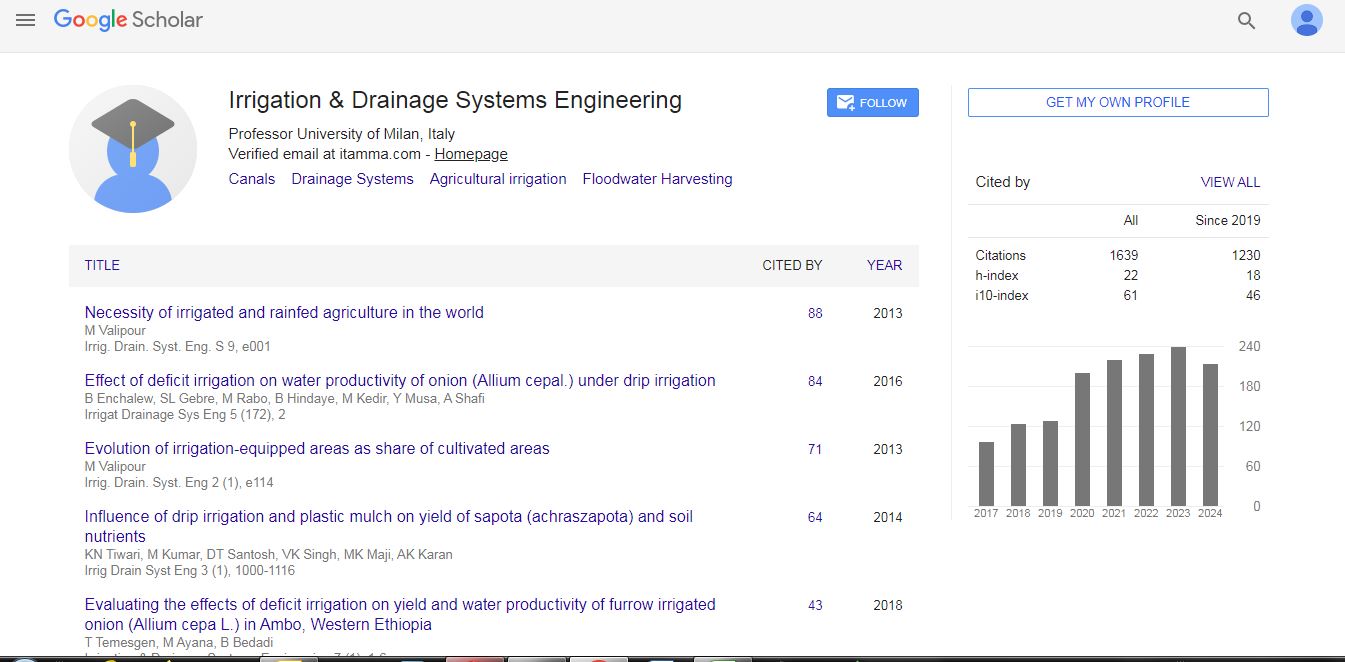
Irrigation & Drainage Systems Engineering received 835 citations as per Google Scholar report