Commentary - (2025) Volume 19, Issue 5
Received: 01-Oct-2025, Manuscript No. jmgm-26-188379;
Editor assigned: 03-Oct-2025, Pre QC No. P-188379;
Reviewed: 17-Oct-2025, QC No. Q-188379;
Revised: 22-Oct-2025, Manuscript No. R-188379;
Published:
29-Oct-2025
, DOI: 10.37421/1747-0862.2025.19.745
Citation: OConnor, James. ”Precise Gene Editing: Base and Prime Editors’ Potential.” J Mol Genet Med 19 (2025):745.
Copyright: © 2025 OConnor J. This is an open-access article distributed under the terms of the Creative Commons Attribution License, which permits unrestricted use, distribution and reproduction in any medium, provided the original author and source are credited.
Base editing and prime editing represent significant advancements in gene therapy, offering precise DNA modifications with reduced off-target effects compared to traditional gene editing tools. Base editors chemically convert one DNA base to another, while prime editors are more versatile, enabling all types of base conversions and small insertions/deletions without requiring double-strand breaks. These technologies hold immense promise for treating genetic diseases by correcting specific mutations at their source [1].
A foundational paper detailing the initial development and mechanism of base editing was published in 2016. It highlighted the ability of engineered deaminases fused to nuclease-deficient Cas9 to mediate programmable Câ?¢G to Tâ?¢A or Aâ?¢T to Gâ?¢C base conversions in mammalian cells. The work established the potential for precision gene editing without double-strand breaks [2].
In 2019, a groundbreaking study introduced prime editing, a versatile genome editing technology capable of directly writing new genetic information into targeted DNA locations. Prime editors can mediate all 12 possible base-to-base conversions and small insertions and deletions (indels) without requiring double-strand DNA breaks or donor DNA templates, greatly expanding the scope of genome editing [3].
A comprehensive review published in 2022 provided an in-depth look at the technological advancements and therapeutic potential of base editing. It discussed different base editor designs, their efficiencies, and challenges, along with their applications in preclinical models for various genetic disorders such as sickle cell disease and cystic fibrosis [4].
A perspective piece from 2021 highlighted the ongoing evolution of prime editing, including strategies to improve its efficiency, expand its targeting scope, and reduce potential off-target edits. It also discussed the application of prime editing in the development of novel therapeutic approaches for genetic diseases [5].
Research from 2020 demonstrated the in vivo application of base editing to correct a pathogenic mutation in the liver of mice. It showcased the potential of base editing for in vivo gene therapy, addressing the challenge of delivering editing components to specific tissues and achieving therapeutic outcomes [6].
In 2021, a study reported the development of new prime editor variants with improved efficiency and broader targeting capabilities. The enhanced prime editors facilitate more precise and efficient genome editing, paving the way for more robust therapeutic applications [7].
An article published in 2020 explored the safety aspects and potential off-target effects of base editing. It provided valuable insights into strategies for minimizing unintended edits and ensuring the clinical safety of base editing-based therapies [8].
Research from 2020 also showcased the use of prime editing to correct disease-causing mutations in human cells in vitro. The study demonstrated the ability of prime editing to precisely correct various types of mutations relevant to genetic disorders, highlighting its therapeutic potential [9].
Finally, a comprehensive review in 2023 discussed the current landscape of gene editing technologies, including base and prime editing, in the context of developing therapies for inherited diseases. It examined the advantages, limitations, and future directions for translating these tools into clinical practice [10].
Base editing and prime editing represent significant advancements in gene therapy, offering precise DNA modifications with reduced off-target effects compared to traditional gene editing tools. Base editors chemically convert one DNA base to another, while prime editors are more versatile, enabling all types of base conversions and small insertions/deletions without requiring double-strand breaks. These technologies hold immense promise for treating genetic diseases by correcting specific mutations at their source [1].
The initial development and mechanism of base editing were detailed in a foundational paper, highlighting the ability of engineered deaminases fused to nuclease-deficient Cas9 to mediate programmable Câ?¢G to Tâ?¢A or Aâ?¢T to Gâ?¢C base conversions in mammalian cells. This work established the potential for precision gene editing without double-strand breaks [2].
Prime editing was introduced as a versatile genome editing technology capable of directly writing new genetic information into targeted DNA locations. Prime editors can mediate all 12 possible base-to-base conversions and small insertions and deletions (indels) without requiring double-strand DNA breaks or donor DNA templates, greatly expanding the scope of genome editing [3].
A review from 2022 provided an in-depth look at the technological advancements and therapeutic potential of base editing. It discussed different base editor designs, their efficiencies, and challenges, along with their applications in preclinical models for various genetic disorders such as sickle cell disease and cystic fibrosis [4].
The ongoing evolution of prime editing has been highlighted, including strategies to improve its efficiency, expand its targeting scope, and reduce potential off-target edits. The application of prime editing in the development of novel therapeutic approaches for genetic diseases is also discussed [5].
Research has demonstrated the in vivo application of base editing to correct a pathogenic mutation in the liver of mice, showcasing the potential of base editing for in vivo gene therapy by addressing the challenge of delivering editing components to specific tissues and achieving therapeutic outcomes [6].
New prime editor variants with improved efficiency and broader targeting capabilities have been developed, facilitating more precise and efficient genome editing and paving the way for more robust therapeutic applications [7].
Safety aspects and potential off-target effects of base editing have been explored, providing valuable insights into strategies for minimizing unintended edits and ensuring the clinical safety of base editing-based therapies [8].
The use of prime editing to correct disease-causing mutations in human cells in vitro has been showcased, demonstrating its ability to precisely correct various types of mutations relevant to genetic disorders and highlighting its therapeutic potential [9].
A comprehensive review in 2023 discussed the current landscape of gene editing technologies, including base and prime editing, in the context of developing therapies for inherited diseases, examining their advantages, limitations, and future directions for translation into clinical practice [10].
Base editing and prime editing are advanced gene editing technologies that offer precise DNA modifications with reduced off-target effects. Base editors convert one DNA base to another, while prime editors are more versatile, allowing all base conversions and small insertions/deletions without double-strand breaks. These methods hold significant promise for treating genetic diseases. Base editing was first developed in 2016, enabling programmable DNA base conversions. Prime editing emerged in 2019, offering a "search and replace" genome editing capability. Research continues to advance these technologies, focusing on improving efficiency, expanding targeting, and enhancing safety. Applications include in vivo gene therapy and the correction of disease-causing mutations in human cells. Ongoing reviews highlight their therapeutic potential and the challenges in translating them into clinical practice.
None
None
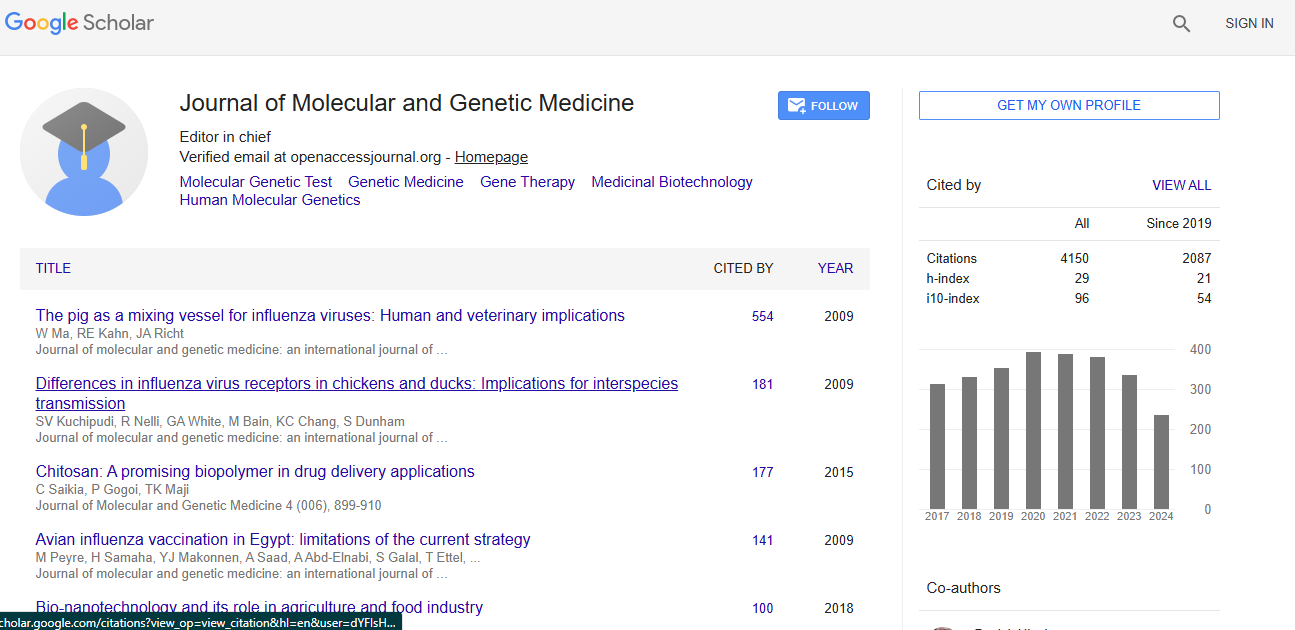
Molecular and Genetic Medicine received 3919 citations as per Google Scholar report