Perspective - (2025) Volume 13, Issue 5
Received: 01-Sep-2025, Manuscript No. economics-26-186073;
Editor assigned: 03-Sep-2025, Pre QC No. P-186073;
Reviewed: 17-Sep-2025, QC No. Q-186073;
Revised: 22-Sep-2025, Manuscript No. R-186073;
Published:
29-Sep-2025
, DOI: 10.37421/2375-4389.2025.13.548
Citation: Duarte, Isabel. ”Post-Conflict Recovery: Holistic Growth
and Stability.” J Glob Econ 13 (2025):548.
Copyright: © 2025 Duarte I. This is an open-access article distributed under the terms of the Creative Commons Attribution License, which permits unrestricted use, distribution
and reproduction in any medium, provided the original author and source are credited.
Rebuilding economies after conflict is a complex endeavor that requires a comprehensive and multifaceted strategy, focusing on inclusive growth and the strengthening of institutional frameworks to ensure lasting stability and prosperity [1].
The process necessitates not only economic revitalization but also a commitment to the rule of law and the development of robust governance structures that can support sustainable progress [1].
International aid plays a pivotal role in the initial phases of post-conflict economic development, providing essential resources for immediate relief and reconstruction efforts. However, its long-term effectiveness is contingent upon careful planning, strong coordination, and a clear alignment with the recipient nation's overarching priorities [2].
The development of resilient infrastructure stands as a fundamental pillar for economic recovery in post-conflict environments. This encompasses not only the physical rebuilding of damaged assets but also the establishment of institutional mechanisms essential for their effective management and maintenance [3].
The private sector is a critical engine for job creation and innovation within economies recovering from conflict. Its full potential can only be realized through the establishment of a secure and predictable business environment, characterized by clear regulations, accessible financing, and the protection of property rights [4].
Addressing the pervasive issue of unemployment, particularly among the youth, is a crucial component of both economic recovery and the broader process of peacebuilding in post-conflict societies. Targeted programs focused on skills development and job linkage are therefore essential [5].
The establishment and reinforcement of the rule of law and effective governance are indispensable for achieving sustainable economic development in the aftermath of conflict. This includes fostering transparency, accountability, and independent judicial systems to build public and investor confidence [6].
Careful management of natural resources in post-conflict societies is paramount to preventing renewed conflict and ensuring that the benefits derived from these resources are distributed equitably. Transparent and accountable institutions are key to achieving this balance [7].
A vital, yet often overlooked, aspect of post-conflict peacebuilding and economic recovery is the successful reintegration of former combatants into civilian life and the economy. This requires specialized programs to equip them with the skills and support needed for sustainable livelihoods [8].
The development of a robust financial sector is instrumental in facilitating economic recovery and stimulating investment in societies emerging from conflict. This involves strengthening banking systems, expanding access to credit, and developing capital markets to foster economic activity [9].
Enhancing trade facilitation and improving market access are critical for post-conflict economies seeking to integrate into the global marketplace and achieve sustained economic growth. Streamlining trade processes and investing in trade infrastructure can significantly boost export potential [10].
The multifaceted process of rebuilding economies in post-conflict settings demands a nuanced approach, emphasizing inclusive growth, the strengthening of institutional capacities, and the unwavering commitment to the rule of law. Effective strategies often involve leveraging direct foreign investment, mobilizing domestic resources, and creating sustainable employment opportunities, with a particular focus on youth and marginalized populations. Furthermore, tackling corruption and cultivating good governance are indispensable for maximizing aid effectiveness and ensuring long-term stability [1].
The impact of international aid on post-conflict economic development is undeniably complex. While it serves as a critical lifeline for immediate relief and reconstruction, its enduring influence hinges on meticulous design, seamless coordination, and strict alignment with national development priorities. Ultimately, sustainable progress necessitates a transition from donor dependency to national ownership and the cultivation of a stable environment conducive to private sector investment. Transparency and accountability in aid management are paramount to preventing corruption and ensuring that resources effectively reach their intended beneficiaries [2].
Building resilient infrastructure is a foundational element for fostering economic recovery in post-conflict environments. This extends beyond mere physical reconstruction to include the development of robust institutional frameworks responsible for the management and upkeep of these vital assets. Prioritizing projects that yield the greatest multiplier effect on employment and trade, while simultaneously considering environmental sustainability, is crucial for achieving long-term growth. Engaging communities in the planning and implementation of infrastructure projects fosters a sense of ownership and significantly reduces the risk of renewed conflict [3].
The private sector's role in post-conflict economic development is vital for driving job creation and fostering innovation. However, the establishment of a conducive business environment is a prerequisite for its success. This environment must be characterized by security, predictable regulatory frameworks, readily available access to finance, and the diligent protection of property rights. Policies designed to encourage entrepreneurship and provide robust support for small and medium-sized enterprises (SMEs) are indispensable for broad-based economic recovery and reducing the dependence on external aid [4].
Addressing unemployment, especially among the youth, stands as a critical imperative for both economic development and the consolidation of peace in post-conflict societies. Programs specifically designed to enhance skills development, offer vocational training, and effectively link graduates with available job opportunities are of paramount importance. Investing in sectors with high employment potential, such as agriculture, manufacturing, and services, can significantly contribute to economic stability and mitigate the risk of renewed conflict [5].
The principles of the rule of law and effective governance are not merely beneficial but absolutely essential for achieving sustainable economic development in the wake of conflict. The establishment of independent judiciaries, transparent public administration, and reliable mechanisms for accountability serves to deter corruption and build confidence among both investors and citizens. Furthermore, reforming security sectors and ensuring civilian oversight are critical steps in creating a stable environment that is conducive to economic activity [6].
In post-conflict societies, the management of natural resources demands careful consideration to prevent the resurgence of conflict and to ensure the equitable distribution of benefits derived from their exploitation. The establishment of transparent and accountable institutions responsible for resource extraction and revenue management is of critical importance. Investing the revenues generated from these resources into diversified economic activities and essential public services can powerfully foster inclusive growth and long-term stability [7].
The reintegration of ex-combatants into the civilian economy represents a vital component of post-conflict peacebuilding and economic recovery efforts. This process necessitates the implementation of tailored programs that provide comprehensive vocational training, essential psychosocial support, and tangible opportunities for establishing sustainable livelihoods. A failure to effectively reintegrate ex-combatants can pose significant security risks and act as a substantial impediment to overall economic progress [8].
Financial sector development plays a pivotal role in lubricating the wheels of economic recovery and attracting much-needed investment in societies emerging from conflict. This involves a concerted effort to strengthen banking systems, promote widespread access to credit for both businesses and households, and foster the development of capital markets. Ensuring financial stability and rigorously protecting depositors are fundamental to rebuilding trust and stimulating robust economic activity [9].
Facilitating trade and improving market access are crucial for post-conflict economies seeking to successfully integrate into the global economic landscape and achieve sustained growth. The reduction of trade barriers, the streamlining of customs procedures, and strategic investments in trade-related infrastructure can significantly boost export performance and attract vital foreign direct investment. Moreover, regional trade agreements can play a substantial role in promoting economic cooperation and fostering greater stability within and between nations [10].
Post-conflict economic recovery is a complex process requiring a holistic approach that integrates inclusive growth, institutional capacity building, and the rule of law. International aid is crucial for initial relief but must be aligned with national priorities for long-term effectiveness. Developing resilient infrastructure and fostering a conducive business environment for the private sector are key drivers of job creation and innovation. Addressing youth unemployment through skills development and training is vital for peacebuilding. Good governance, transparent natural resource management, and the reintegration of ex-combatants are essential for stability. Financial sector development and enhanced trade facilitation are critical for economic integration and sustained growth.
None
None
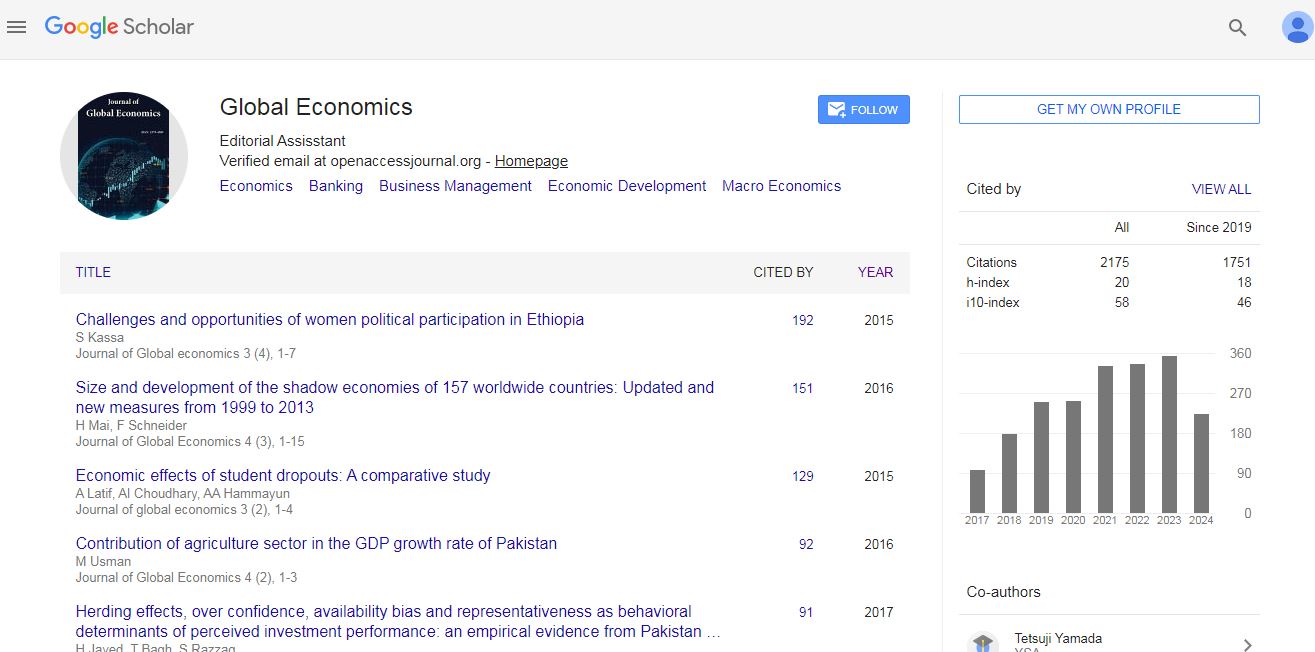
Journal of Global Economics received 2175 citations as per Google Scholar report