Perspective - (2025) Volume 13, Issue 4
Received: 01-Jul-2025, Manuscript No. economics-26-186061;
Editor assigned: 03-Jul-2025, Pre QC No. P-186061;
Reviewed: 17-Jul-2025, QC No. Q-186061;
Revised: 22-Jul-2025, Manuscript No. R-186061;
Published:
29-Jul-2025
, DOI: 10.37421/2375-4389.2025.13.537
Citation: Nielsen, Laura. ”Policies for Inclusive Growth and Equitable
Outcomes.” J Glob Econ 13 (2025):537.
Copyright: © 2025 Nielsen L. This is an open-access article distributed under the terms of the Creative Commons Attribution License, which permits unrestricted use,
distribution and reproduction in any medium, provided the original author and source are credited.
The intricate relationship between economic growth and income inequality is a subject of persistent global concern, demanding careful consideration from policymakers worldwide. Different policy choices have the profound capacity to either widen existing disparities or actively mitigate them, underscoring the need for nuanced and targeted interventions. This discourse highlights the essential role of progressive taxation, robust social safety nets, and strategic investments in education and skills development as crucial pillars for fostering inclusive growth and ensuring that the benefits of economic expansion are broadly shared across society [1].
Examining the impact of fiscal policies on income distribution is paramount for understanding how government actions shape economic outcomes. The analysis of government spending and taxation patterns reveals their direct influence on income inequality. It is concluded that well-designed fiscal systems are not merely tools for revenue generation but can serve as powerful mechanisms for redistributing income and cultivating economic stability. The importance of meticulously evaluating the impact of these policies on various income groups cannot be overstated [2].
Technological advancement, particularly in the wake of automation and digitalization, presents a complex duality in its relationship with income inequality. While technology undeniably drives productivity and innovation, it also carries the inherent risk of exacerbating the divide between high-skilled and low-skilled workers. Without the implementation of complementary policies designed to manage these shifts, the potential for widening income gaps becomes a significant concern [3].
Investing in human capital through education and vocational training emerges as a vital strategy for addressing income inequality. Evidence strongly suggests that expanding access to quality educational opportunities and relevant skills development programs can significantly enhance earning potential, particularly for disadvantaged segments of the population. Such investments are instrumental in promoting a more equitable distribution of economic gains and fostering upward mobility [4].
The pervasive influence of globalization on income inequality, both within nations and across international borders, warrants close examination. While globalization has been a potent engine for economic growth, its advantages have not always been distributed uniformly. This necessitates a dual approach: robust international cooperation to manage its effects and carefully crafted domestic policies to address its distributional consequences and ensure broader benefit sharing [5].
Social protection programs represent a critical component of strategies aimed at alleviating poverty and reducing income inequality. The effectiveness of different social safety nets, including unemployment benefits and conditional cash transfers, is highlighted. These programs are essential for providing a crucial floor for vulnerable populations, offering a degree of economic security and mitigating the harshest effects of income disparities [6].
Labor market policies play a significant role in shaping income distribution and overall inequality. Policies such as minimum wage laws, provisions for collective bargaining, and active labor market programs are analyzed for their impact on wage dispersion. The effectiveness of these measures is highly dependent on their specific design, implementation, and the prevailing economic and social context [7].
Financial inclusion is increasingly recognized as a powerful tool for diminishing income inequality. By enhancing access to essential financial services, including credit and savings facilities, for low-income households and small businesses, economic empowerment can be fostered. This greater access contributes to a more equitable distribution of wealth and opportunities, breaking down traditional barriers to economic participation [8].
The complex interplay between urban development policies and income inequality requires careful scrutiny. Policies governing housing, transportation infrastructure, and equitable access to public services within urban areas can either serve to mitigate or exacerbate existing income disparities among residents. Understanding these dynamics is crucial for creating more inclusive and equitable urban environments [9].
Finally, the political economy of income inequality offers a critical lens through which to understand policy formation and its outcomes. An analysis of political institutions and power dynamics reveals how they shape economic policies and, consequently, their distributional effects. A thorough understanding of these underlying forces is indispensable for the development and implementation of truly effective policies aimed at reducing inequality [10].
This research delves into the multifaceted relationship between economic growth and income inequality, emphasizing the critical role of policy interventions. It underscores that strategic policy choices, including progressive taxation, robust social safety nets, and targeted investments in education and skills development, are instrumental in fostering inclusive growth and mitigating disparities. The article highlights that economic progress should not come at the cost of widening income gaps, but rather should be leveraged to create a more equitable society [1].
The study provides an empirical analysis of how fiscal policies influence income distribution, examining the impact of government spending and taxation patterns. It concludes that fiscal systems, when designed effectively, can serve as crucial instruments for income redistribution and the promotion of economic stability. The importance of assessing these policies' effects across different income strata is a key takeaway, ensuring that fiscal measures contribute to a fairer economic landscape [2].
Furthermore, the research explores the significant impact of technological advancements, particularly automation and digitalization, on income inequality. It posits that while technology is a driver of productivity, its benefits must be managed to prevent an exacerbation of the gap between high-skilled and low-skilled labor. Complementary policies are thus essential to harness technological progress for shared prosperity [3].
Investment in human capital, specifically through enhanced access to quality education and vocational training, is identified as a potent strategy for reducing income inequality. By equipping individuals with the necessary skills and knowledge, these programs can elevate earning potentials for disadvantaged groups, leading to a more equitable distribution of economic benefits and opportunities for upward mobility [4].
The paper also scrutinizes the effects of globalization on income inequality, both within and between nations. It acknowledges globalization's role in driving economic growth but stresses that its benefits are not universally shared. This necessitates concerted international collaboration and well-calibrated domestic policies to manage its distributional consequences and ensure that its advantages are more broadly disseminated [5].
Social protection strategies are analyzed for their efficacy in poverty alleviation and inequality reduction. The research emphasizes the significance of well-targeted and adequately funded social safety nets, such as unemployment benefits and conditional cash transfers, in providing essential support and a safety net for vulnerable populations, thereby contributing to economic security and stability [6].
The effectiveness of labor market policies in addressing income inequality is examined, including minimum wage laws, collective bargaining, and active labor market programs. It is argued that these policies can significantly impact wage dispersion and overall income inequality, but their success is contingent upon their specific design and adaptation to the local context and economic conditions [7].
Financial inclusion is presented as a vital mechanism for narrowing income gaps. By expanding access to financial services like credit and savings for low-income households and small businesses, economic empowerment can be achieved. This increased financial participation fosters economic growth and contributes to a more equitable distribution of wealth and opportunities across society [8].
The research investigates the direct link between urban development policies and income inequality. It highlights how policies related to urban planning, housing, transportation, and access to public services can either ameliorate or worsen income disparities among city dwellers, emphasizing the need for equitable urban development strategies [9].
Finally, the article delves into the political economy of income inequality, analyzing how political structures and power dynamics influence economic policy decisions and their subsequent distributional effects. It concludes that understanding these underlying political forces is crucial for formulating and implementing policies that effectively tackle income inequality and promote a more just economic system [10].
This collection of research explores the complex issue of income inequality from various economic and policy perspectives. It highlights the critical role of targeted interventions such as progressive taxation, social safety nets, education, and skills development in fostering inclusive growth. Fiscal and labor market policies are analyzed for their impact on income distribution, with findings suggesting that well-designed systems can effectively redistribute wealth. Technological advancements and globalization are examined for their potential to both drive growth and exacerbate inequalities, necessitating complementary policy responses. Human capital investment and financial inclusion are presented as key strategies for empowering disadvantaged groups and promoting equitable economic outcomes. The influence of urban development and political economy on inequality is also considered, emphasizing the need for a comprehensive understanding of policy drivers. Ultimately, the research underscores the interconnectedness of economic factors and policy choices in shaping income distribution and the imperative for strategic, equitable policy formulation.
None
None
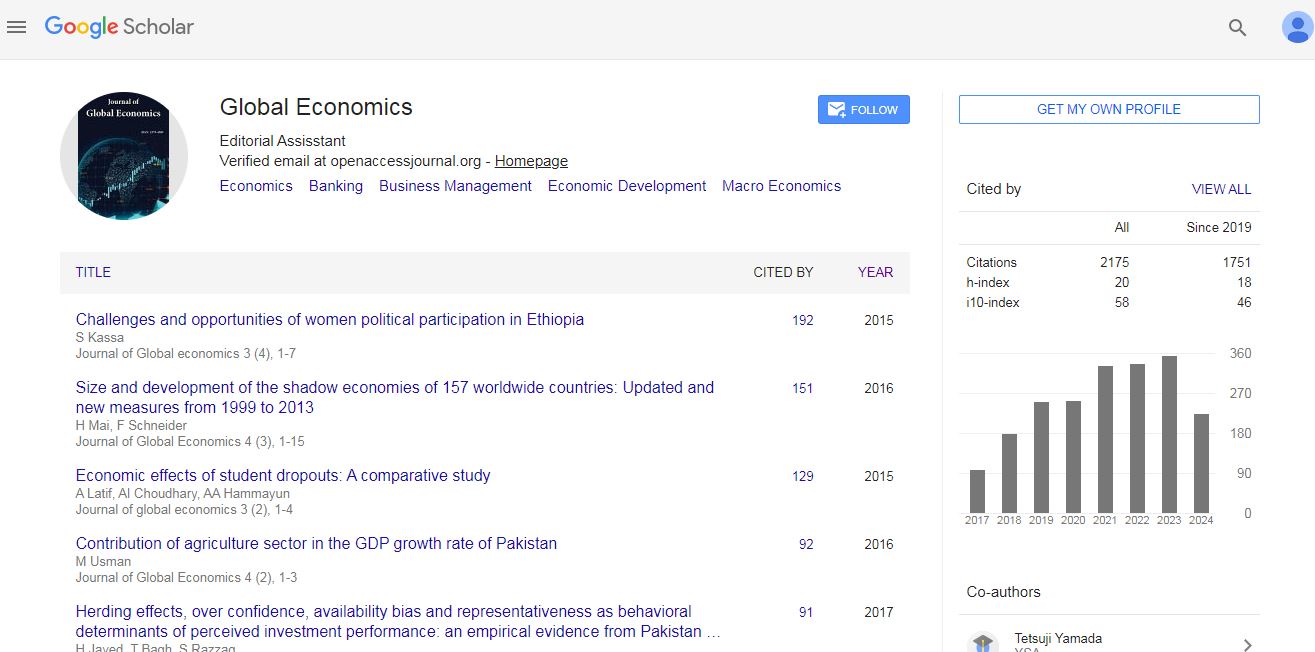
Journal of Global Economics received 2175 citations as per Google Scholar report