Brief Report - (2025) Volume 10, Issue 5
Received: 01-Oct-2025, Manuscript No. jcct-26-183265;
Editor assigned: 03-Oct-2025, Pre QC No. P-183265;
Reviewed: 17-Oct-2025, QC No. Q-183265;
Revised: 22-Oct-2025, Manuscript No. R-183265;
Published:
29-Oct-2025
, DOI: 10.37421/2577-0535.2025.9.328
Citation: Whitman, Katherine E.. ”Platform Trials: Transforming Oncology Drug Development.” J Cancer Clin Trials 10 (2025):328.
Copyright: © 2025 Whitman E. Katherine This is an open-access article distributed under the terms of the Creative Commons Attribution License, which permits unrestricted use, distribution and reproduction in any medium, provided the original author and source are credited.
Platform trials in oncology represent a significant advancement, fundamentally reshaping the landscape of clinical research by enabling the simultaneous evaluation of multiple investigational agents against a common control arm. This innovative approach drastically streamlines patient accrual and optimizes resource utilization, thereby accelerating the drug development pipeline. The ability to make rapid decisions regarding the efficacy of individual agents and to more quickly identify promising combinations is a hallmark of this paradigm shift. Successful implementation hinges on robust data infrastructure, sophisticated adaptive trial designs, and clearly defined regulatory pathways, ensuring efficiency and scientific rigor. [1] The operational and statistical complexities inherent in platform trials, while substantial, yield considerable advantages in drug development. A key benefit is the capacity to dynamically add or discontinue treatments based on interim analyses, which effectively de-risks the overall development process. Achieving effective implementation demands close and continuous collaboration among statisticians, clinicians, regulatory bodies, and industry partners to adeptly navigate logistical challenges and uphold the highest standards of scientific integrity. [2] Regulatory perspectives on platform trials are undergoing a dynamic evolution, with agencies increasingly acknowledging their immense value in expediting the development of effective cancer therapies. Proactive engagement with regulatory bodies and the establishment of clear guidance are absolutely crucial for the successful design, execution, and subsequent approval of these complex trials. This evolving regulatory landscape is key to unlocking the full potential of platform trials. [3] The statistical methodologies that underpin platform trials are absolutely central to their remarkable efficiency and flexibility. Techniques such as adaptive randomization, sample size re-estimation, and Bayesian approaches empower flexible trial conduct and facilitate the derivation of robust, reliable conclusions. These advanced statistical methods are indispensable for the efficient evaluation of multiple treatments within a unified trial framework. [4] The successful implementation of platform trials necessitates a considerable investment in sophisticated infrastructure. This includes the deployment of electronic data capture systems, the establishment of robust data management protocols, and the cultivation of advanced bioinformatic capabilities. These systems must be meticulously designed to efficiently handle the inherent complexity associated with multiple treatment arms and adaptive design features. [5] Patient recruitment and retention remain critical determinants of success for any clinical trial, and platform trials are no exception to this fundamental principle. Strategies to optimize patient accrual encompass the clear definition of patient eligibility criteria, effective and consistent communication with referring physicians, and the design of patient-centric trials. The inherent efficiency of platform trials can significantly expedite the delivery of novel treatments to patients who need them. [6] The economic benefits derived from platform trials are undeniably significant. By obviating the need for numerous individual trials for each investigational agent, platform trials can substantially reduce the overall costs associated with drug development. This enhanced economic efficiency can directly translate into faster access to potentially life-saving therapies for patients battling cancer. [7] Real-world data (RWD) and real-world evidence (RWE) are increasingly recognized for their potential to play a complementary and valuable role in the context of platform trials. The judicious integration of RWD/RWE can effectively inform trial design, provide valuable insights into monitoring treatment effects, and in specific circumstances, may even serve as external control arms, thereby further enhancing overall trial efficiency. [8] Ethical considerations are of paramount importance in the design and execution of platform trials. Ensuring patient safety, obtaining truly informed consent, and guaranteeing equitable access to investigational treatments demand meticulous planning and continuous, vigilant monitoring throughout the trial. Transparency in both trial design and the dissemination of results is absolutely crucial for fostering and maintaining trust among all stakeholders. [9] Future directions for platform trials are exceptionally promising and include their application in earlier lines of cancer therapy, the development of adaptive combination studies, and the sophisticated integration of novel endpoints. The continued evolution and refinement of platform trial methodologies hold the potential to further amplify the efficiency and overall impact of oncology drug development for years to come. [10]
Platform trials in oncology represent a fundamental paradigm shift, fundamentally altering the approach to clinical research through the simultaneous evaluation of multiple investigational agents against a shared control arm. This streamlined methodology significantly enhances patient accrual and optimizes resource allocation, leading to more efficient drug development processes. The capacity for rapid decision-making regarding agent efficacy and the accelerated identification of promising drug combinations are key advantages. Critical to the successful implementation of this approach are the establishment of a robust data infrastructure, the adoption of sophisticated adaptive trial designs, and the development of clear, supportive regulatory pathways. [1] The operational and statistical considerations integral to platform trials, while complex, offer substantial benefits that can accelerate the drug development lifecycle. A notable advantage is the ability to incorporate or remove treatments based on interim analyses, thereby mitigating the financial and temporal risks associated with drug development. Effective execution relies heavily on close, interdisciplinary collaboration between statisticians, clinicians, regulatory authorities, and industry partners to address logistical hurdles and maintain rigorous scientific standards. [2] Regulatory agencies are increasingly adapting their perspectives on platform trials, recognizing their substantial contribution to accelerating the development of effective cancer treatments. The establishment of clear guidelines and proactive engagement with regulatory bodies are indispensable elements for the successful design and subsequent approval of platform trials, ensuring they meet all necessary scientific and ethical standards. [3] The statistical methodologies forming the bedrock of platform trials are essential for their operational efficiency. Employing techniques such as adaptive randomization, flexible sample size re-estimation, and Bayesian statistical approaches allows for adaptive trial conduct and the generation of scientifically sound conclusions. These advanced methods are indispensable for the effective evaluation of multiple therapeutic agents within a single, cohesive trial framework. [4] Successful implementation of platform trials necessitates a significant commitment to developing and maintaining advanced infrastructure. This includes the deployment of robust electronic data capture systems, the establishment of comprehensive data management protocols, and the cultivation of sophisticated bioinformatic capabilities. These systems must be specifically engineered to adeptly manage the inherent complexities of multiple treatment arms and the dynamic nature of adaptive design features. [5] Effective patient recruitment and retention are paramount to the success of all clinical trials, and platform trials are no exception. Strategies aimed at optimizing patient accrual involve clearly defined eligibility criteria, consistent and effective communication with referring physicians, and the development of patient-centered trial designs. The inherent efficiency of platform trials can contribute significantly to expediting the availability of new therapeutic options for patients. [6] Platform trials offer considerable economic advantages by consolidating the evaluation of multiple investigational agents into a single trial framework, thereby reducing the need for numerous, costly individual studies. This enhanced efficiency in drug development can directly translate into quicker access to potentially life-saving cancer therapies for patients globally. [7] The integration of real-world data (RWD) and real-world evidence (RWE) presents a valuable opportunity to complement platform trials. Such integration can inform trial design, facilitate the monitoring of treatment effects, and in certain contexts, potentially serve as external control arms, thereby further augmenting the overall efficiency and robustness of the trial. [8] Ethical considerations are of utmost importance in the design and conduct of platform trials. Ensuring patient safety, obtaining comprehensive informed consent, and maintaining equitable access to investigational treatments require meticulous planning and ongoing oversight. A commitment to transparency in trial design and the dissemination of results is crucial for building and sustaining trust among patients, clinicians, and regulatory bodies. [9] Future advancements in platform trials are expected to expand their application into earlier stages of therapy, facilitate the development of complex adaptive combination studies, and incorporate novel endpoints. The ongoing evolution of platform trial methodologies promises to further enhance the efficiency, impact, and reach of oncology drug development. [10]
Platform trials represent a transformative approach in oncology drug development, enabling the simultaneous evaluation of multiple agents against a common control. This design streamlines patient accrual, optimizes resource use, and accelerates decision-making regarding treatment efficacy and combinations. Key to their success are robust data infrastructure, adaptive designs, and clear regulatory pathways. Operational complexities are managed through interdisciplinary collaboration, while advanced statistical methods like adaptive randomization enhance efficiency. Significant investment in infrastructure, including electronic data capture and bioinformatic capabilities, is essential. Strategies for patient recruitment and retention are vital, as are the economic benefits derived from reduced development costs. Real-world data and evidence can complement these trials, and ethical considerations, including patient safety and informed consent, are paramount. Future directions include earlier line applications and adaptive combination studies.
None
None
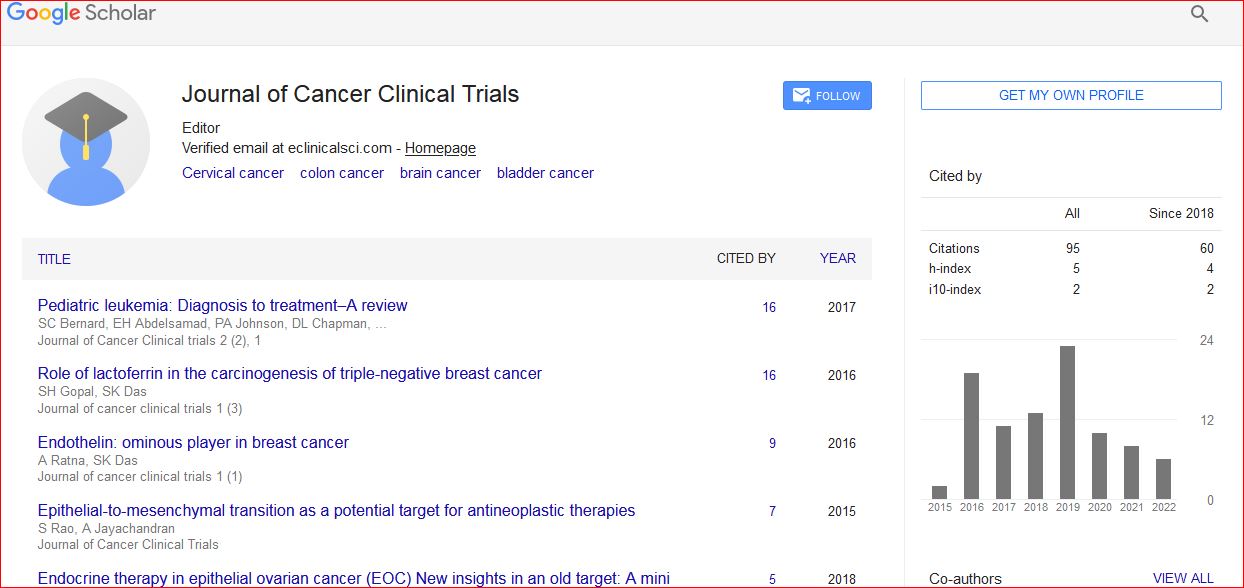
Journal of Cancer Clinical Trials received 95 citations as per Google Scholar report