Brief Report - (2025) Volume 14, Issue 2
Received: 01-Jun-2025, Manuscript No. jms-25-172626;
Editor assigned: 03-Jun-2025, Pre QC No. P-172626;
Reviewed: 17-Jun-2025, QC No. Q-172626;
Revised: 23-Jun-2025, Manuscript No. R-172626;
Published:
30-Jun-2025
, DOI: 10.37421/2167-0943.2024.13.399
Citation: Vedra, Kiran. ”Pharmacotherapy Advances Reshape Obesity Treatment.” J Metabolic Synd 14 (2025):399
Copyright: © 2025 Vedra K. This is an open-access article distributed under the terms of the Creative Commons Attribution License, which permits unrestricted use, distribution
and reproduction in any medium, provided the original author and source are credited
This review provides an in-depth look at the newest pharmacological options and emerging therapies for managing weight. It covers a range of agents, including GLP-1 receptor agonists and dual agonists, discussing their mechanisms and clinical utility in the broader context of obesity treatment. The discussion highlights how these medications are changing the landscape of obesity care, offering more effective approaches for significant and sustained weight loss [1].
This study demonstrates the effectiveness of once-weekly semaglutide in adolescents struggling with obesity. The trial results showed substantial reductions in body weight compared to placebo, suggesting a promising new avenue for managing adolescent obesity, which often presents unique challenges. The findings underscore the potential for GLP-1 receptor agonists to improve health outcomes in this younger population [2].
This pivotal trial investigated tirzepatide, a dual GIP and GLP-1 receptor agonist, for obesity treatment. The results revealed significant weight loss, exceeding that seen with current GLP-1 monotherapies, indicating a breakthrough in medical weight management. The study provides strong evidence for tirzepatide's efficacy in achieving substantial and clinically meaningful reductions in body weight [3].
This systematic review and meta-analysis assessed the long-term effectiveness and safety of various pharmacotherapies for obesity. It synthesized data from numerous randomized controlled trials, offering a comprehensive overview of which medications provide sustained weight loss and what their safety profiles look like over extended periods. The findings help clinicians make informed decisions about long-term treatment strategies [4].
This trial explored the cardiovascular outcomes in individuals with overweight or obesity treated with semaglutide. It addressed a critical question: do these weight loss medications also offer cardiovascular benefits? The study provided significant evidence regarding semaglutide's impact on major adverse cardiovascular events, contributing to a more holistic understanding of its therapeutic advantages beyond just weight reduction [5].
This article offers an update on the most promising novel targets and agents in the pipeline for obesity pharmacotherapy. It discusses how research is evolving to identify new mechanisms for weight regulation and how these insights are being translated into next-generation medications. The piece outlines the future directions of anti-obesity drug development, hinting at even more effective and tailored treatments [6].
This guideline review focuses on adult obesity management, specifically integrating new pharmacological agents and emphasizing the role of dietitians. It provides practical recommendations for healthcare professionals, detailing how to incorporate newer medications into a comprehensive care plan. The article underlines the importance of a multidisciplinary approach to achieve optimal patient outcomes [7].
This review article provides a comprehensive overview of both current and future pharmacological treatments for obesity. It delves into the mechanisms of action for existing drugs and discusses promising agents in development, highlighting emerging trends in the field. The paper offers valuable insights into how these medications contribute to weight management and metabolic health [8].
This Phase 3 trial investigated the efficacy of oral semaglutide in adolescents with obesity. It explored a non-injectable option for this demographic, assessing its safety and effectiveness for weight reduction. The study provides important data on the potential for oral GLP-1 receptor agonists to expand treatment access and options for younger patients with obesity [9].
This study examined setmelanotide in patients with Bardet-Biedl syndrome and other syndromic forms of obesity. It addresses a specific, genetically-driven subset of obesity, demonstrating the targeted approach required for these rare conditions. The findings highlight the efficacy of setmelanotide, a MC4R agonist, in achieving significant weight loss in patients with specific genetic mutations causing severe early-onset obesity [10].
The landscape of obesity pharmacotherapy is rapidly evolving with the introduction of novel agents and emerging therapies. A recent review provides an in-depth look at these newest pharmacological options, including GLP-1 receptor agonists and dual agonists, discussing their mechanisms and clinical utility in the broader context of obesity treatment [1]. These medications are significantly changing obesity care, offering more effective approaches for substantial and sustained weight loss.
Concurrently, an update on the most promising novel targets and agents in the pipeline outlines how research is identifying new mechanisms for weight regulation, translating these insights into next-generation medications and hinting at even more effective and tailored treatments for the future [6]. Further insights into current and future perspectives on pharmacological treatments for obesity delve into existing drugs' mechanisms and discuss promising agents in development, highlighting emerging trends in the field [8].
Focusing on specific agents, once-weekly semaglutide has demonstrated remarkable effectiveness in adolescents struggling with obesity. Trial results show substantial reductions in body weight compared to placebo, suggesting a promising new avenue for managing adolescent obesity, which presents unique challenges, and underscoring the potential for GLP-1 receptor agonists in younger populations [2]. Building on this, a Phase 3 trial investigated the efficacy of oral semaglutide in adolescents, exploring a non-injectable option and providing important data on its safety and effectiveness for weight reduction, potentially expanding treatment access [9]. Furthermore, tirzepatide, a dual GIP and GLP-1 receptor agonist, has been a pivotal investigation for obesity treatment. Its trial results revealed significant weight loss, exceeding that seen with current GLP-1 monotherapies, indicating a breakthrough in medical weight management and providing strong evidence for its efficacy in achieving clinically meaningful reductions in body weight [3].
Beyond primary weight loss, the therapeutic advantages of these medications extend to other critical health outcomes. One trial specifically explored the cardiovascular outcomes in individuals with overweight or obesity treated with semaglutide, addressing a vital question about whether these weight loss medications offer broader cardiovascular benefits [5]. The study provided significant evidence regarding semaglutide's impact on major adverse cardiovascular events, contributing to a more holistic understanding of its benefits. For long-term treatment strategies, a systematic review and meta-analysis have comprehensively assessed the long-term effectiveness and safety of various pharmacotherapies for obesity [4]. This synthesis of data from numerous randomized controlled trials offers a thorough overview of which medications provide sustained weight loss and what their safety profiles look like over extended periods, assisting clinicians in making informed decisions.
Integrating these pharmacological advancements into patient care is crucial. Guidelines for adult obesity management specifically focus on incorporating new pharmacological agents and emphasize the essential role of dietitians [7]. This review provides practical recommendations for healthcare professionals on how to weave newer medications into a comprehensive care plan, highlighting the importance of a multidisciplinary approach for optimal patient outcomes. Additionally, for specific, genetically-driven forms of obesity, such as Bardet-Biedl syndrome, targeted treatments like setmelanotide have been examined [10]. This study addresses a subset of obesity requiring a specialized approach, highlighting the efficacy of MC4R agonists in achieving significant weight loss in patients with specific genetic mutations causing severe early-onset obesity.
Recent advances in pharmacotherapy for weight management showcase a transformative shift in obesity care. New agents, including GLP-1 receptor agonists and dual agonists, offer more effective approaches for significant and sustained weight loss. These medications are fundamentally changing the landscape of obesity treatment. Studies highlight the effectiveness of once-weekly semaglutide in adolescents, demonstrating substantial reductions in body weight and underscoring its potential to improve health outcomes in younger populations. A pivotal trial also revealed tirzepatide, a dual GIP and GLP-1 receptor agonist, delivers significant weight loss, exceeding that seen with current GLP-1 monotherapies. Beyond weight reduction, semaglutide has shown critical cardiovascular benefits in individuals with overweight or obesity, contributing to a more holistic understanding of its therapeutic advantages. The development of oral semaglutide further expands treatment options for adolescents, providing a non-injectable alternative. A systematic review and meta-analysis have comprehensively assessed the long-term effectiveness and safety of various pharmacotherapies, aiding clinicians in informed decision-making for sustained treatment strategies. The ongoing research into novel targets and agents indicates future directions for anti-obesity drug development, hinting at even more tailored and effective treatments. Guideline reviews emphasize integrating these new pharmacological agents into adult obesity management, highlighting the crucial role of dietitians and a multidisciplinary approach for optimal patient outcomes. This encompasses both current and future perspectives on pharmacological interventions for metabolic health. Moreover, targeted therapies like setmelanotide address specific, genetically-driven forms of obesity, demonstrating efficacy in rare conditions such as Bardet-Biedl syndrome. This collective body of work illustrates the rapid evolution and increasing sophistication of pharmacological approaches to obesity.
None
None
Indexed at, Google Scholar, Crossref
Indexed at, Google Scholar, Crossref
Indexed at, Google Scholar, Crossref
Indexed at, Google Scholar, Crossref
Indexed at, Google Scholar, Crossref
Indexed at, Google Scholar, Crossref
Indexed at, Google Scholar, Crossref
Indexed at, Google Scholar, Crossref
Indexed at, Google Scholar, Crossref
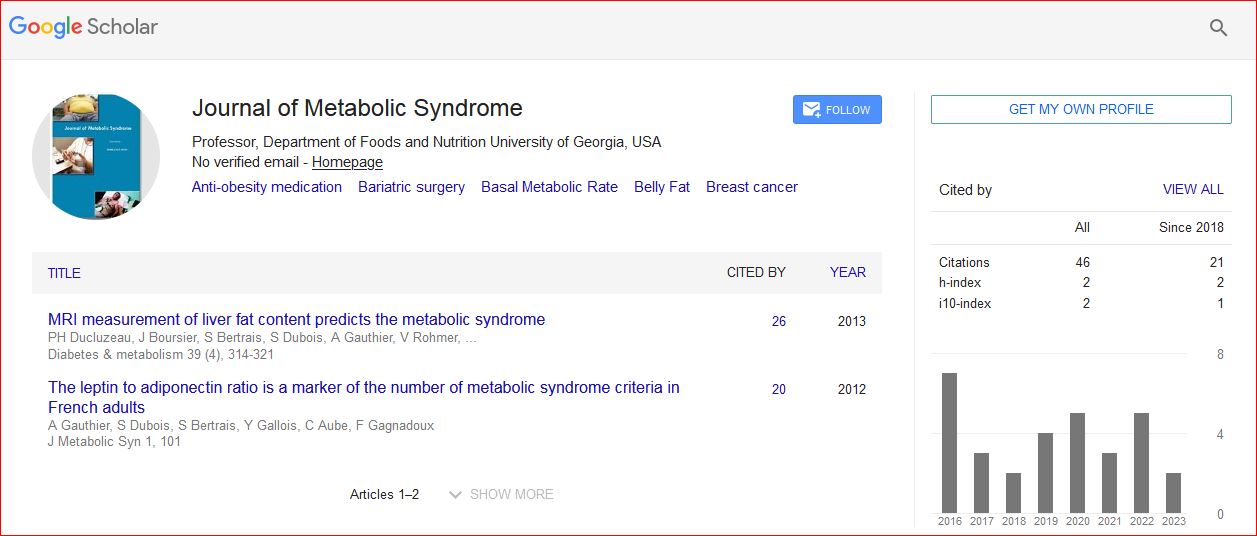
Journal of Metabolic Syndrome received 48 citations as per Google Scholar report