Opinion - (2025) Volume 15, Issue 6
Received: 01-Dec-2025, Manuscript No. mccr-25-178203;;
Editor assigned: 03-Dec-2025, Pre QC No. P-178203;;
Reviewed: 17-Dec-2025, QC No. Q-178203;;
Revised: 22-Dec-2025, Manuscript No. R-178203;;
Published:
29-Dec-2025
, DOI: 10.37421/2161-0444.2025.15.813
Citation: Tanaka, Yuki. ”Pharmacophore Modeling: A Cornerstone of Drug Discovery.” Med Chem 15 (2025):813.
Copyright: © 2025 Tanaka Y. This is an open-access article distributed under the terms of the Creative Commons Attribution License, which permits unrestricted use, distribution and reproduction in any medium, provided the original author and source are credited.
Pharmacophore modeling stands as a pivotal computational methodology in modern drug discovery, offering a robust framework for the identification and refinement of potential drug candidates. This technique fundamentally involves the creation of a three-dimensional spatial arrangement of molecular features that are deemed essential for a molecule's interaction with its biological target. These essential features, often referred to as pharmacophoric elements, can encompass a range of chemical functionalities such as hydrogen bond donors and acceptors, hydrophobic centers, and charged groups, all of which contribute to the molecule's biological activity [1].
The application of pharmacophore modeling extends across various stages of the drug discovery pipeline, proving particularly instrumental in the early phases of identifying novel hit compounds. By generating pharmacophore models based on known active molecules, researchers can then query large chemical databases, effectively performing virtual screening to discover new entities that possess the requisite pharmacophoric features. This accelerates the process of finding molecules with therapeutic potential, a critical step in bringing new medicines to patients [2].
Furthermore, the utility of pharmacophore models is not confined to initial discovery; they are equally vital in the optimization of lead compounds. Once a promising lead molecule is identified, pharmacophore models can guide structural modifications. These modifications are strategically designed to enhance various drug-like properties, including increased potency, improved selectivity for the intended target over off-targets, and favorable pharmacokinetic profiles, thereby moving the compound closer to becoming a viable drug candidate [1].
The development of predictive pharmacophore models is intrinsically linked to rational drug design principles. The process typically involves building and subsequently refining pharmacophore hypotheses based on a set of known active compounds. These refined hypotheses serve as powerful filters for virtual screening efforts, enabling the identification of novel chemical structures that exhibit potential therapeutic value within specific disease areas [3].
To further augment the predictive power and scope of pharmacophore modeling, it is often integrated with complementary computational approaches. Techniques such as molecular docking and molecular dynamics simulations can be combined with pharmacophore models to provide a more comprehensive understanding of potential drug candidates. This multi-pronged strategy allows for the consideration of not only the ideal spatial arrangement of pharmacophoric features but also the detailed binding mode within the target protein, leading to the discovery of more potent and selective drug candidates [4].
Despite its widespread adoption and success, the development of robust pharmacophore models is not without its challenges. These challenges can arise particularly when dealing with flexible molecules or biological targets that exhibit dynamic binding sites. Addressing these complexities requires advanced strategies, including the use of diverse datasets and rigorous validation metrics, to ensure that the generated pharmacophore models possess strong predictive power for identifying truly promising lead compounds [5].
Pharmacophore-based virtual screening has solidified its position as a cornerstone of modern drug discovery workflows. Its efficacy in discovering novel inhibitors for various targets has been repeatedly demonstrated. For instance, this method has proven successful in identifying potent inhibitors for targets implicated in specific disease contexts, efficiently navigating vast chemical spaces to pinpoint molecules with desirable pharmacological profiles [6].
The iterative refinement of pharmacophore models is another critical aspect, especially during the lead optimization phase. This process involves generating initial pharmacophore hypotheses and then systematically modifying them based on the biological activity data of newly synthesized analogs. This iterative approach leads to enhanced potency and a deeper comprehension of the intricate structure-activity relationships governing the compound's efficacy [7].
Recent advancements have seen the integration of sophisticated machine learning techniques with traditional pharmacophore modeling. These hybrid approaches leverage the power of learning from large datasets to improve the accuracy and efficiency of drug discovery. By identifying patterns and correlations that might be overlooked by purely rule-based methods, these enhanced models can better predict compound activity and pinpoint promising lead candidates with greater precision [8].
Ultimately, pharmacophore mapping serves as a vital tool for elucidating the essential molecular features that mediate drug-target interactions. By accurately representing these critical features, pharmacophore models can effectively guide the synthesis and selection of novel compounds designed to modulate specific biological pathways or targets, thereby facilitating the development of new therapeutic agents [9].
Pharmacophore modeling is a sophisticated computational technique employed in drug discovery to define and visualize the essential three-dimensional structural features of molecules responsible for their biological activity. These features, such as hydrogen bond donors/acceptors, hydrophobic regions, and charged centers, are mapped in space to create a pharmacophore model [1].
This method plays a crucial role in virtual screening, where large chemical libraries are searched for compounds that can adopt a conformation matching the defined pharmacophore. This process significantly accelerates the identification of novel hit compounds with the potential to interact with a specific biological target [2].
Beyond initial hit identification, pharmacophore models are indispensable for lead optimization. They provide a rational basis for designing structural modifications aimed at improving a lead compound's potency, selectivity, and pharmacokinetic properties, thereby guiding the iterative process of drug development [1].
The construction of predictive pharmacophore models is central to rational drug design. By building and validating hypotheses based on known active molecules, researchers can effectively screen virtual compound collections to discover new chemical entities with potential therapeutic applications in various disease areas [3].
To enhance the reliability and scope of drug discovery efforts, pharmacophore modeling is often combined with other computational techniques. Integrating pharmacophore models with molecular docking and molecular dynamics simulations allows for a more thorough evaluation of potential drug candidates, considering both their pharmacophoric features and their binding modes within the target protein [4].
Developing accurate and robust pharmacophore models can present challenges, particularly when dealing with flexible molecules or targets with dynamic binding sites. Overcoming these obstacles requires advanced modeling strategies, including the utilization of diverse datasets and rigorous validation protocols to ensure the models' predictive accuracy in lead discovery [5].
Pharmacophore-based virtual screening is a well-established and effective strategy in modern drug discovery. Its application has led to the identification of numerous potent inhibitors for various therapeutic targets by efficiently exploring vast chemical spaces for molecules with desirable pharmacological profiles [6].
The process of lead optimization frequently involves iterative refinement of pharmacophore models. This iterative cycle, driven by the biological activity of newly synthesized compounds, helps in enhancing the potency of lead molecules and deepening the understanding of structure-activity relationships [7].
Recent advancements have incorporated machine learning techniques into pharmacophore modeling workflows. These machine learning-enhanced approaches analyze large datasets to improve the prediction of compound activity and the identification of promising lead candidates, thereby increasing the efficiency and accuracy of the drug discovery process [8].
Pharmacophore mapping is a vital component in understanding the molecular requirements for drug-target interactions. It guides the design and synthesis of novel compounds aimed at modulating specific biological pathways or targets, ultimately contributing to the development of new therapeutic agents [9].
Pharmacophore modeling is a powerful computational technique in drug discovery that defines the essential 3D features of molecules responsible for biological activity. It is used for identifying novel lead compounds through virtual screening of chemical databases and for optimizing existing leads by guiding structural modifications to enhance potency, selectivity, and pharmacokinetic properties. The development of predictive pharmacophore models, often refined iteratively and integrated with other computational methods like molecular docking and machine learning, is crucial for rational drug design. While challenges exist, particularly with flexible molecules, pharmacophore modeling remains a cornerstone of modern drug discovery, enabling the efficient identification and optimization of potential therapeutics by understanding critical drug-target interactions.
None
None
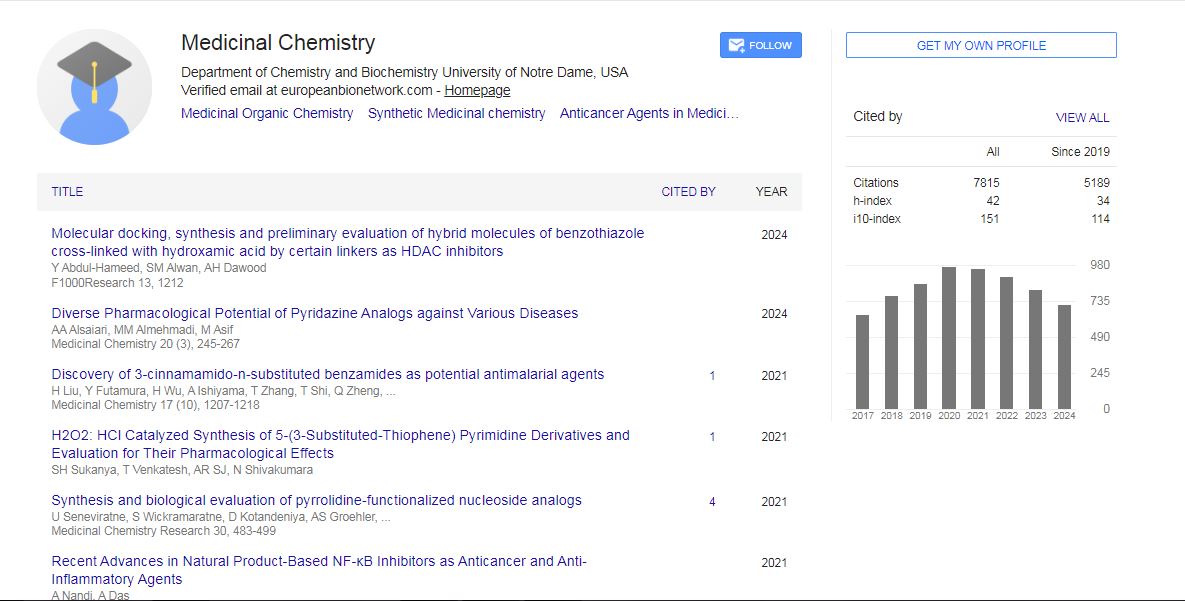
Medicinal Chemistry received 6627 citations as per Google Scholar report