Short Communication - (2025) Volume 11, Issue 6
Received: 01-Dec-2025, Manuscript No. JOV-26-186454;
Editor assigned: 03-Dec-2025, Pre QC No. P-186454;
Reviewed: 17-Dec-2025, QC No. Q-186454;
Revised: 22-Dec-2025, Manuscript No. R-186454;
Published:
29-Dec-2025
, DOI: 10.37421/2471-9544.2025.11.339
Citation: Richter, Simon. ”Phantom Currents: Microvascular Flow and Disease.” J Vasc 11 (2025):339.
Copyright: © 2025 Richter S. This is an open-access article distributed under the terms of the Creative Commons Attribution License, which permits unrestricted use, distribution and reproduction in any medium, provided the original author and source are credited.
The concept of "phantom currents" in the microvascular plane has emerged as a critical area of investigation, referring to unmeasured or imprecisely quantified blood flow dynamics that can significantly impact tissue perfusion and disease pathogenesis, particularly in systemic vasculitis. These subtle or transient currents may arise from complex rheological interactions, paracrine signaling, or microcirculatory adaptations, making their understanding crucial for developing more accurate diagnostic tools and targeted therapies for microvascular diseases. The Division of Vasculitis Research at the University of Freiburg is actively investigating these phenomena, highlighting the growing importance of this research domain [1].
Recent studies suggest that endothelial mechanotransduction plays a pivotal role in responding to altered microvascular flow, indicating that subtle changes in shear stress, potentially representing these "phantom currents," can trigger inflammatory pathways. The research emphasizes how mechanosensitive ion channels and signaling cascades within endothelial cells are activated by these flow variations, contributing to the inflammatory milieu characteristic of vasculitic conditions. These findings underscore the necessity of comprehending microhemodynamics beyond bulk flow measurements [2].
Furthermore, the exploration of how inflammatory mediators, such as cytokines, induce dynamic changes in microvascular network architecture has revealed the emergence of complex flow patterns not readily captured by standard imaging. These altered flow dynamics, termed "phantom currents," are hypothesized to contribute to impaired oxygen delivery and increased susceptibility to immune cell infiltration in affected tissues. The study proposes advanced imaging techniques to visualize these subtle flow phenomena, signaling a direction for future diagnostic approaches [3].
Computational modeling has become an essential tool in understanding microvascular flow, particularly in addressing the challenge of simulating turbulent or complex flow regimes at the micro-scale that might be missed in simpler models. A novel approach has been introduced to capture these "phantom currents," which arise from interactions between red blood cells, plasma, and vessel walls. These simulations offer valuable insights into how such complex flows can influence endothelial shear stress distribution and leukocyte adhesion in inflammation [4].
The impact of platelet activation and aggregation on microvascular flow dynamics is another key area of focus. It is proposed that platelet microthrombi and circulating aggregates can create localized flow disturbances, or "phantom currents." These transient phenomena can alter shear stress and promote endothelial activation, thereby contributing to the propagation of vascular inflammation observed in vasculitis. The study highlights the critical need to consider platelet behavior in the context of microcirculatory function [5].
Investigating the role of the endothelial glycocalyx in response to inflammatory stimuli reveals that glycocalyx shedding can alter the rheological properties of blood and the vessel wall. This alteration can lead to the formation of "phantom currents" â?? unusual flow patterns not solely attributable to vessel geometry. These altered flow conditions are suggested to exacerbate endothelial damage and inflammation in vasculitis, emphasizing the protective role of an intact glycocalyx [6].
Research into the influence of vasoactive mediators on microvascular tone and perfusion heterogeneity indicates that pulsatile changes in smooth muscle activity, influenced by inflammatory signals, can generate transient and localized flow variations, or "phantom currents." These phenomena are thought to contribute to tissue ischemia and inflammation in vasculitic conditions, highlighting the dynamic nature of microvascular control mechanisms [7].
Examining the role of red blood cell (RBC) deformability and aggregation in microvascular flow under inflammatory conditions suggests that altered RBC properties can lead to complex flow phenomena and micro-stresses, effectively creating "phantom currents." These flow abnormalities are proposed to compromise oxygen transport and activate endothelial cells, contributing to vasculitis pathogenesis. Advanced microfluidic techniques are employed to probe these effects [8].
The contribution of inflammatory cytokines to altered flow resistance in the microcirculation is also being explored. It is proposed that cytokine-induced changes in endothelial permeability and adhesion molecule expression can create subtle flow anomalies, or "phantom currents," beyond changes in lumen diameter. These flow alterations are hypothesized to play a role in immune cell recruitment and tissue damage in vasculitis [9].
Finally, the role of nitric oxide (NO) bioavailability in regulating microvascular flow under inflammatory conditions is being investigated. Dysregulation of NO production and signaling can lead to aberrant flow patterns and increased shear stress fluctuations, conceptualized as "phantom currents." Such altered flow dynamics are proposed to contribute to endothelial dysfunction and vasculitis progression, underscoring the therapeutic potential of NO pathway modulation [10].
The concept of "phantom currents" within the microvascular system represents a significant advancement in understanding microcirculatory physiology and pathology, particularly in the context of vasculitis. These currents are defined as unmeasured or imprecisely quantified blood flow dynamics that exert a substantial influence on tissue perfusion and the development of diseases. Potential origins of these phenomena include intricate rheological interactions, paracrine signaling pathways, and adaptive responses within the microcirculation. The identification and characterization of these currents are paramount for the development of more precise diagnostic methodologies and effective therapeutic interventions for microvascular disorders. The Division of Vasculitis Research at the University of Freiburg is actively engaged in exploring these complex phenomena, underscoring their clinical relevance [1].
Mechanotransduction in endothelial cells, in response to changes in microvascular flow, is increasingly recognized as a key initiator of inflammatory cascades. Subtle variations in shear stress, which may be indicative of "phantom currents," can activate mechanosensitive ion channels and intracellular signaling pathways within endothelial cells. This activation contributes to the inflammatory environment characteristic of vasculitic conditions, emphasizing the importance of microhemodynamic forces beyond aggregate flow measurements in disease pathogenesis [2].
Inflammatory mediators, notably cytokines, have been shown to induce dynamic alterations in the architecture of microvascular networks, leading to the formation of complex flow patterns not discernible through conventional imaging techniques. These "phantom currents" are implicated in compromised oxygen delivery and heightened susceptibility to immune cell infiltration in affected tissues. The development and application of advanced imaging modalities are proposed as crucial for the visualization and study of these subtle flow characteristics [3].
Computational fluid dynamics (CFD) is proving instrumental in modeling microvascular flow, especially in simulating complex or turbulent flow regimes at the micro-scale that conventional models might overlook. The introduction of novel approaches allows for the capture of "phantom currents" arising from interactions among red blood cells, plasma, and the vessel walls. Such simulations provide critical insights into the impact of these intricate flow patterns on endothelial shear stress and leukocyte adhesion during inflammatory processes [4].
The role of platelet behavior, including activation and aggregation, in modulating microvascular flow dynamics is a subject of active research. The formation of platelet microthrombi and circulating aggregates can generate localized flow disturbances, conceptualized as "phantom currents." These transient events can modify shear stress and promote endothelial activation, thereby facilitating the progression of vascular inflammation in vasculitis, highlighting the necessity of considering platelet dynamics in microcirculatory assessments [5].
The endothelial glycocalyx, a protective layer on the luminal surface of endothelial cells, plays a significant role in microvascular function. Inflammatory stimuli can lead to glycocalyx shedding, altering blood rheology and vessel wall properties, which in turn can result in the formation of "phantom currents." These aberrant flow conditions can exacerbate endothelial damage and inflammation, suggesting that the integrity of the glycocalyx is crucial in mitigating the effects of such flow disturbances in vasculitis [6].
The influence of vasoactive mediators on microvascular tone and the heterogeneity of perfusion is another critical aspect. Inflammatory signals can modulate smooth muscle activity, leading to pulsatile changes that generate transient and localized flow variations, or "phantom currents." These "phantom currents" are associated with tissue ischemia and inflammation, underscoring the dynamic regulation of microvascular tone and its implications in disease [7].
Alterations in red blood cell (RBC) deformability and aggregation under inflammatory conditions can significantly affect microvascular flow. These changes can induce complex flow phenomena and micro-stresses, effectively creating "phantom currents" that impair oxygen transport and activate endothelial cells. Advanced microfluidic techniques are being utilized to investigate these hemorheological effects and their contribution to vasculitis pathogenesis [8].
The impact of inflammatory cytokines on microvascular resistance is being elucidated, with a focus on how these mediators alter endothelial permeability and adhesion molecule expression. These changes can lead to subtle flow anomalies or "phantom currents" that are not solely dependent on lumen diameter. These flow alterations are hypothesized to be involved in immune cell recruitment and tissue damage in vasculitis, pointing to a complex interplay between inflammation and hemodynamics [9].
Finally, the regulation of microvascular flow by nitric oxide (NO) bioavailability under inflammatory conditions is crucial. Dysfunctional NO signaling can result in aberrant flow patterns and increased shear stress fluctuations, which can be conceptualized as "phantom currents." These altered flow dynamics are implicated in endothelial dysfunction and the progression of vasculitis, suggesting potential therapeutic avenues through modulation of NO pathways [10].
The concept of "phantom currents" in microvascular blood flow describes unmeasured or imprecisely quantified flow dynamics that significantly impact tissue perfusion and disease pathogenesis, especially in vasculitis. These subtle currents can arise from complex rheological interactions, paracrine signaling, or microcirculatory adaptations. Understanding them is vital for improved diagnostics and therapies for microvascular diseases. Research highlights the role of endothelial mechanotransduction, inflammatory mediators like cytokines, platelet behavior, endothelial glycocalyx integrity, vasoactive mediators, red blood cell properties, and nitric oxide bioavailability in generating or influencing these "phantom currents." Computational modeling and advanced imaging are key tools for their study. These currents can lead to impaired oxygen delivery, endothelial activation, increased inflammation, and tissue damage, emphasizing the intricate relationship between hemodynamics and disease progression in vasculitis.
None
None
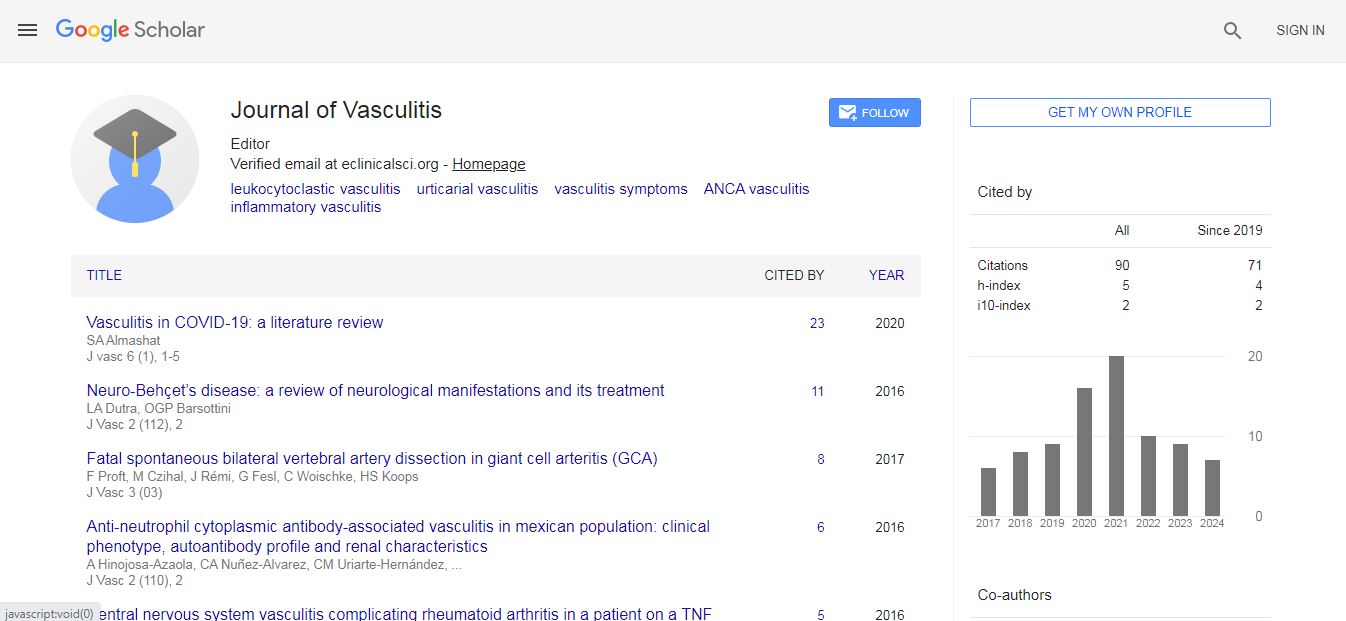
Journal of Vasculitis received 83 citations as per Google Scholar report