Opinion - (2025) Volume 14, Issue 4
Received: 01-Jul-2025, Manuscript No. jmmd-26-184691;
Editor assigned: 03-Jul-2025, Pre QC No. P-184691;
Reviewed: 17-Jul-2025, QC No. Q-184691;
Revised: 22-Jul-2025, Manuscript No. R-184691;
Published:
29-Jul-2025
, DOI: 10.37421/2161-0703.2025.14.535
Citation: Fatima, Noor. ”Phage Therapy: A New Era Against Resistance.” J Med Microb Diagn 14 (2025):535.
Copyright: © 2025 Fatima N. This is an open-access article distributed under the terms of the Creative Commons Attribution License, which permits unrestricted use, distribution and reproduction in any medium, provided the original author and source are credited.
Phage therapy represents a compelling alternative to conventional antibiotics, offering a mechanism to combat bacterial infections through the targeted action of bacteriophages, viruses that specifically infect bacteria. This approach is gaining significant traction as a potential solution to the escalating global crisis of antibiotic resistance, providing a means to treat infections that have become refractory to existing drugs. The inherent specificity of phages allows them to attack only particular bacterial species or strains, thereby preserving the beneficial microbiome of the host, a critical advantage over broad-spectrum antibiotics. The development and application of phage therapy involve a multi-step process including the isolation of phages effective against target pathogens, comprehensive characterization of their lytic capabilities, and the subsequent formulation for therapeutic use. This revival of an older treatment strategy is experiencing a renaissance driven by its unique advantages in an era characterized by dwindling antibiotic options and the rise of untreatable infections. The resurgence of phage therapy is fundamentally driven by the urgent and critical need for novel antimicrobial strategies capable of addressing the growing threat posed by multidrug-resistant (MDR) bacteria. This therapeutic modality offers a unique approach by leveraging the natural predatory behavior of bacteriophages against bacteria. It delves into the intricate mechanisms by which bacteriophages effectively kill bacteria, encompassing both lytic and lysogenic cycles. Furthermore, it discusses their potential to treat infections caused by formidable pathogens such as Staphylococcus aureus and Pseudomonas aeruginosa. Key advantages of phage therapy, including its remarkable specificity and its inherent ability to self-replicate at the infection site, are highlighted. Simultaneously, the review addresses the existing challenges that must be carefully considered for its successful integration into clinical practice, such as the development of phage resistance, the complexities of phage pharmacokinetics, and the intricacies of regulatory approval processes. This specific study undertakes an in-depth investigation into the efficacy of bacteriophage cocktails against clinically relevant strains of Acinetobacter baumannii, a bacterium recognized as a notorious and persistent nosocomial pathogen. The core focus of this research lies in the isolation and meticulous characterization of novel lytic phages, with a subsequent emphasis on combining these isolated phages to create sophisticated cocktails designed to effectively overcome existing phage resistance mechanisms. The findings derived from this research provide compelling evidence that phage cocktails possess the capability to significantly reduce bacterial loads both in vitro and in vivo within animal models. This offers a highly promising and innovative approach for the effective treatment of Acinetobacter baumannii infections, particularly in scenarios where conventional antibiotic options are severely limited or entirely ineffective. The intricate genetic and molecular basis underlying the interactions between phages and bacteria is of paramount importance for the rational and effective design of phage-based therapeutic strategies. This paper offers a comprehensive exploration of the fundamental mechanisms governing phage-bacteria interactions, encompassing critical stages such as phage adsorption to the bacterial surface, the process of infection initiation, intracellular replication of the phage genome, and ultimately, the lysis of the bacterial cell. Concurrently, it examines the diverse bacterial defense mechanisms that have evolved to counteract phage activity, including sophisticated systems like CRISPR-Cas and restriction-modification systems. A thorough understanding of these complex and dynamic relationships is essential for the precise selection of potent and effective phages and for the development of advanced strategies aimed at mitigating or overcoming phage resistance, thereby significantly enhancing the overall therapeutic efficacy of phage-based treatments. Phage therapy demonstrates substantial promise in its application for combating infections caused by antibiotic-resistant Gram-negative bacteria, a group of pathogens that are notoriously challenging to treat with current therapeutic options. This article provides a comprehensive review of the current status and ongoing advancements in phage therapy specifically tailored for Gram-negative pathogens. It explores its potential applications against prevalent and clinically significant bacteria such as Escherichia coli and Klebsiella pneumoniae. Furthermore, the article critically discusses the inherent challenges associated with implementing phage therapy in the context of Gram-negative bacteria. These challenges include the presence of lipopolysaccharide on the outer membrane, which can impede phage binding, and the potential for horizontal gene transfer of resistance determinants. Despite these significant hurdles, ongoing dedicated research efforts and numerous clinical trials are actively paving the way for the successful and widespread implementation of phage therapy in this critical area of infectious disease treatment. The inherent personalized nature of phage therapy, a characteristic where phages are frequently selected and meticulously tailored to address an individual patient's specific infection, presents a distinct and significant advantage over the use of broad-spectrum antibiotics. This review embarks on an exploration of the fundamental principles guiding the process of phage isolation, the critical steps involved in their characterization, and the systematic development of personalized phage preparations. It places considerable emphasis on the vital importance of accurately identifying the specific bacterial strain responsible for an infection and subsequently matching it with precisely effective and targeted phages. Moreover, the article thoughtfully touches upon the multifaceted challenges and emerging opportunities associated with the crucial task of scaling up the production of personalized phage therapies to facilitate their widespread availability and adoption for clinical use. Beyond the direct application of whole bacteriophages, the exploration of phage-derived enzymes, such as lysins, unveils another promising avenue for the development of novel antimicrobial therapies. Lysins are specifically phage-encoded proteins that play a critical role in the bacterial lysis process during the phage replication cycle, primarily by degrading the bacterial cell wall. These potent enzymes can be effectively isolated and utilized as standalone antimicrobial agents, exhibiting rapid action and remarkable specificity. This article provides a thorough review of the significant potential of phage lysins, both as a monotherapy and in synergistic combination with existing antibiotics, to effectively address and manage challenging bacterial infections. A key emphasis is placed on their unique ability to bypass many of the common resistance mechanisms that bacteria have developed against traditional antibiotics. The regulatory pathways governing the approval and clinical implementation of phage therapy are currently undergoing significant evolution on a global scale, presenting a crucial consideration for its successful translation into mainstream clinical practice. This review offers a comprehensive examination of the current regulatory landscape pertaining to bacteriophage-based therapeutics across various geographical regions. It critically highlights both the existing challenges and the emerging opportunities that influence the process of obtaining regulatory approval. Furthermore, the article underscores the essential need for the development and adoption of standardized protocols that encompass phage characterization, manufacturing processes, and the design of clinical trials. Such standardization is deemed vital for facilitating regulatory acceptance and ultimately promoting the widespread adoption of phage therapy as a truly viable and effective alternative to conventional antibiotics. The application of phage therapy within the domain of veterinary medicine is experiencing a notable increase in traction, offering a sustainable and environmentally conscious approach to combating bacterial infections in both livestock and companion animals. This approach holds the potential to significantly reduce the overall reliance on antibiotics in agriculture and animal husbandry. This article presents a broad overview of the considerable potential that phage therapy holds for improving animal health, discussing its proven efficacy against common animal pathogens such as Salmonella and E. coli. It further emphasizes the significant benefits associated with the use of phage therapy, including the reduction of antibiotic residues in food products and the crucial mitigation of the development and spread of antimicrobial resistance within animal populations. Understanding the dynamic evolutionary processes by which bacteria develop resistance to phages is of paramount importance for ensuring the long-term sustainability and success of phage therapy as a clinical strategy. This research rigorously investigates the specific genetic mechanisms through which bacteria acquire resistance to particular bacteriophages. The study places a significant focus on the crucial role played by mutations occurring in bacterial surface receptors and the subsequent activation of innate bacterial defense systems. Additionally, the research explores and evaluates various strategies designed to effectively overcome or significantly delay the emergence of phage resistance. These strategies include the judicious use of phage cocktails, the implementation of sequential phage application protocols, and the genetic engineering of phages to broaden their host range or enhance their infectivity capabilities.
Phage therapy presents a compelling alternative to antibiotics, leveraging bacteriophages (viruses that infect bacteria) to selectively target and eliminate pathogenic bacteria. This approach offers a potential solution to rising antibiotic resistance by providing a mechanism to combat infections that are no longer treatable with conventional drugs. Phages can be highly specific, attacking only the targeted bacterial species or even strains, thus minimizing disruption to the host's beneficial microbiome. The development and application of phage therapy involve isolating phages effective against specific pathogens, characterizing their lytic activity, and formulating them for therapeutic use. This revival of an older treatment strategy is gaining momentum due to its unique advantages in an era of dwindling antibiotic options [1].
The resurgence of phage therapy is driven by the urgent need for novel antimicrobial strategies against multidrug-resistant (MDR) bacteria. This review delves into the mechanisms by which bacteriophages kill bacteria, including lytic and lysogenic cycles, and discusses their potential applications in treating infections caused by pathogens like *Staphylococcus aureus* and *Pseudomonas aeruginosa*. It highlights the advantages of phage therapy, such as specificity and self-replication at the infection site, and also addresses challenges related to phage resistance, pharmacokinetics, and regulatory approval. The integration of phage therapy into clinical practice requires careful consideration of these aspects [2].
This study investigates the efficacy of bacteriophage cocktails against clinically relevant strains of *Acinetobacter baumannii*, a notorious nosocomial pathogen. The research focuses on isolating and characterizing novel lytic phages and combining them to create cocktails that can overcome phage resistance. The findings demonstrate that phage cocktails can effectively reduce bacterial load *in vitro* and *in vivo* in animal models, offering a promising approach for treating *A. baumannii* infections where antibiotic options are limited [3].
The genetic and molecular basis of phage-bacteria interactions is crucial for the rational design of phage therapy. This paper explores the mechanisms of phage adsorption, infection, replication, and lysis, as well as bacterial defense mechanisms against phages, such as CRISPR-Cas systems and restriction-modification systems. Understanding these intricate relationships allows for the selection of potent phages and the development of strategies to mitigate phage resistance, thereby enhancing the therapeutic efficacy of phage-based treatments [4].
Phage therapy holds significant promise for combating infections caused by antibiotic-resistant Gram-negative bacteria, a group notoriously difficult to treat. This article reviews the current status of phage therapy for Gram-negative pathogens, including applications against *Escherichia coli* and *Klebsiella pneumoniae*. It discusses the challenges associated with phage therapy in Gram-negative bacteria, such as the presence of lipopolysaccharide on the outer membrane affecting phage binding and the potential for horizontal gene transfer of resistance. Despite these hurdles, ongoing research and clinical trials are paving the way for its successful implementation [5].
The personalized nature of phage therapy, where phages are often selected and tailored to an individual patient's infection, offers a distinct advantage over broad-spectrum antibiotics. This review explores the principles of phage isolation, characterization, and the development of personalized phage preparations. It discusses the importance of identifying the specific bacterial strain causing an infection and matching it with effective phages. Furthermore, the article touches upon the challenges and opportunities in scaling up personalized phage production for widespread clinical use [6].
The exploration of phage-derived enzymes, such as lysins, offers another avenue for antimicrobial therapy. Lysins are phage-encoded proteins responsible for degrading the bacterial cell wall during phage lysis. These enzymes can be isolated and used as antimicrobial agents, acting rapidly and with high specificity. This article reviews the potential of phage lysins as a standalone therapy or in combination with antibiotics to address challenging bacterial infections, emphasizing their ability to bypass many common resistance mechanisms [7].
Regulatory pathways for phage therapy are evolving globally, posing a significant consideration for its clinical translation. This review examines the current regulatory landscape for bacteriophage-based therapeutics in different regions, highlighting the challenges and opportunities for obtaining approval. It discusses the need for standardized protocols for phage characterization, manufacturing, and clinical trial design to facilitate regulatory acceptance and widespread adoption of phage therapy as a viable alternative to antibiotics [8].
The application of phage therapy in veterinary medicine is gaining traction, offering a sustainable approach to combatting bacterial infections in livestock and companion animals, thereby reducing antibiotic use in agriculture. This article provides an overview of phage therapy's potential in animal health, discussing its efficacy against common animal pathogens such as *Salmonella* and *E. coli*. It highlights the benefits of phage therapy in reducing antibiotic residues in food products and mitigating the development of antimicrobial resistance in animal populations [9].
Understanding the evolution of bacterial resistance to phages is paramount for the long-term success of phage therapy. This research investigates the genetic mechanisms by which bacteria develop resistance to specific bacteriophages, focusing on the role of mutations in surface receptors and the activation of defense systems. The study also explores strategies to overcome or delay the emergence of phage resistance, such as using phage cocktails, sequential phage application, and engineering phages with broader host ranges or enhanced infectivity [10].
Phage therapy, utilizing bacteriophages to target and eliminate bacteria, is emerging as a critical alternative to antibiotics, particularly against multidrug-resistant strains. Its advantages include high specificity, preservation of the microbiome, and self-replication at infection sites. The development involves isolating effective phages, characterizing them, and formulating therapeutic preparations. Challenges such as phage resistance, pharmacokinetics, and regulatory hurdles are being addressed through research into phage-bacteria interactions, phage cocktails, and phage-derived enzymes like lysins. Personalized phage therapy and its application in veterinary medicine are also gaining prominence. Ongoing research focuses on understanding bacterial resistance mechanisms and developing strategies to overcome them, paving the way for broader clinical adoption and a new era in combating antimicrobial resistance.
None
None
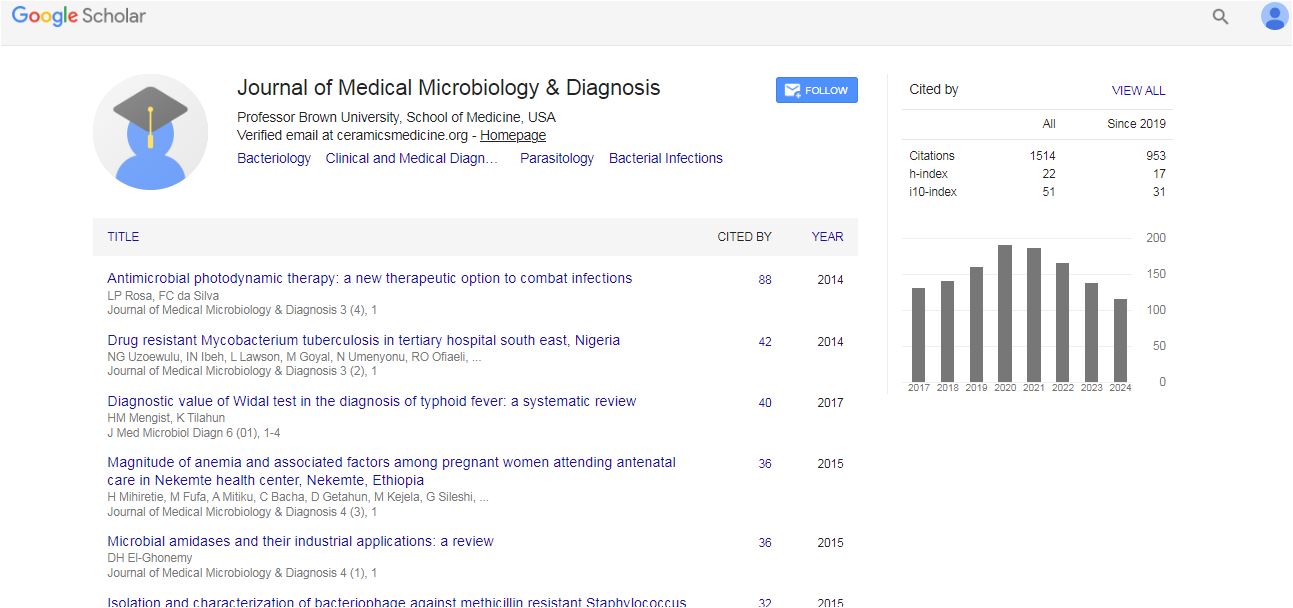
Medical Microbiology & Diagnosis received 14 citations as per Google Scholar report