Brief Report - (2025) Volume 14, Issue 5
Received: 02-Sep-2025, Manuscript No. pbt-25-173772;
Editor assigned: 04-Sep-2025, Pre QC No. P-173772;
Reviewed: 18-Sep-2025, QC No. Q-173772;
Revised: 23-Sep-2025, Manuscript No. R-173772;
Published:
30-Sep-2025
, DOI: 10.37421/2167-7689.2025.14.501
Citation: D’Souza, Caroline. ”Pervasive Risk Management: Enhancing Resilience & Performance.” Pharmaceut Reg Affairs 14 (2025):501.
Copyright: © 2025 D’Souza C. This is an open-access article distributed under the terms of the Creative Commons Attribution License, which permits unrestricted use,
distribution and reproduction in any medium, provided the original author and source are credited.
Risk management is an indispensable aspect of modern organizational operations, cutting across various industries and strategic imperatives. Its application spans from ensuring project success and enhancing operational resilience to safeguarding public health and adapting to global challenges. The necessity of systematically identifying, assessing, and mitigating potential disruptions has driven a diverse body of research, each contributing unique perspectives and methodologies to this evolving field. This collection of studies explores the multi-faceted nature of risk management, presenting frameworks, reviews, and implementation strategies tailored to specific contexts and challenges. In the realm of construction, an innovative Building Information Modeling (BIM)-based framework has been developed to significantly enhance risk management. This framework focuses on identifying critical risk factors and proposes a structured method for their assessment and mitigation. It leverages BIMâ??s inherent capabilities for superior visualization and collaborative decision-making, aiming to improve project outcomes throughout their entire lifecycle [1].
Organizational resilience, a critical attribute in todayâ??s unpredictable business landscape, is intricately linked to effective Enterprise Risk Management (ERM). A comprehensive review of existing literature synthesizes how robust ERM practices fundamentally contribute to an organization's capacity to anticipate, respond to, and recover from disruptive events. This research underscores the strategic imperative of seamlessly integrating ERM into core business processes, recognizing it as essential for fostering sustainable resilience [2].
For agile software development projects, managing risks presents unique challenges due to their dynamic nature. A systematic review delves into current practices, identifying common risk categories and effective mitigation strategies. It emphasizes the crucial role of integrating risk activities throughout agile sprints, highlighting the continuous and adaptive risk planning required in fast-paced Information Technology (IT) environments [3].
Patient safety, a paramount concern in healthcare, greatly benefits from comprehensive risk management. One paper details the successful implementation of a holistic risk management plan within a tertiary care hospital. This plan outlines strategic steps, beginning with the identification of potential hazards and progressing to the development of robust mitigation strategies and meticulous monitoring of outcomes. The findings demonstrate a significant reduction in adverse events and a marked improvement in the overall quality of care [4].
The global supply chain faces constant threats from disruptions, making effective risk management vital for both resilience and sustainability. A systematic review investigates various supply chain risk management strategies, distinguishing between proactive and reactive measures. It highlights the critical importance of diversification, collaboration among stakeholders, and the strategic adoption of technology in minimizing disruptions while simultaneously promoting environmentally and socially responsible supply chain operations [5].
Addressing broader environmental concerns, a proposed framework guides businesses in integrating climate change adaptation and disaster risk reduction into their existing environmental management systems. This approach advocates for a proactive and holistic strategy to identify, assess, and manage climate-related risks, thereby ensuring long-term operational resilience and adherence to evolving environmental standards [6].
In the banking sector, dynamic financial risk management is being revolutionized through machine learning approaches. This research showcases how advanced algorithms can be effectively utilized to model and predict diverse financial risks, empowering banks to develop more adaptive and precise risk management plans, especially crucial in the context of a rapidly evolving market environment [7].
Protecting critical infrastructure from cyber threats is a growing concern. A comprehensive cybersecurity risk management framework has been specifically designed for these vital sectors. This framework encompasses systematic identification, thorough assessment, and effective treatment of cyber threats. It stresses a layered defense approach and continuous monitoring as essential components to safeguard essential services against increasingly sophisticated cyberattacks [8].
Manufacturing Small and Medium-sized Enterprises (SMEs) encounter distinct operational risks. A literature review explores current operational risk management practices within these entities, identifying common risks, existing mitigation strategies, and the challenges unique to SMEs. It also suggests areas for improvement in developing robust and scalable risk management plans tailored for these organizations [9].
Finally, the interplay between strategic risk management, innovation culture, dynamic capabilities, and firm performance is thoroughly investigated. This study posits that effective strategic risk management, when coupled with a strong innovation culture and well-developed dynamic capabilities, significantly enhances a firm's capacity to navigate uncertainties and judiciously capitalize on opportunities, particularly within dynamic markets [10].
This collection underscores the pervasive influence of risk management across diverse domains, revealing its evolution through technological integration, strategic planning, and adaptive methodologies, all aimed at fostering stability and and progress.
Risk management forms the bedrock of stability and progress across a myriad of organizational and operational landscapes. The body of research presented here offers a comprehensive look into its application, from project-specific challenges to broader strategic imperatives. For instance, in construction, a Building Information Modeling (BIM)-based framework provides a systematic methodology for risk management, emphasizing the critical identification, assessment, and mitigation of risks. This approach capitalizes on BIMâ??s visualization capabilities to foster collaborative decision-making, thereby enhancing project outcomes throughout their lifecycle [1]. This demonstrates a proactive stance on managing the inherent uncertainties of large-scale construction endeavors.
Further highlighting strategic organizational resilience, the role of Enterprise Risk Management (ERM) is extensively reviewed. This literature synthesis underlines how robust ERM practices are instrumental in an organization's ability to foresee, react to, and recover from disruptive events. Integrating ERM into core business processes is not merely a best practice but a strategic imperative for cultivating enduring resilience [2]. Meanwhile, the dynamic environment of agile software development projects necessitates a unique approach to risk management. A systematic review in this domain identifies prevalent risk categories and outlines adaptive mitigation strategies, underscoring the necessity for continuous risk planning integrated directly into agile sprints [3]. These insights reveal how risk management must evolve to match the pace and flexibility of modern development methodologies.
The application of holistic risk management extends profoundly into sensitive sectors such as healthcare. A detailed account from a tertiary care hospital illustrates the successful implementation of a comprehensive plan focused on patient safety. This involves a structured process, from the initial identification of potential hazards to the creation of targeted mitigation strategies and the continuous monitoring of results, ultimately leading to a notable reduction in adverse events and an overall improvement in care quality [4]. Beyond individual organizations, global challenges demand equally robust responses. Supply chain risk management strategies are crucial for enhancing both resilience and sustainability. Current research synthesizes proactive and reactive measures, advocating for diversification, enhanced collaboration, and strategic technology adoption to mitigate disruptions and foster responsible operations [5].
Moreover, the increasing urgency of environmental concerns is addressed through a framework designed to integrate climate change adaptation and disaster risk reduction into existing environmental management systems. This framework champions a proactive, holistic approach to identify, assess, and manage climate-related risks, ensuring long-term operational resilience and adherence to evolving environmental standards [6]. The financial sector also benefits from advanced methodologies, with research proposing a machine learning approach for dynamic financial risk management in banking. This innovation demonstrates how sophisticated algorithms can model and predict various financial risks, enabling banks to craft more adaptive and precise management plans in an ever-changing market [7].
Protecting vital societal functions is paramount, particularly for critical infrastructure sectors facing sophisticated cyber threats. A comprehensive cybersecurity risk management framework is introduced, detailing systematic identification, assessment, and treatment of these threats. This framework advocates for a layered defense and continuous monitoring, ensuring the protection of essential services from increasingly complex cyberattacks [8]. Operational efficiencies, especially in manufacturing Small and Medium-sized Enterprises (SMEs), are also reliant on effective risk practices. A literature review examines operational risk management within these entities, pinpointing common risks, existing strategies, and challenges unique to SMEs, suggesting avenues for developing more robust and scalable solutions [9]. Finally, at the highest level of corporate strategy, the relationship between strategic risk management, an innovative culture, dynamic capabilities, and overall firm performance is explored. This research suggests that when effective strategic risk management is paired with a strong innovation culture and well-developed dynamic capabilities, it significantly enhances a firm's ability to navigate uncertainties and capitalize on opportunities, particularly in volatile markets [10]. This demonstrates the profound impact of integrated risk thinking on sustained business success.
Risk management emerges as a crucial discipline across various sectors, demonstrating its adaptability and strategic importance. Studies highlight its application in enhancing construction project management through Building Information Modeling (BIM) by identifying, assessing, and mitigating critical risk factors to improve visualization and collaborative decision-making. Enterprise Risk Management (ERM) is explored for its contribution to organizational resilience, emphasizing its role in anticipating, responding to, and recovering from disruptive events, urging integration into core business processes for sustainable resilience. The agile software development domain benefits from systematic reviews focusing on common risk categories and adaptive mitigation strategies for dynamic Information Technology (IT) environments. In healthcare, a holistic risk management plan significantly improves patient safety in tertiary care hospitals by outlining strategic steps from hazard identification to monitoring outcomes, leading to reduced adverse events. Supply chain management leverages strategies to bolster resilience and sustainability, synthesizing research on proactive and reactive measures, and emphasizing diversification, collaboration, and technology adoption. Environmental management systems are enhanced through frameworks integrating climate change adaptation and disaster risk reduction, fostering a proactive approach to climate-related risks. Financial institutions utilize machine learning for dynamic risk management, enabling banks to predict and manage financial risks more precisely. Critical infrastructure sectors employ comprehensive cybersecurity risk management frameworks that prioritize systematic identification, assessment, and treatment of cyber threats with layered defense and continuous monitoring. Operational risks in manufacturing Small and Medium-sized Enterprises (SMEs) are addressed through literature reviews identifying unique challenges and suggesting improvements for scalable risk management. Finally, strategic risk management, coupled with innovation culture and dynamic capabilities, is shown to significantly boost firm performance by navigating uncertainties and capitalizing on opportunities in evolving markets. This collective research underscores the pervasive and evolving nature of risk management across a multitude of organizational contexts.
None
None
1. Muhammad I, Kamran A, Muhammad WI. "Framework for Managing Risks in Construction Projects Based on BIM".Buildings 12 (2022):1831.
Indexed at, Google Scholar, Crossref
2. Kevin WST, Michael RPT, Jeffrey MHT. "Enterprise Risk Management and Organizational Resilience: A Review and Future Research Agenda".Risk Manag. Insur. Rev. 25 (2022):67-96.
Indexed at, Google Scholar, Crossref
3. Mohammad A, Ahmad HA, Mohammad AA. "Risk Management in Agile Software Development Projects: A Systematic Literature Review".IEEE Access 9 (2021):47045-47063.
Indexed at, Google Scholar, Crossref
4. Hani A, Ali A, Maryam A. "Implementation of a comprehensive risk management plan to improve patient safety in a tertiary care hospital".Int. J. Health Care Qual. Assur. 33 (2020):799-813.
Indexed at, Google Scholar, Crossref
5. Md. IH, A. HMR, Khairul A. "Supply chain risk management strategies for enhancing resilience and sustainability: a systematic review".J. Clean. Prod. 381 (2023):134808.
Indexed at, Google Scholar, Crossref
6. Lena HMS, Janina HHL, Thomas HRS. "Integrating Climate Change Adaptation and Disaster Risk Reduction into Environmental Management Systems: A Framework for Businesses".Environ. Sci. Policy 119 (2021):1-10.
Indexed at, Google Scholar, Crossref
7. Zoran I, Milan K, Dragan P. "Dynamic Financial Risk Management in Banks: A Machine Learning Approach".Risks 8 (2020):121.
Indexed at, Google Scholar, Crossref
8. Muhammad NK, Salman K, Naveed K. "A Comprehensive Cybersecurity Risk Management Framework for Critical Infrastructure".Appl. Sci. 11 (2021):6522.
Indexed at, Google Scholar, Crossref
9. Adib FMK, Wan MRWH, Muhammad AMN. "Operational risk management in manufacturing SMEs: A literature review".IOP Conf. Ser.: Mater. Sci. Eng. 991 (2020):012022.
Indexed at, Google Scholar, Crossref
10. Yanan T, Yongjun L, Mingzhi L. "Strategic risk management and firm performance: The role of innovation culture and dynamic capabilities".J. Bus. Res. 140 (2022):12-25.
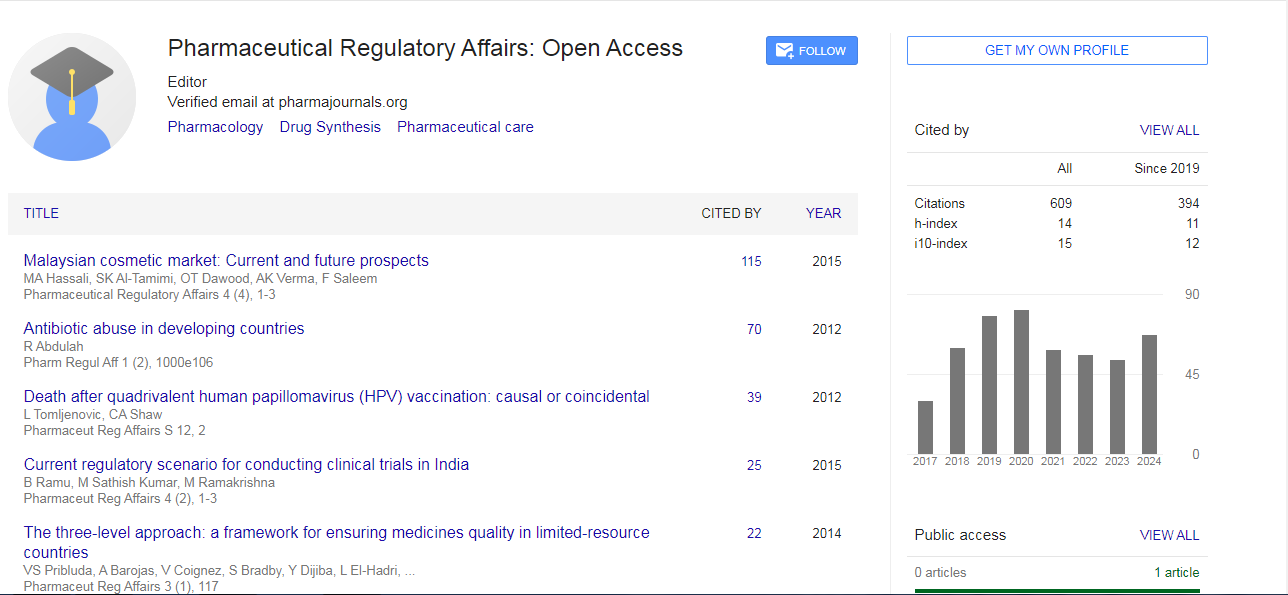
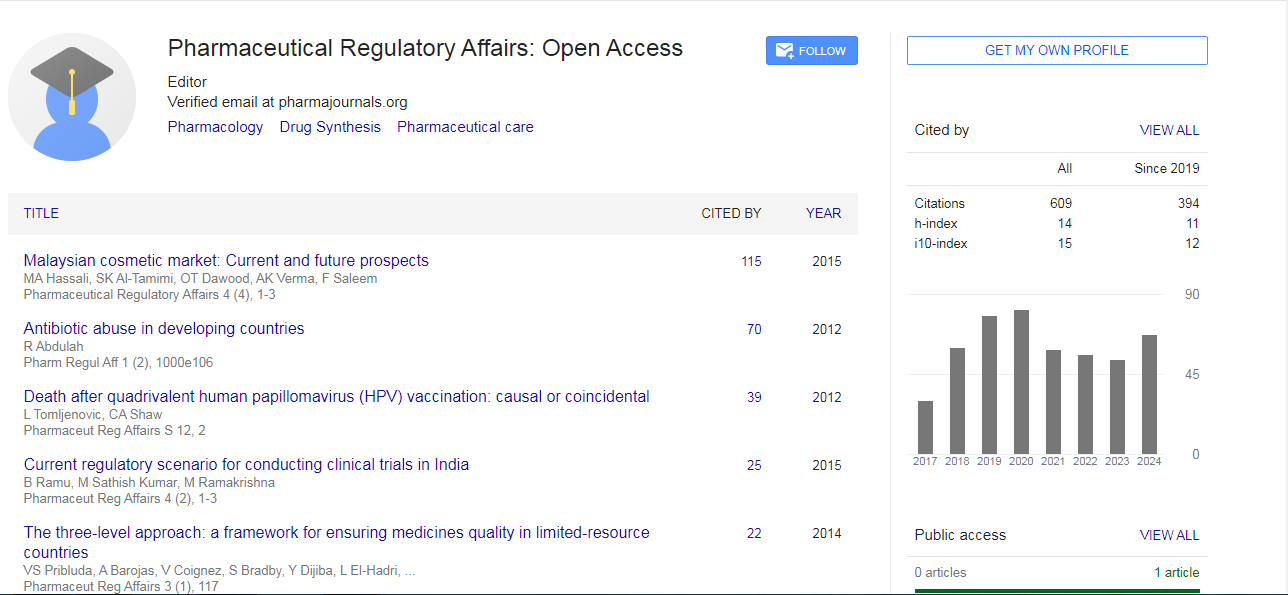
Pharmaceutical Regulatory Affairs: Open Access received 533 citations as per Google Scholar report