Brief Report - (2025) Volume 10, Issue 3
Received: 02-Jun-2025, Manuscript No. jomp-26-185085;
Editor assigned: 04-Jun-2025, Pre QC No. P-185085;
Reviewed: 18-Jun-2025, QC No. Q-185085;
Revised: 23-Jun-2025, Manuscript No. R-185085;
Published:
30-Jun-2025
, DOI: 10.37421/2576-3857.2025.10.303
Citation: Ramirez, Alejandro. ”Personalizing Chemoradiotherapy for Esophageal Cancer Outcomes.” J Oncol Med and Pract 10 (2025):303.
Copyright: © 2025 Ramirez A. This is an open-access article distributed under the terms of the Creative Commons Attribution License, which permits unrestricted use, distribution and reproduction in any medium, provided the original author and source are credited.
Optimizing chemoradiotherapy (CRT) for esophageal carcinoma is a complex endeavor that hinges on tailoring treatment intensity and timing based on various factors, including disease stage, individual patient characteristics, and the assessment of treatment response. De-escalation strategies are being explored for specific patient groups, aiming to maintain therapeutic efficacy while concurrently reducing treatment-related toxicity. While concurrent CRT remains the established standard of care, significant research is being conducted to explore sequence optimization, such as the incorporation of induction or consolidation chemotherapy, with the overarching goal of enhancing patient survival outcomes. The integration of molecular biomarkers and advanced imaging modalities is emerging as a crucial element in predicting treatment response and guiding personalized therapeutic decisions, signifying a progressive shift towards a more precision-based approach in managing esophageal cancer [1].
Efforts are underway to investigate the impact of a diverse range of chemotherapy agents and varied radiation fractionation schedules when used in combination with radiotherapy for esophageal cancer. The primary aim of these investigations is to identify specific therapeutic regimens that can maximize tumor response while simultaneously minimizing the incidence and severity of treatment-related toxicities. A key aspect highlighted in this research is the paramount importance of early response assessment, which can facilitate potential treatment modifications and personalization. This proactive approach can lead to more effective outcomes and better patient management [2].
Furthermore, significant research interest is directed towards exploring the potential of novel targeted agents and immunotherapies, aiming to enhance the efficacy of traditional chemoradiotherapy regimens for esophageal cancer. This research encompasses investigating specific biomarkers that can reliably predict patient response to these novel combinations and developing effective strategies for managing the combined toxicities that may arise from these complex treatment paradigms. Such advancements hold promise for improving patient outcomes and expanding therapeutic options [3].
This review delves into the evolving role of both neoadjuvant and adjuvant chemoradiotherapy within the comprehensive management of esophageal cancer. A central theme is the critical importance of integrating multimodality treatments and personalizing therapy based on a thorough understanding of tumor characteristics and predicted patient outcomes. The overarching focus remains on achieving significant improvements in survival rates and overall patient well-being [4].
Research is actively exploring dose-escalation and dose-reduction strategies within the framework of chemoradiotherapy for esophageal cancer. The core objective is to meticulously identify optimal doses for both chemotherapy agents and radiation, aiming to maximize tumoricidal effects while judiciously minimizing both acute and late toxicities. This careful balance is essential for improving patient quality of life throughout and following treatment [5].
This article provides a comprehensive analysis of the current landscape surrounding chemoradiotherapy for esophageal cancer. It places a strong emphasis on the critical importance of meticulous patient selection, strategic treatment sequencing, and the thoughtful integration of advanced radiotherapy techniques. Modalities such as intensity-modulated radiation therapy (IMRT) and proton therapy are highlighted for their potential to significantly improve patient outcomes [6].
This paper specifically explores the pivotal role of molecular profiling in predicting treatment response to chemoradiotherapy in esophageal cancer. It meticulously discusses how specific genetic mutations and distinct gene expression patterns can profoundly inform and guide treatment decisions. This approach has the potential to pave the way for more personalized and consequently more effective therapeutic strategies, tailored to the unique biological profile of each patient's tumor [7].
A review focused on the integration of immunotherapy with conventional chemoradiotherapy for esophageal cancer is presented. This work critically examines the underlying rationale for such combinations, early clinical trial results, and the inherent challenges associated with effectively combining these distinct therapeutic modalities. The ultimate goal is to improve patient survival and significantly reduce recurrence rates [8].
This study undertakes a detailed examination of the role that induction and consolidation chemotherapy play when used in conjunction with standard chemoradiotherapy for esophageal cancer. It meticulously analyzes their impact on pathological complete response rates and overall survival, while also discussing the potential for treatment de-escalation in patients who demonstrate a robust initial response [9].
This research investigates the promising potential of adaptive radiotherapy and response-guided treatment modifications within the context of esophageal cancer chemoradiotherapy. It effectively highlights how the utilization of real-time imaging and continuous assessment can lead to the optimization of radiation delivery and chemotherapy regimens. Such adaptive strategies are crucial for improving tumor control and minimizing treatment-related toxicity [10].
The optimization of chemoradiotherapy (CRT) for esophageal carcinoma necessitates a highly personalized approach, meticulously tailoring treatment intensity and timing based on a comprehensive evaluation of disease stage, individual patient factors, and ongoing response assessment. Strategies focused on de-escalation for select patient populations are being rigorously explored, with the aim of preserving therapeutic efficacy while simultaneously mitigating treatment-related toxicity. Although concurrent CRT remains the standard practice, research continues to investigate sequence optimization, including the incorporation of induction or consolidation chemotherapy, as a means to enhance survival outcomes. The critical role of molecular biomarkers and advanced imaging in predicting treatment response and guiding personalized treatment decisions is increasingly recognized, driving a paradigm shift towards a more precision-based approach to care [1].
This study is dedicated to investigating the effects of various chemotherapy agents and different radiation fractionation schedules when employed in combination with radiotherapy for esophageal cancer. The overarching objective is to identify specific regimens that can achieve maximal tumor response while minimizing treatment-associated toxicities. A significant emphasis is placed on the importance of early response assessment as a mechanism for enabling timely treatment modifications, thereby optimizing patient management [2].
An exploration into the potential of novel targeted agents and immunotherapies to augment the efficacy of established chemoradiotherapy protocols for esophageal cancer is a key area of investigation. This research includes the identification of biomarkers that can predict response to these innovative combinations and the development of strategies for managing the associated combined toxicities. Such advancements are crucial for expanding therapeutic options [3].
This review meticulously discusses the evolving landscape of neoadjuvant and adjuvant chemoradiotherapy in the management of esophageal cancer. It underscores the imperative of integrating multimodality treatments and personalizing therapy based on detailed tumor characteristics and patient outcomes, with a sustained focus on improving survival rates [4].
The investigation into dose-escalation and dose-reduction strategies within chemoradiotherapy for esophageal cancer is a critical area of research. The central aim is to pinpoint the optimal doses of both chemotherapy agents and radiation to maximize tumoricidal effects while carefully minimizing acute and late toxicities, thereby enhancing the patient's quality of life [5].
This article offers an in-depth analysis of the current state of chemoradiotherapy for esophageal cancer. It emphasizes the crucial importance of appropriate patient selection, strategic treatment sequencing, and the incorporation of advanced radiotherapy techniques, such as intensity-modulated radiation therapy (IMRT) and proton therapy, with the explicit goal of improving patient outcomes [6].
This paper specifically examines the role of molecular profiling in predicting the response to chemoradiotherapy in esophageal cancer. It elaborates on how genetic mutations and gene expression patterns can substantially inform treatment decisions, thereby facilitating the development of more personalized and effective therapeutic strategies [7].
A review dedicated to the integration of immunotherapy with traditional chemoradiotherapy for esophageal cancer is presented. This work scrutinizes the underlying rationale, early clinical trial findings, and the challenges inherent in combining these modalities to improve patient survival and diminish recurrence rates [8].
This study meticulously evaluates the role of induction and consolidation chemotherapy when used alongside standard chemoradiotherapy for esophageal cancer. It analyzes their impact on pathological complete response rates and overall survival, while also considering the potential for treatment de-escalation in patients who exhibit a favorable response [9].
This research investigates the potential benefits of adaptive radiotherapy and response-guided treatment modifications in the context of esophageal cancer chemoradiotherapy. It highlights how real-time imaging and assessment can optimize radiation delivery and chemotherapy regimens, leading to improved tumor control and reduced toxicity [10].
Optimizing chemoradiotherapy for esophageal cancer involves tailoring treatment based on disease stage, patient factors, and response. De-escalation strategies aim to reduce toxicity while maintaining efficacy. Concurrent CRT is standard, but induction or consolidation chemotherapy is being explored for improved survival. Molecular biomarkers and advanced imaging are crucial for personalized treatment. Research is investigating various chemotherapy agents and radiation schedules to maximize tumor response and minimize toxicity, emphasizing early response assessment. Novel targeted agents and immunotherapies are being explored to enhance traditional CRT. Dose optimization and advanced radiotherapy techniques like IMRT and proton therapy are also key areas of focus. Molecular profiling, adaptive radiotherapy, and response-guided modifications hold promise for personalized and effective treatment strategies, aiming to improve outcomes and reduce side effects.
None
None
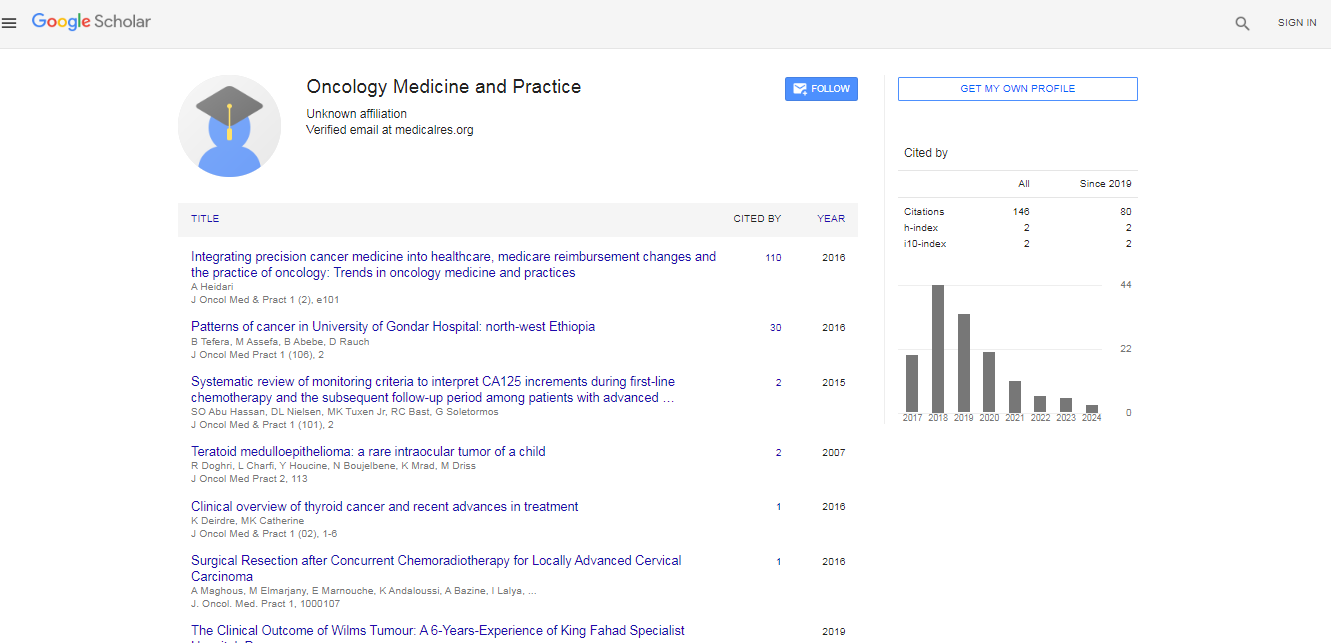
Journal of Oncology Medicine & Practice received 142 citations as per Google Scholar report