Perspective - (2025) Volume 9, Issue 5
Received: 01-Oct-2025, Manuscript No. cmcr-25-178083;
Editor assigned: 03-Oct-2025, Pre QC No. P-178083;
Reviewed: 17-Oct-2025, QC No. Q-178083;
Revised: 22-Oct-2025, Manuscript No. R-178083;
Published:
29-Oct-2025
, DOI: 10.37421/2684-4915.2025.9.399
Citation: Nguyen, Chloe. ”Personalized Medicine: Revolutionizing Individualized Care.” Clin Med Case Rep 09 (2025):399.
Copyright: © 2025 Nguyen C. This is an open-access article distributed under the terms of the Creative Commons Attribution License, which permits unrestricted use, distribution and reproduction in any medium, provided the original author and source are credited.
Personalized medicine is fundamentally transforming healthcare by offering tailored treatments that consider each patient's unique genetic makeup, environment, and lifestyle. This paradigm shift moves beyond conventional 'one-size-fits-all' approaches, promising medical care precisely aligned with individual needs. The field's evolution is deeply rooted in genomic profiling and extends to sophisticated immunotherapeutic strategies for cancer. These innovations underscore the crucial role of molecular markers in precision oncology, enabling accurate prediction of treatment responses and effective management of resistance. Integrating multi-omics data and advanced bioinformatics refines this predictive capability, ultimately improving patient outcomes [1].
The overarching concept of personalized medicine, with its diverse applications, offers substantial promise, yet faces significant hurdles. Challenges include navigating complex regulatory environments, addressing critical data privacy concerns, and establishing robust infrastructure [2].
Pharmacogenomics, a pivotal area, explores how genetic variations impact drug response, efficacy, and toxicity. Understanding these influences allows clinicians to select optimal medications and dosages, moving towards personalized drug therapy [3].
Artificial Intelligence (AI) stands as a transformative force, with applications spanning diagnostics, drug discovery, and treatment optimization. Despite its potential, AI integration presents technical challenges with complex biological data. Ethical considerations like algorithmic bias, data privacy, and accountability must guide AI's responsible development for equitable and effective personalized healthcare [4].
Multi-omics technologies further propel personalized medicine by combining data from genomics, proteomics, and metabolomics. This creates a comprehensive view of an individual's biology, enabling precise disease risk assessment, diagnosis, and targeted treatments. Interpreting and integrating these vast datasets computationally remains a significant challenge for clinical translation [5].
Advanced gene-editing tools, such as CRISPR-Cas9 technology, also play a vital role. It allows for precise correction of disease-causing mutations, paving the way for novel therapeutic strategies for genetic disorders and enhancing cell-based therapies. Research focuses on improving CRISPR-Cas9 specificity and safety for individualized applications [6].
Digital health tools are increasingly central, with wearables, mobile health apps, telemedicine, and electronic health records facilitating real-time data collection. This enables personalized interventions, fosters patient engagement, and enhances preventive care and remote monitoring, making healthcare more accessible and individualized [7].
Processing and deriving insights from massive healthcare datasets is critical. Big data analytics leverages vast clinical, genomic, and environmental information to generate insights for individual patient care. Various analytical techniques are employed to improve diagnostic accuracy, predict disease progression, and optimize treatment strategies tailored to specific patients [8].
However, translating these innovations into routine clinical practice requires a robust framework. Implementation science provides structured approaches to overcome barriers related to clinician adoption, patient acceptance, and organizational readiness. Effective strategies are fundamental to ensuring personalized medicine delivers its promised benefits broadly [9].
Looking ahead, precision nutrition is emerging as a significant aspect, investigating how individual differences in genetics, gut microbiome, metabolism, and lifestyle influence nutritional requirements and responses. By tailoring dietary recommendations, precision nutrition aims to more effectively prevent and manage diseases, moving towards individualized strategies for optimal health outcomes [10].
Personalized medicine is revolutionizing healthcare by tailoring medical decisions, treatments, and products to the individual patient. This approach capitalizes on the unique biological characteristics of each person, particularly their genetic makeup, to provide more effective and safer healthcare. In cancer therapy, for instance, personalized medicine has evolved from genomic profiling to advanced immunotherapeutic approaches. It emphasizes the importance of molecular markers for precision oncology, integrating multi-omics data and sophisticated bioinformatics to predict treatment responses and manage resistance, ultimately aiming to improve patient outcomes [1]. This tailored approach fundamentally shifts healthcare from a one-size-fits-all model to highly individualized care.
The broad landscape of personalized medicine encompasses core concepts and diverse applications across numerous medical fields. While its promise lies in customizing healthcare based on individual variability in genes, environment, and lifestyle, the field also confronts significant challenges. These include complex regulatory hurdles, pressing data privacy concerns, and the need for robust infrastructure to support its widespread implementation [2]. A crucial component of this individualization is pharmacogenomics, which explores how genetic variations influence drug response, toxicity, and efficacy. By understanding these genetic predispositions, clinicians can select optimal medications and dosages, effectively personalizing drug therapy and integrating pharmacogenomic testing into routine healthcare [3].
The integration of advanced technologies like Artificial Intelligence (AI) further propels personalized medicine forward. AI applications range from enhancing diagnostics and accelerating drug discovery to optimizing treatment plans. However, integrating AI with complex biological data presents technical challenges, alongside ethical considerations such as data privacy, algorithmic bias, and accountability. Responsible development and deployment of AI are essential to ensure equitable and effective personalized healthcare [4]. Similarly, multi-omics technologies provide an insightful look into an individual's biology by combining data from genomics, proteomics, metabolomics, and other 'omics' fields. This holistic view enables more precise disease risk assessment, diagnosis, and treatment. The computational challenges involved in integrating and interpreting these vast datasets are considerable but crucial for translating them into actionable clinical insights [5].
Gene-editing technologies like CRISPR-Cas9 are also making significant strides in personalized medicine. This technology offers the potential for precise correction of disease-causing mutations, the development of novel therapeutic strategies for genetic disorders, and the enhancement of cell-based therapies. Current research focuses on improving the specificity and safety of CRISPR-Cas9 for therapeutic use in individual patients [6]. Beyond genetic interventions, digital health tools are increasingly relevant. Wearable sensors, mobile health apps, telemedicine, and electronic health records contribute to collecting real-time patient data, facilitating personalized interventions, and improving patient engagement. Digital health promises to enhance preventive care, remote monitoring, and tailored treatment plans, making healthcare more accessible and individualized [7].
The ability to process and analyze massive amounts of information is also paramount. Big data analytics plays a vital role in leveraging the volume, velocity, and variety of healthcare data, including clinical, genomic, and environmental information. This is used to generate insights for individual patient care, improving diagnostic accuracy, predicting disease progression, and optimizing treatment strategies tailored to specific patients [8]. For these innovations to reach patients, effective translation from research to clinical practice is key. Implementation science addresses the complexities of integrating novel interventions into healthcare systems, identifying and overcoming barriers related to clinician adoption, patient acceptance, and organizational readiness. Robust implementation strategies are essential for personalized medicine to deliver its benefits on a broad scale [9]. Furthermore, precision nutrition is emerging as a critical field within personalized medicine. It explores how individual differences in genetics, gut microbiome, metabolism, and lifestyle impact nutritional requirements and responses to diet, allowing for tailored dietary recommendations to prevent and manage diseases more effectively [10].
Personalized medicine is transforming healthcare by tailoring treatments to individual patient profiles. It leverages genomic profiling and advanced immunotherapeutic approaches in cancer therapy, highlighting the role of molecular markers and multi-omics data for predicting responses and managing resistance [1]. This approach extends to understanding how genetic variations influence drug response, toxicity, and efficacy, enabling optimal medication selection through pharmacogenomics [3]. The broader landscape of personalized medicine encompasses diverse applications but faces challenges like regulatory hurdles, data privacy, and infrastructure needs [2]. Artificial Intelligence (AI) plays a critical role in diagnostics, drug discovery, and treatment optimization, though ethical considerations like bias and accountability are paramount [4]. Multi-omics technologies, combining data from genomics, proteomics, and metabolomics, create a holistic biological view for precise disease assessment and treatment, presenting computational challenges in data integration [5]. Emerging technologies like CRISPR-Cas9 offer precise gene editing for genetic disorders and cell-based therapies [6]. Digital health tools, including wearables and telemedicine, enhance data collection and personalized interventions, improving accessibility and individualized care [7]. Big data analytics further leverages vast healthcare data to improve diagnostic accuracy and optimize treatment strategies [8]. Effective translation of these innovations into clinical practice requires robust implementation science, addressing barriers to clinician and patient adoption [9]. Precision nutrition also emerges as a key area, tailoring dietary recommendations based on individual genetics and metabolism for optimal health outcomes [10].
None
None
Indexed at, Google Scholar, Crossref
Indexed at, Google Scholar, Crossref
Indexed at, Google Scholar, Crossref
Indexed at, Google Scholar, Crossref
Indexed at, Google Scholar, Crossref
Indexed at, Google Scholar, Crossref
Indexed at, Google Scholar, Crossref
Indexed at, Google Scholar, Crossref
Indexed at, Google Scholar, Crossref
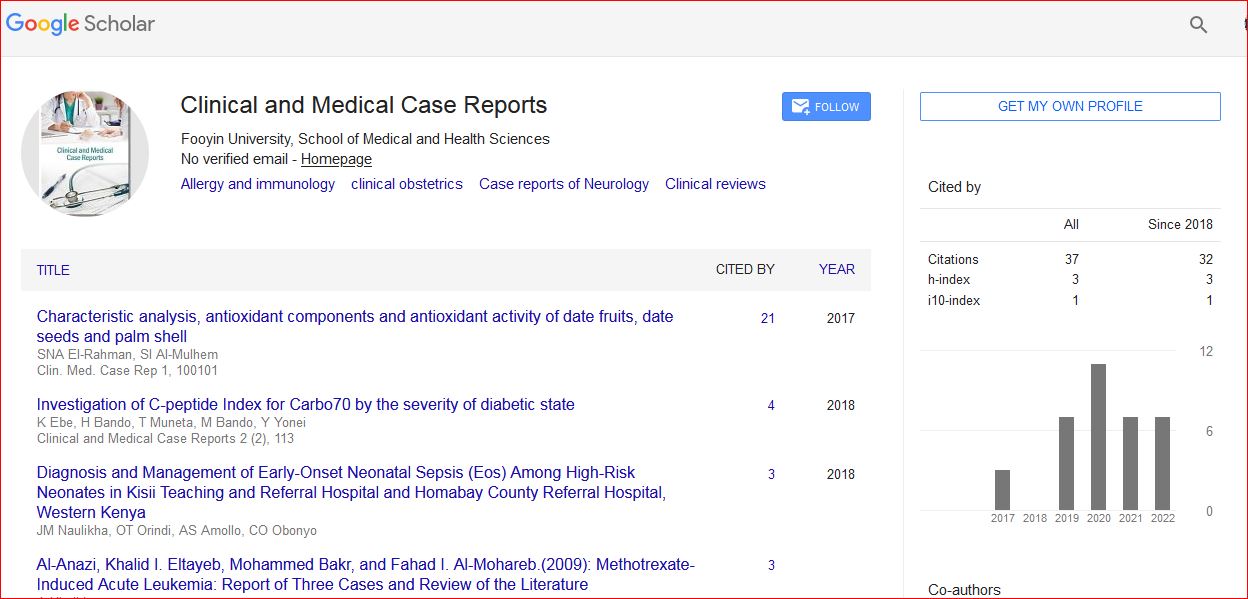
Clinical and Medical Case Reports received 53 citations as per Google Scholar report