Opinion - (2025) Volume 10, Issue 6
Received: 01-Dec-2025, Manuscript No. jomp-26-185136;
Editor assigned: 03-Dec-2025, Pre QC No. P-185136;
Reviewed: 17-Dec-2025, QC No. Q-185136;
Revised: 22-Dec-2025, Manuscript No. R-185136;
Published:
29-Dec-2025
, DOI: 10.37421/2576-3857.2025.10.338
Citation: Schmidt, Andreas. ”Personalized Lung Cancer Combinations: Tailored Treatment Strategies.” J Oncol Med and Pract 10 (2025):338.
Copyright: © 2025 Schmidt A. This is an open-access article distributed under the terms of the Creative Commons Attribution License, which permits unrestricted use, distribution and reproduction in any medium, provided the original author and source are credited.
Personalized combination therapy strategies are emerging as a crucial approach in the management of lung adenocarcinoma, aiming to overcome treatment resistance and improve patient outcomes. These strategies involve tailoring therapeutic regimens based on individual tumor characteristics, such as specific driver mutations, the immune microenvironment, and genomic alterations. Key approaches include combining targeted therapies with immunotherapy or integrating different targeted agents to exploit synergistic effects and block multiple oncogenic pathways. Understanding the molecular landscape of each patient's tumor is paramount for designing effective and durable treatment plans. This personalized approach involves analyzing genetic mutations, protein expression, and tumor mutational burden (TMB) to predict response to specific therapies. For example, combining EGFR inhibitors with other targeted agents or immunotherapy can be beneficial for certain EGFR-mutated NSCLC patients, especially those who develop resistance to first-line treatments. Similarly, strategies targeting KRAS mutations or exploring novel pathways like MET amplification are under active development. The evolving landscape of lung adenocarcinoma treatment increasingly relies on a multi-pronged approach, leveraging combination therapies to combat intrinsic and acquired resistance. This review delves into how combining targeted agents that hit different oncogenic pathways, such as EGFR, ALK, or KRAS, can provide more durable responses than monotherapy. Furthermore, the synergy between targeted therapies and immunotherapy is explored, highlighting how these combinations can re-invigorate anti-tumor immune responses, particularly in patients with high TMB or specific immune evasion mechanisms. The discussion also touches upon the importance of timing and sequencing of these agents, as well as the development of novel biomarkers to guide personalized treatment selection. The immune microenvironment plays a pivotal role in the efficacy of lung adenocarcinoma treatments, particularly with the advent of immunotherapy. Personalized combination strategies are now focusing on modulating this microenvironment to enhance treatment responses. This includes combining immune checkpoint inhibitors (ICIs) with other immunotherapeutic agents, like oncolytic viruses or cancer vaccines, or with non-immunotherapeutic drugs such as chemotherapy or targeted therapy. The rationale is to overcome immune suppression within the tumor, increase antigen presentation, and augment T-cell infiltration and activity. Understanding the specific immune cell populations and cytokine profiles within a patient's tumor is key to selecting the most effective combination approach. Resistance to targeted therapies, particularly in EGFR-mutated lung adenocarcinoma, necessitates the development of innovative combination strategies. This study investigates the efficacy of combining third-generation EGFR inhibitors with other agents to overcome acquired resistance mechanisms, such as T790M mutations or bypass pathways. The research highlights the potential of these combinations to re-sensitize tumors to treatment and prolong progression-free survival. It emphasizes the need for ongoing molecular profiling to identify resistance mechanisms and tailor subsequent combination therapies for individual patients. KRAS mutations are prevalent in lung adenocarcinoma, and until recently, direct targeting of KRAS remained challenging. The emergence of KRAS G12C inhibitors has opened new avenues for personalized combination therapies. This article explores strategies that combine KRAS G12C inhibitors with other targeted agents (e.g., EGFR inhibitors, MEK inhibitors) or immunotherapy. The goal is to enhance anti-tumor activity by simultaneously blocking multiple signaling pathways or by modulating the tumor immune microenvironment. Preclinical and early clinical data suggest that these combinations hold promise for improving outcomes in patients with KRAS-mutated lung adenocarcinoma. Precision medicine in lung adenocarcinoma necessitates a deep understanding of tumor heterogeneity and its implications for treatment resistance. Combination therapies are being designed to target multiple subclones within a tumor simultaneously or sequentially. This review discusses the challenges and opportunities in developing personalized combination strategies that account for intratumoral heterogeneity, including the use of liquid biopsies for dynamic monitoring of tumor evolution and adaptation. The integration of genomic, transcriptomic, and proteomic data is crucial for identifying effective combination regimens that can overcome diverse resistance mechanisms. The integration of neoadjuvant and adjuvant therapies in lung adenocarcinoma aims to improve surgical outcomes and reduce the risk of recurrence. Personalized combination strategies are being explored in the neoadjuvant setting to shrink tumors before surgery and potentially eradicate micrometastases. This includes combining chemotherapy with immunotherapy or targeted agents. The article discusses the rationale, clinical evidence, and future directions for personalized combination neoadjuvant therapies, emphasizing the importance of early intervention and tailoring treatment based on tumor biology. Biomarker-driven approaches are fundamental to personalized combination therapy strategies in lung adenocarcinoma. This review focuses on predictive biomarkers for response to various targeted agents and immunotherapies, such as EGFR mutations, ALK fusions, ROS1 rearrangements, PD-L1 expression, and tumor mutational burden (TMB). It discusses how these biomarkers guide the selection of appropriate monotherapies or combination regimens. The ongoing challenge is to identify novel biomarkers and develop robust assays that can accurately predict response to complex combination treatments, thereby optimizing patient selection and treatment outcomes. The development of resistance to single-agent therapies is a major hurdle in the management of lung adenocarcinoma. Combination strategies, particularly those that target parallel or serial oncogenic pathways, are crucial for overcoming this challenge. This article examines the preclinical rationale and clinical data supporting combinations of novel targeted agents and explores strategies for predicting and overcoming resistance through rational drug combinations. The emphasis is on a dynamic and adaptive approach to treatment, continuously re-evaluating tumor biology and adjusting therapeutic regimens accordingly.
Personalized combination therapy strategies are increasingly vital in treating lung adenocarcinoma, with the goal of overcoming treatment resistance and enhancing patient outcomes. This approach involves tailoring therapeutic regimens based on an individual's tumor characteristics, including specific driver mutations, the tumor's immune microenvironment, and its genomic alterations. Key strategies involve combining targeted therapies with immunotherapy, or integrating different targeted agents to achieve synergistic effects and block multiple oncogenic pathways. A thorough understanding of each patient's tumor molecular landscape is indispensable for designing effective and long-lasting treatment plans. The analysis of genetic mutations, protein expression, and tumor mutational burden (TMB) is crucial for predicting response to specific therapies within these personalized strategies. For instance, in patients with EGFR-mutated non-small cell lung cancer (NSCLC), combining EGFR inhibitors with other targeted agents or immunotherapy can be particularly beneficial, especially for those who develop resistance to first-line treatments. Furthermore, ongoing research focuses on strategies that target KRAS mutations or explore novel pathways such as MET amplification. The therapeutic landscape for lung adenocarcinoma is continuously shifting, with a growing reliance on combination therapies to address both intrinsic and acquired resistance mechanisms. This review specifically examines how combining targeted agents that inhibit different oncogenic pathways, such as those affecting EGFR, ALK, or KRAS, can lead to more durable responses compared to monotherapy. It also explores the synergistic interactions between targeted therapies and immunotherapy, emphasizing their potential to reinvigorate anti-tumor immune responses, particularly in patients with high TMB or specific immune evasion mechanisms. The review further considers the critical aspects of treatment timing and sequencing, alongside the development of novel biomarkers to guide personalized treatment selection. The immune microenvironment significantly influences the effectiveness of lung adenocarcinoma treatments, especially with the widespread adoption of immunotherapy. Personalized combination strategies are now being developed with the specific aim of modulating this microenvironment to improve treatment responses. This includes combining immune checkpoint inhibitors (ICIs) with other immunotherapeutic agents, such as oncolytic viruses or cancer vaccines, or with non-immunotherapeutic drugs like chemotherapy or targeted therapy. The underlying rationale is to counteract immune suppression within the tumor, enhance antigen presentation, and promote T-cell infiltration and activity. Identifying the specific immune cell populations and cytokine profiles within a patient's tumor is paramount for selecting the most effective combination approach. The emergence of acquired resistance to targeted therapies, particularly in EGFR-mutated lung adenocarcinoma, underscores the necessity for innovative combination strategies. This study focuses on evaluating the efficacy of combining third-generation EGFR inhibitors with other therapeutic agents to overcome acquired resistance mechanisms, such as T790M mutations or bypass pathways. The research findings suggest that these combinations have the potential to re-sensitize tumors to treatment and extend progression-free survival. The study strongly emphasizes the ongoing need for molecular profiling to identify resistance mechanisms and subsequently tailor combination therapies for individual patients. KRAS mutations are frequently observed in lung adenocarcinoma, and historically, direct targeting of KRAS has presented significant challenges. However, the recent development of KRAS G12C inhibitors has introduced new possibilities for personalized combination therapies. This article examines strategies that involve combining KRAS G12C inhibitors with other targeted agents, such as EGFR or MEK inhibitors, or with immunotherapy. The objective of these combinations is to enhance anti-tumor activity by simultaneously inhibiting multiple signaling pathways or by modulating the tumor immune microenvironment. Preliminary preclinical and early clinical data indicate that these combination approaches show considerable promise for improving outcomes in patients with KRAS-mutated lung adenocarcinoma. Precision medicine for lung adenocarcinoma requires a comprehensive understanding of tumor heterogeneity and its impact on treatment resistance. Consequently, combination therapies are being designed to target multiple subclones within a tumor, either simultaneously or sequentially. This review addresses the complexities and opportunities associated with developing personalized combination strategies that account for intratumoral heterogeneity. It also highlights the utility of liquid biopsies for the dynamic monitoring of tumor evolution and adaptation. The integration of genomic, transcriptomic, and proteomic data is considered essential for identifying effective combination regimens capable of overcoming diverse resistance mechanisms. The incorporation of neoadjuvant and adjuvant therapies in lung adenocarcinoma management is aimed at improving surgical outcomes and reducing the likelihood of recurrence. Personalized combination strategies are being actively investigated in the neoadjuvant setting with the intention of shrinking tumors prior to surgery and potentially eliminating micrometastases. These strategies often involve combining chemotherapy with immunotherapy or targeted agents. The article discusses the underlying rationale, current clinical evidence, and future directions for personalized combination neoadjuvant therapies, underscoring the importance of early intervention and tailoring treatment based on the specific tumor biology. Biomarker-driven approaches are fundamental to the implementation of personalized combination therapy strategies in lung adenocarcinoma. This review concentrates on predictive biomarkers that indicate a patient's potential response to various targeted agents and immunotherapies. Examples include EGFR mutations, ALK fusions, ROS1 rearrangements, PD-L1 expression, and tumor mutational burden (TMB). The review explains how these biomarkers are utilized to guide the selection of appropriate monotherapies or combination regimens. A persistent challenge remains the identification of novel biomarkers and the development of robust assays capable of accurately predicting response to complex combination treatments, thereby optimizing patient selection and improving treatment outcomes. Resistance to single-agent therapies represents a significant obstacle in the management of lung adenocarcinoma. Combination strategies, particularly those designed to target parallel or serial oncogenic pathways, are critical for overcoming this challenge. This article reviews the preclinical rationale and clinical data supporting combinations of novel targeted agents and explores methods for predicting and overcoming resistance through rational drug combinations. The overarching theme is the adoption of a dynamic and adaptive approach to treatment, involving continuous re-evaluation of tumor biology and subsequent adjustment of therapeutic regimens.
Personalized combination therapy is a key strategy in lung adenocarcinoma treatment, aiming to overcome resistance and improve outcomes. This involves tailoring treatments based on individual tumor characteristics, such as mutations, immune microenvironment, and genomic alterations. Combining targeted therapies with immunotherapy or different targeted agents can exploit synergistic effects and block multiple oncogenic pathways. Analyzing molecular profiles like genetic mutations, protein expression, and tumor mutational burden helps predict treatment response. Strategies targeting specific mutations like EGFR and KRAS are being developed, along with combinations that modulate the tumor immune microenvironment. Biomarkers play a crucial role in guiding these personalized approaches. Addressing tumor heterogeneity and resistance mechanisms through rational drug combinations is essential for effective management. Integration of neoadjuvant and adjuvant therapies with personalized combinations also shows promise. Future directions involve sophisticated combination regimens informed by real-time molecular profiling and AI-driven decision support.
None
None
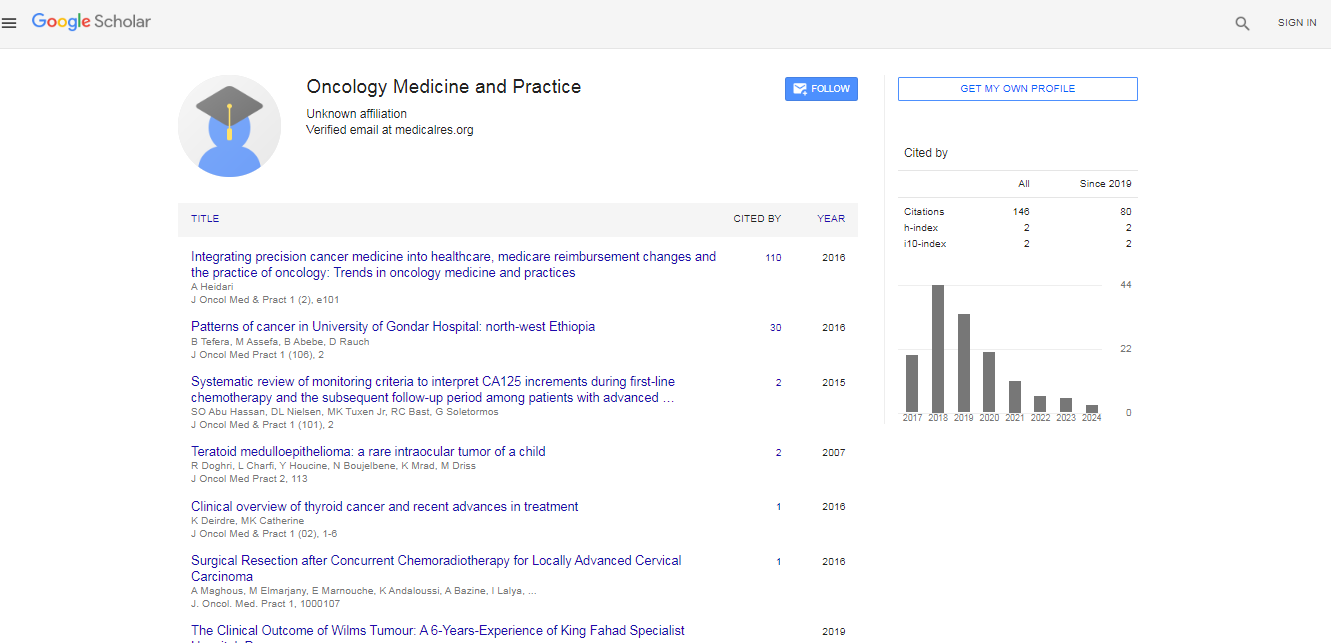
Journal of Oncology Medicine & Practice received 142 citations as per Google Scholar report