Short Communication - (2025) Volume 13, Issue 4
Received: 04-Aug-2025, Manuscript No. jcdd-25-176822;
Editor assigned: 06-Aug-2025, Pre QC No. P-176822;
Reviewed: 20-Aug-2025, QC No. Q-176822;
Revised: 25-Aug-2025, Manuscript No. R-176822;
Published:
01-Sep-2025
, DOI: 10.37421/2329-9517.2025.13.688
Citation: Theresa Muller. ”Personalized Hypertension Management:
Guidelines, Targets, Future.” J Cardiovasc Dis Diagn 13 (2025):688.
Copyright: © 2025 M. Theresa This is an open-access article distributed under the terms of the Creative Commons Attribution License, which permits unrestricted use,
distribution and reproduction in any medium, provided the original author and source are credited.
Modern hypertension management is constantly advancing, with updated recommendations emphasizing a patient-specific approach. The European Society of Hypertension, for example, has issued comprehensive guidelines for diagnosing, evaluating, and managing arterial hypertension. These guidelines advocate for personalized treatment, establishing lifestyle modifications as foundational, and underscoring the vital role of accurate blood pressure measurement. Key updates include refined blood pressure targets, new insights into combination therapies, and considerations for vulnerable populations and specific clinical conditions, aiming to effectively reduce cardiovascular risk[1].
Hypertension stands as a leading global risk factor for cardiovascular disease. Its early detection and aggressive treatment are crucial to mitigating long-term consequences such as heart failure, stroke, and kidney disease. This necessitates population-level screening, individualized risk assessment, and comprehensive management to reduce cardiovascular morbidity and mortality[7].
Addressing complex forms of hypertension presents ongoing challenges. Resistant hypertension, where blood pressure remains high despite optimal use of three antihypertensive drugs, is a significant area of research. Novel therapeutic approaches, including emerging pharmacological agents, renal denervation devices, and other interventional strategies, are being explored. The focus is on distinguishing true resistant hypertension from pseudo-resistance to tailor advanced treatments for better blood pressure control and reduced cardiovascular risks[2].
Similarly, secondary hypertension, stemming from diverse etiologies like renal artery stenosis or primary aldosteronism, requires targeted screening and diagnostic strategies. Identifying and treating the underlying cause often leads to successful blood pressure control, making systematic diagnosis and tailored management crucial for improved patient outcomes[5].
Accurate blood pressure measurement forms the cornerstone of effective hypertension diagnosis and management. This entails understanding and avoiding common errors in both office and out-of-office measurements, providing practical guidance on standardized techniques, validated devices, and appropriate cuff sizes. Precision in measurement is fundamental to preventing misclassification, ensuring correct treatment initiation, and monitoring therapeutic efficacy[8].
Moreover, home blood pressure monitoring (HBPM) plays an increasing role in hypertension management. It offers clinical benefits such as improved diagnosis of white-coat and masked hypertension, better medication adherence, and enhanced patient engagement, while also outlining future directions for technology integration and data utilization[3].
Lifestyle modifications are critically important for both preventing and managing hypertension. This includes evidence-backed dietary changes like the DASH diet, which proves highly effective in lowering blood pressure and cardiovascular risk through its emphasis on fruits, vegetables, whole grains, and lean proteins, alongside reduced sodium and saturated fat intake. Practical implementation strategies are also key for clinicians and patients[4].
Regular physical activity, moderation of alcohol, and weight management further underscore the significant potential of these non-pharmacological interventions to lower blood pressure and complement pharmacological therapies[6].
Managing hypertension in older adults presents unique challenges due to age-related physiological changes, multimorbidity, polypharmacy, and frailty. Guidelines advocate for individualized treatment targets and careful consideration of medication side effects, balancing blood pressure control with quality of life and preventing orthostatic hypotension, thus requiring a nuanced geriatric approach[9].
The emerging field of pharmacogenomics offers a promising future for personalized hypertension management. By examining how genetic variations influence individual responses to antihypertensive medications, there is potential to tailor treatment strategies. This aims to improve efficacy and reduce adverse drug reactions, moving towards more effective and individualized hypertension management in the future[10].
Effective hypertension management is a dynamic field, continually refined by updated guidelines emphasizing personalized treatment strategies. The latest recommendations from the European Society of Hypertension provide a robust framework for diagnosis, evaluation, and ongoing management, focusing on individualized blood pressure targets, combination therapies, and specific considerations for diverse patient populations. Lifestyle modifications are consistently highlighted as a foundational element of treatment, crucial for long-term success [1]. This proactive stance is essential because hypertension remains a pervasive global risk factor for cardiovascular disease, leading to severe complications like heart failure, stroke, and kidney disease. Comprehensive strategies advocating for early detection through population-level screening, alongside individualized risk assessment and aggressive treatment, are paramount to significantly reduce cardiovascular morbidity and mortality [7].
Central to accurate diagnosis and effective management is precise blood pressure measurement. This involves diligently avoiding common errors in both office-based and out-of-office readings, adhering to standardized techniques, using validated devices, and selecting appropriate cuff sizes. Such precision is non-negotiable for preventing misclassification, ensuring correct treatment, and reliably monitoring therapeutic efficacy [8]. Complementing traditional measurements, home blood pressure monitoring (HBPM) has gained considerable traction. It offers substantial clinical benefits, including improved detection of white-coat and masked hypertension. Furthermore, HBPM fosters better medication adherence and enhances patient engagement, with future advancements aiming to integrate technology and optimize data utilization [3].
Lifestyle interventions form the bedrock of both hypertension prevention and management, often complementing or reducing the need for pharmacological therapies. The DASH (Dietary Approaches to Stop Hypertension) diet exemplifies this, demonstrating robust efficacy in lowering blood pressure and reducing cardiovascular risk. This diet emphasizes a rich intake of fruits, vegetables, whole grains, and lean proteins, while advocating for reduced sodium and saturated fat consumption [4]. Beyond dietary adjustments, other critical modifications include engaging in regular physical activity, moderating alcohol intake, and maintaining a healthy weight. These interventions are supported by strong evidence and provide practical recommendations for clinicians to empower patients in adopting and sustaining these beneficial changes [6].
Certain hypertension subtypes present unique management challenges. Resistant hypertension, defined by persistently high blood pressure despite optimal use of three antihypertensive medications, necessitates exploration of novel therapeutic avenues. This involves evaluating emerging pharmacological agents, devices for renal denervation, and other interventional strategies. The clinical focus is on accurately distinguishing true resistant hypertension from pseudo-resistance to ensure tailored treatments improve blood pressure control and reduce cardiovascular risks [2]. Another distinct category is secondary hypertension, characterized by diverse underlying etiologies such as renal artery stenosis or primary aldosteronism. A systematic diagnostic approach involving targeted screening is crucial here, as successful treatment of the primary condition often resolves or significantly improves hypertension, thereby enhancing patient outcomes [5].
Managing hypertension in specific populations, such as older adults, introduces additional complexities due to age-related physiological changes, multimorbidity, polypharmacy, and potential frailty. Current guidelines advocate for individualized treatment targets, meticulous assessment of medication side effects, and a balanced approach that prioritizes both blood pressure control and quality of life, while actively preventing issues like orthostatic hypotension [9]. Looking ahead, the field of pharmacogenomics is emerging as a promising frontier. By analyzing how genetic variations influence individual responses to antihypertensive medications, there is potential to personalize treatment strategies. This approach aims to optimize efficacy and minimize adverse drug reactions, paving the way for more precisely tailored and effective hypertension management in the future [10].
Recent insights into hypertension management underscore a personalized, comprehensive approach. Updated European guidelines highlight refined blood pressure targets, combination therapies, and special considerations for vulnerable populations, all aimed at effectively reducing cardiovascular risk. Accurate blood pressure measurement, both in clinic and at home, is foundational for diagnosis, preventing misclassification, and monitoring treatment efficacy. Home monitoring, in particular, improves the diagnosis of conditions like white-coat hypertension and enhances patient engagement. Lifestyle modifications remain critical, with the DASH diet, regular physical activity, and weight management offering significant blood pressure reduction and complementing pharmacological therapies. Addressing complex cases, such as resistant hypertension, involves exploring novel pharmacological agents and interventional strategies like renal denervation, focusing on differentiating true resistance from pseudo-resistance. Secondary hypertension also requires targeted screening and treatment of underlying causes for successful outcomes. Given that hypertension is a leading global risk factor for cardiovascular disease, early detection and aggressive, individualized treatment are paramount to mitigate long-term complications like stroke and kidney disease. Challenges in older adults involve balancing individualized targets with multimorbidity and polypharmacy. The emerging field of pharmacogenomics offers future promise for tailoring treatments based on genetic profiles, aiming for improved efficacy and reduced adverse drug reactions.
Indexed at, Google Scholar, Crossref
Indexed at, Google Scholar, Crossref
Indexed at, Google Scholar, Crossref
Indexed at, Google Scholar, Crossref
Indexed at, Google Scholar, Crossref
Indexed at, Google Scholar, Crossref
Indexed at, Google Scholar, Crossref
Indexed at, Google Scholar, Crossref
Indexed at, Google Scholar, Crossref
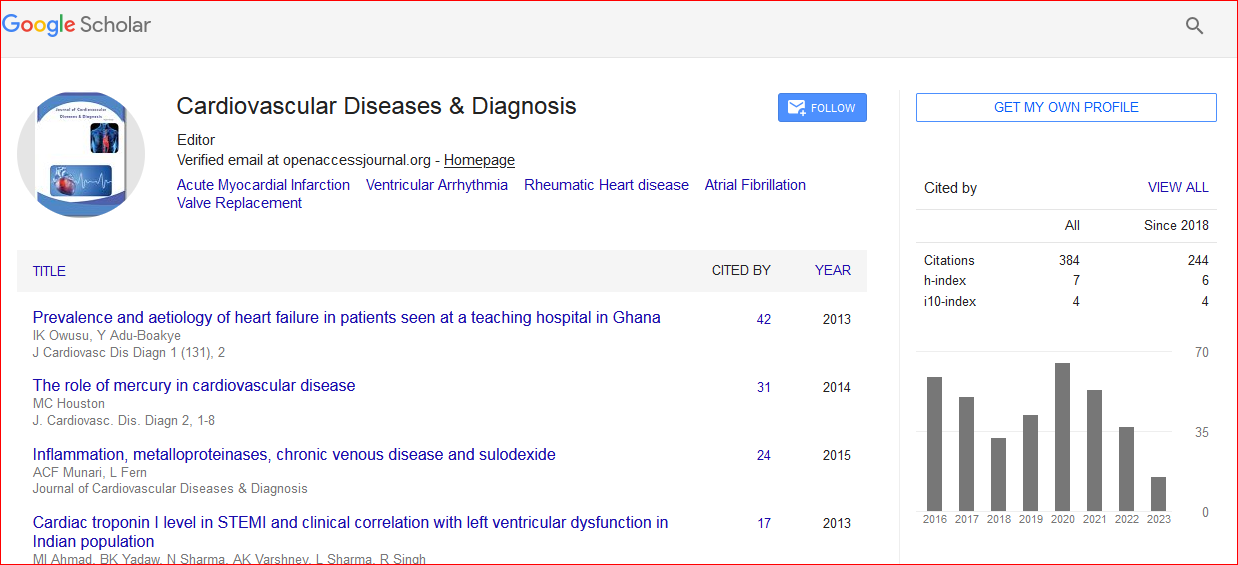
Cardiovascular Diseases & Diagnosis received 427 citations as per Google Scholar report