Perspective - (2025) Volume 16, Issue 5
Received: 01-Sep-2025, Manuscript No. jhmi-26-178876;
Editor assigned: 03-Sep-2025, Pre QC No. P-178876;
Reviewed: 17-Sep-2025, QC No. Q-178876;
Revised: 22-Sep-2025, Manuscript No. R-178876;
Published:
29-Sep-2025
, DOI: 10.37421/2157-7420.2025.16.613
Citation: Rahmawati, Siti N.. ”Personalized Drug Therapy: CDS, ML, Pharmacogenomics, and Challenges.” J Health Med Informat 16 (2025):613.
Copyright: © 2025 Rahmawati N. Siti This is an open-access article distributed under the terms of the Creative Commons Attribution License, which permits unrestricted use, distribution and reproduction in any medium, provided the original author and source are credited.
Clinical decision support (CDS) systems are emerging as pivotal tools in revolutionizing drug therapy by enabling a highly personalized approach. These systems integrate a wide array of patient-specific data, including genetic profiles, existing health conditions, and lifestyle choices, with comprehensive medical knowledge bases. This integration allows for the provision of real-time, evidence-based recommendations tailored for drug selection, dosage adjustments, and ongoing patient monitoring. The overarching goal is to significantly enhance the effectiveness of treatments, minimize the occurrence of adverse drug reactions, and bolster overall patient safety, thereby fostering more individualized and successful therapeutic strategies [1].
By harnessing the power of machine learning algorithms within CDS frameworks, the prediction of individual patient responses to various medications can be substantially improved. This advanced capability involves the meticulous analysis of vast datasets to discern intricate patterns and accurately forecast drug efficacy and potential toxicity. Such predictive insights are indispensable for personalizing drug therapy, particularly in managing complex diseases where uniform treatment protocols may not yield optimal results for every individual [2].
The integration of pharmacogenomic data stands as a fundamental pillar in the advancement of personalized drug therapy. CDS systems equipped to incorporate pharmacogenomic information are capable of predicting how a patient's unique genetic makeup will influence their response to specific drugs. This capability guides clinicians in making safer and more effective treatment selections, thereby embracing a precision medicine approach that reduces the risk of adverse drug events and maximizes therapeutic benefits [3].
Despite the immense potential, the widespread implementation of CDS for personalized drug therapy encounters several challenges. These include the critical need for standardized data formats, overcoming interoperability issues between disparate healthcare systems, and the rigorous validation of the underlying algorithms. Furthermore, ensuring the ethical application of sensitive patient data and actively addressing potential biases inherent in artificial intelligence models are paramount considerations for achieving broad adoption [4].
The evolution and seamless integration of electronic health records (EHRs) with CDS tools are fundamental to the realization of personalized drug therapy. EHRs provide the essential infrastructure for the capture, organization, and management of patient data. CDS systems, in turn, leverage this data to generate actionable insights, facilitating a more dynamic and individualized approach to pharmacotherapy that adapts to each patient's unique needs [5].
The successful implementation of CDS for personalized drug therapy necessitates a collaborative, multidisciplinary strategy. This approach requires the active involvement of clinicians, health informaticians, pharmacists, and even patients themselves. Such collaborative endeavors are crucial for the design, validation, and integration of these systems into existing clinical workflows, ensuring they are user-friendly and deliver tangible clinical value [6].
The increasing utilization of real-world data (RWD) and real-world evidence (RWE) is proving vital for the continuous refinement of CDS systems in the context of personalized drug therapy. The analysis of RWD derived from diverse patient populations allows for the ongoing learning and adaptation of algorithms, ultimately leading to more robust and broadly applicable treatment recommendations [7].
Developing user-centered CDS interfaces is of paramount importance for ensuring the successful adoption of these systems in personalized drug therapy. Gathering feedback from clinicians and conducting rigorous usability testing are essential steps to guarantee that treatment recommendations are presented clearly, concisely, and in an actionable manner. This ensures seamless integration into existing clinical workflows without imposing an undue cognitive burden on healthcare providers [8].
The impact of personalized drug therapy, guided by advanced CDS, on healthcare costs and patient outcomes warrants ongoing and thorough investigation. While the inherent goal of personalization is to improve efficacy and safety, the initial investment in the necessary technology and data infrastructure can be substantial. Therefore, long-term studies are essential to conclusively demonstrate the cost-effectiveness of these sophisticated therapeutic approaches [9].
Ethical considerations surrounding data privacy, informed consent, and equitable access are of utmost importance in the deployment of CDS for personalized drug therapy. It is imperative to ensure that these advanced systems provide benefits across all patient populations and do not inadvertently widen existing health disparities. This requires careful strategic planning and continuous ethical oversight throughout the implementation process [10].
Clinical decision support (CDS) systems represent a significant advancement in optimizing personalized drug therapy. By consolidating patient-specific information such as genomic data, comorbidities, and lifestyle factors with extensive medical knowledge bases, CDS can deliver immediate, evidence-based recommendations for drug selection, dosage, and monitoring. This methodology aims to enhance therapeutic effectiveness, reduce adverse drug reactions, and improve patient safety, ultimately leading to more individualized and effective treatment plans [1].
The application of machine learning algorithms within CDS frameworks holds the potential to significantly enhance the prediction of how individual patients will respond to various medications. This process involves analyzing extensive datasets to identify patterns and forecast drug efficacy and toxicity. Such predictive capabilities are vital for personalizing drug therapy, especially in managing complex health conditions where standardized treatment protocols might not be universally optimal [2].
A cornerstone of personalized drug therapy is the integration of pharmacogenomic data. CDS systems that incorporate pharmacogenomic insights can accurately predict how a patient's genetic makeup will influence their response to particular drugs, thereby assisting clinicians in making safer and more efficacious treatment choices. This precise approach minimizes the risk of adverse drug events and maximizes therapeutic outcomes [3].
Implementing CDS for personalized drug therapy presents several challenges, including the need for data standardization, addressing interoperability issues between diverse healthcare systems, and the requirement for robust algorithm validation. Moreover, ensuring the ethical use of patient data and mitigating potential biases within AI models are critical factors for widespread adoption [4].
The evolution of electronic health records (EHRs) and their integration with CDS tools are fundamental to achieving personalized drug therapy. EHRs provide the necessary infrastructure for capturing and managing patient data, while CDS systems interpret this information to offer actionable insights, enabling a more dynamic and individualized approach to pharmacotherapy [5].
The successful implementation of CDS for personalized drug therapy demands a multidisciplinary effort involving clinicians, informaticians, pharmacists, and patients. Collaborative actions are essential for the design, validation, and integration of these systems into clinical workflows, ensuring they are user-friendly and offer genuine clinical value [6].
The role of real-world data (RWD) and real-world evidence (RWE) is becoming increasingly crucial for refining CDS systems in personalized drug therapy. Analyzing RWD from varied patient populations facilitates continuous learning and adaptation of algorithms, resulting in more robust and generalizable recommendations [7].
Developing user-centered CDS interfaces is critical for the successful adoption of personalized drug therapy. Clinician feedback and usability testing are essential to ensure that recommendations are presented clearly, concisely, and actionably, integrating seamlessly into existing clinical workflows without causing cognitive overload [8].
The economic impact and outcomes associated with personalized drug therapy guided by CDS require continuous investigation. While personalization aims for improved efficacy and safety, the initial investment in technology and data infrastructure is considerable. Long-term studies are crucial to establish the cost-effectiveness of these advanced therapeutic approaches [9].
Ethical considerations related to data privacy, consent, and equitable access are paramount in deploying CDS for personalized drug therapy. Ensuring that these advanced systems benefit all patient populations and do not exacerbate existing health disparities necessitates careful planning and ongoing ethical oversight [10].
Clinical decision support (CDS) systems are instrumental in personalizing drug therapy by integrating patient data with medical knowledge to provide real-time recommendations. Machine learning enhances prediction of individual drug responses, while pharmacogenomics guides safer and more effective treatment choices based on genetic makeup. Implementation faces challenges like data standardization, interoperability, and algorithm validation, alongside ethical concerns regarding data privacy and bias. The synergy of electronic health records (EHRs) with CDS is crucial, supported by multidisciplinary collaboration and user-centered design. Real-world data (RWD) aids in algorithm refinement. Continued research into cost-effectiveness and ethical implications is vital for equitable and beneficial widespread adoption.
None
None
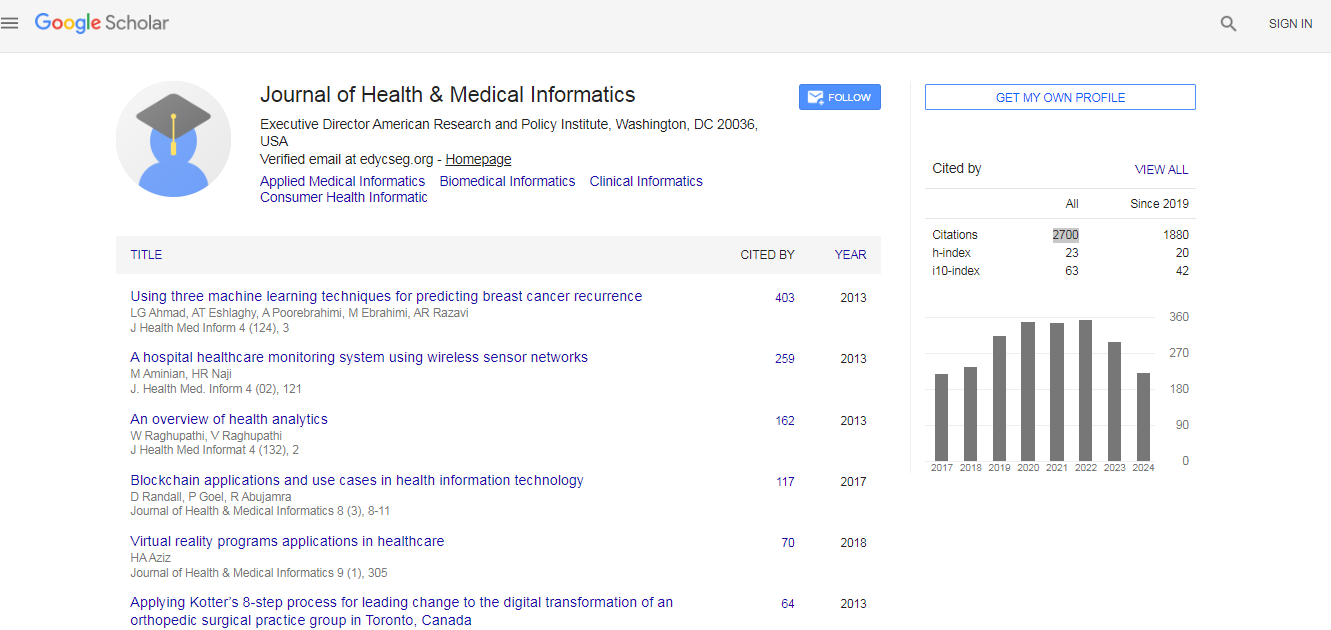
Journal of Health & Medical Informatics received 2700 citations as per Google Scholar report