Perspective - (2025) Volume 11, Issue 3
Received: 01-Aug-2025, Manuscript No. jotr-25-175598;;
Editor assigned: 04-Aug-2025, Pre QC No. P-175598;
Reviewed: 18-Aug-2025, QC No. Q-175598;
Revised: 22-Aug-2025, Manuscript No. R-175598;
Published:
29-Aug-2025
, DOI: 10.37421/2476-2261. 2025.11.318
Citation: Whitaker, Charles. ”Personalized Cancer Medicine: Evolution, Challenges, Future.” J Oncol Transl Res 11 (2025):318.
Copyright: © 2025 Whitaker C. This is an open-access article distributed under the terms of the Creative Commons Attribution License, which permits unrestricted use, distribution and reproduction in any medium, provided the original author and source are credited.
Personalized cancer medicine has evolved, highlighting triumphs in molecular diagnostics and targeted therapies. It also points out hurdles like drug resistance and high costs. Future directions emphasize Artificial Intelligence (AI), multi-omics, and combination strategies to refine treatment approaches [1].
This article explores the journey of precision oncology, moving from mapping molecular profiles to developing truly personalized treatments. It touches on how understanding individual patient biology helps tailor therapies, improving outcomes and moving beyond a one-size-fits-all approach to cancer care [2].
Pharmacogenomics is all about how a patient's genetic makeup influences their response to drugs. This paper highlights how leveraging these genetic insights can optimize drug selection and dosage, minimize side effects, and make treatments far more effective for individual cancer patients [3].
What this really means is that liquid biopsies and multi-omics technologies are pushing personalized cancer medicine forward. This article shows how these tools, by analyzing circulating tumor DNA and other biomarkers, offer less invasive ways to track cancer progression and guide treatment choices, tailoring care in real-time [4].
Let's break down how machine learning and Artificial Intelligence (AI) are changing personalized cancer medicine. This paper explains that these technologies can process vast amounts of patient data to predict treatment responses, identify novel biomarkers, and even design individualized therapy regimens, making cancer treatment more precise and effective [5].
This article introduces how spatial omics technologies are enhancing personalized cancer medicine. It describes how these methods allow researchers to map molecular profiles within the actual tissue context, offering unprecedented insights into tumor heterogeneity and microenvironment interactions, which is crucial for targeted therapies [6].
Personalized cancer medicine faces unique challenges and opportunities as it moves from the lab to patient care. This paper examines the critical steps needed to translate research findings into clinical practice, focusing on hurdles like regulatory approvals, economic viability, and the integration of complex data [7].
Understanding biomarkers is key in personalized cancer medicine. This article explains how these biological indicators help diagnose cancer earlier, predict disease progression, and guide the selection of targeted therapies, making treatments far more tailored and effective for each patient's specific cancer type [8].
Here's how molecular tumor boards are advancing personalized cancer medicine: they bring together diverse medical experts to review individual patient cases, integrating complex genomic data with clinical information. This collaborative approach leads to highly individualized treatment recommendations, which is a major step forward [9].
This paper serves as a comprehensive guide to the current landscape of personalized cancer medicine. It outlines the foundational principles, key technological advancements, and the ongoing shift towards treatments that are specifically tailored to an individual's unique genetic and molecular profile [10].
Personalized cancer medicine has revolutionized how cancer is approached, moving significantly beyond conventional, broad-spectrum treatments. The journey has seen the evolution from simple molecular profiling to developing truly individualized therapeutic strategies. This approach meticulously considers a patient's unique biological makeup to tailor interventions, thereby enhancing outcomes and abandoning the previous one-size-fits-all methodology [2]. Recent advancements highlight significant triumphs in molecular diagnostics and the development of highly specific targeted therapies. Despite these successes, the field grapples with persistent challenges, including the emergence of drug resistance, the substantial costs associated with advanced treatments, and the complexities inherent in translating cutting-edge research from laboratory findings into practical clinical applications [1, 7].
A cornerstone of this personalized approach is pharmacogenomics, which delves into how an individual's genetic profile dictates their response to various medications. Leveraging these genetic insights is pivotal for optimizing drug selection and dosage, a strategy that not only minimizes adverse side effects but also markedly boosts the effectiveness of treatments for individual cancer patients [3]. Parallel to this, understanding and utilizing biomarkers is fundamental. These biological indicators are indispensable for earlier cancer diagnosis, predicting disease progression, and guiding the precise selection of targeted therapies. Ultimately, this ensures that treatments are far more customized and effective for each patient's specific cancer type [8]. These two areas together form a powerful basis for designing treatments that are both precise and potent.
Further pushing the boundaries of personalized cancer medicine are innovative technologies like liquid biopsies and various multi-omics platforms. What this really means is that these tools, by analyzing circulating tumor DNA and other critical biomarkers, offer less invasive avenues to monitor cancer progression and inform treatment decisions, allowing for real-time adjustments to patient care [4]. Adding another layer of depth, spatial omics technologies enhance this personalized paradigm by enabling researchers to map molecular profiles directly within the context of actual tissue. This provides unprecedented insights into tumor heterogeneity and the intricate interactions within the microenvironment, which is absolutely critical for the development and application of highly targeted therapies [6].
The integration of advanced computational methods, particularly machine learning and Artificial Intelligence (AI), represents a transformative shift. These technologies can process and interpret vast quantities of patient data, allowing for the accurate prediction of treatment responses, the identification of novel biomarkers, and even the design of bespoke individualized therapy regimens. This makes cancer treatment inherently more precise and effective [5]. In practice, this sophisticated data integration is often facilitated by molecular tumor boards. These multidisciplinary panels bring together diverse medical experts to review individual patient cases, integrating complex genomic data with extensive clinical information. This collaborative, expert-driven approach is a significant leap forward, leading to highly individualized and optimized treatment recommendations [9].
Looking ahead, the landscape of personalized cancer medicine continues to evolve, constantly adapting foundational principles and embracing technological advancements. The ongoing shift is firmly towards treatments that are meticulously tailored to an individualâ??s unique genetic and molecular profile [10]. While challenges remain in areas such as regulatory approvals and economic viability, the concerted effort across various disciplines promises a future where cancer care is increasingly precise, effective, and truly personal.
Personalized cancer medicine has seen significant evolution, moving from basic molecular profiling to tailoring treatments based on individual patient biology. Key achievements include advances in molecular diagnostics and targeted therapies, improving outcomes by shifting away from a one-size-fits-all approach. However, hurdles persist, such as drug resistance, high costs, and the complex process of translating research findings into clinical practice. Future directions emphasize leveraging Artificial Intelligence (AI) and machine learning to process vast patient data, predict treatment responses, and design individualized regimens. Multi-omics technologies, including liquid biopsies and spatial omics, are also crucial, offering less invasive ways to monitor progression and providing deep insights into tumor heterogeneity within tissue context. Pharmacogenomics, by understanding how genetic makeup influences drug response, optimizes selection and dosage, minimizing side effects. Biomarkers are essential for early diagnosis, prognosis, and guiding targeted therapies. Furthermore, molecular tumor boards, bringing together diverse experts, integrate complex genomic and clinical data to formulate highly individualized treatment recommendations. This comprehensive approach underscores the continuous effort to refine cancer care, making it more precise and effective for each patient's unique profile, navigating both the opportunities and the challenges from research to patient care.
None
None
Katta VR, Chen P, Fan W. "Personalized cancer medicine: achievements, challenges, and future directions.".Signal Transduct Target Ther 9 (2024):47.
Indexed at, Google Scholar, Crossref
Luigi G, Giuseppe B, Cinzia R. "The promise of precision oncology: from molecular profiles to personalized treatments.".Expert Rev Precis Med Drug Dev 9 (2024):1-13.
Indexed at, Google Scholar, Crossref
Jian W, Zhixia Z, Shunfeng H. "Pharmacogenomics in personalized cancer medicine.".Cancer Gene Ther 30 (2023):1403-1411.
Indexed at, Google Scholar, Crossref
Yongjie S, Zhaoting Y, Baocheng L. "Advancing personalized cancer medicine through liquid biopsies and multi-omics technologies.".Transl Oncol 38 (2023):101832.
Indexed at, Google Scholar, Crossref
Wei Y, Xiaonan T, Jing L. "Machine learning and AI in personalized cancer medicine.".Cancer Med 12 (2023):8345-8356.
Indexed at, Google Scholar, Crossref
Jiaojiao C, Weijia S, Jianing L. "Spatial omics technologies for personalized cancer medicine.".Mol Cancer 22 (2023):120.
Indexed at, Google Scholar, Crossref
Kalidoss P, Ganga M, Kalidasan A. "Personalized cancer medicine: From bench to bedside challenges and opportunities.".Int J Mol Sci 23 (2022):11475.
Indexed at, Google Scholar, Crossref
Satpal S, Priyanka S, Neha G. "Biomarkers in Personalized Cancer Medicine.".Curr Drug Metab 23 (2022):134-142.
Indexed at, Google Scholar, Crossref
Jessica AM, Farjana Z, Molly F. "Advancing personalized cancer medicine through molecular tumor boards.".Cancer Cell 39 (2021):291-299.
Indexed at, Google Scholar, Crossref
Bissan A, Rafael P, Farideh T. "Personalized Cancer Medicine: A Guide to the Current Landscape.".Clin Cancer Res 26 (2020):27-37.
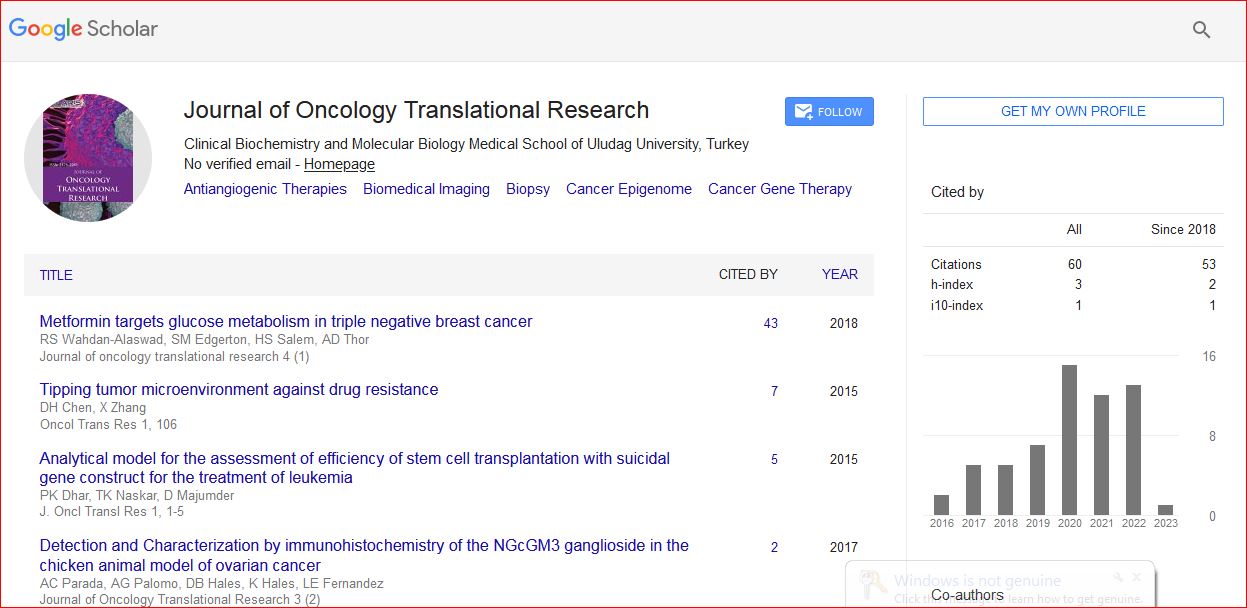
Journal of Oncology Translational Research received 93 citations as per Google Scholar report